Iraqi governing council holds 1st meeting
( 2003-07-14 10:27) (Agencies)
With the blessing of US administrators, Iraqis inaugurated a broadly representative governing council Sunday dominated by the Shiites once oppressed by Saddam Hussein, planting the seeds of the nation's political future three months after Saddam Hussein's ouster.
|
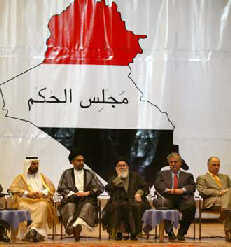
Members of the newly formed Iraq Governing Council hold a press conference under a large map of the country at a Baghdad conference hall July 13, 2003. From left to right are marsh Arab leader Abdul-Karim al-Mohammadawi, Shi'ite leaders Adbul Aziz al Hakim and Mohammad Bahr al-Uloom, Kurdish leader Jalal Talabani and Iraqi National Congress leader Ahmed Chalabi. [Reuters]
|
In a deeply symbolic first public action, the council set April 9 - the day Baghdad fell to US forces - as a national holiday and banned celebrations on six dates important to Saddam and his Baath Party. And the act was announced, significantly, by a prominent Shiite cleric. Shiites, long oppressed by Saddam, now dominate the 25-member council.
"The establishment of this council represents the Iraqi national will after the collapse of the dictatorial regime," said the cleric, Mohammed Bahr al-Uloum from the holy southern city of Najaf.
The council will have real political muscle, with the power to name ministers and approve the 2004 budget. But final control of Iraq still rests with L. Paul Bremer - the US administrator of Iraq and a major architect of the council.
The council, painstakingly assembled from representatives of the country's main political factions and ethnic groups, said it would select its leadership Monday.
With the US military still struggling on the security front_ facing daily attacks on Americans that are blamed on Saddam holdovers - establishment of the council is a major political step, giving an Iraqi face to the US-led occupation of the country. American administrators had changed plans several times in the past months, wavering over how much authority to give the new body, which fueled a feeling among many Iraqis that the Americans had come as colonizers, not liberators.
As the new members were introduced to the world at the Baghdad Convention Center, Bremer stood and applauded from the front row. But he made no comment, a move designed to lower the American profile.
Council member Adnan Pachachi, a former foreign minister, said he does not expect Bremer to veto council decisions and believed negotiations would settle all disputes.
Still to be seen is whether the council can convince the Iraqi people that it represents them, even though they never had a chance to vote on its members. Coalition leaders say an election in Iraq is not yet practical.
On the same day as the inauguration, US forces launched their latest sweep in cities and towns of central Iraq, hunting for Saddam loyalists amid expectations of anti-US attacks to mark a number of Baathist holidays this week. In Washington, Defense Secretary Donald H. Rumsfeld warned attacks on US troops may worsen this summer.
"There's still a lot people from the Baathist and Fedayeen Saddam regime types who are there, who are disadvantaged by the fact that their regime has been thrown out and would like to get back, but they're not going to succeed," he said.
Images of the inauguration were broadcast live by Western and Arab satellite television, received in about 40 percent of homes in Baghdad. Council members - some dressed in traditional Arab robes, some in Islamic cleric garb, others in business suits - sat in a semicircle of chairs on a stage before an audience of dignitaries.
The council includes 13 Shiites, five Kurds, five Sunnis, one Christian and one Turkoman. Three members are women. Shiites make up a 60 percent majority of Iraq's 24 million population, but they have never ruled the country and suffered deeply under Saddam's minority Sunni government.
"I helped deliver thousands of Iraqi babies, and now I am taking part in the birth of a new country and a new rule based on women's rights, humanity, unity and freedom," said Raja Habib al-Khuzaai, one of the female council members and the director of a maternity hospital in southern Iraq.
Sergio Vieira de Mello, the U.N. special representative to Iraq, called the day "historic," and said the country was "moving back to where it rightfully belongs, at peace with itself and a member of the community of nations."
De Mello was the only Westerner to speak at the session, and his appearance on the stage was seen as a gesture to the United Nations. The U.N. Security Council had refused to sanction the US-led invasion of Iraq - revealing a still-festering diplomatic breach - and afterward the world body pressed for more influence in helping establish democracy in Iraq even as it eventually approved the US-British occupation.
Many of the Governing Council members were pro-American in comments made during a news conference after the inauguration, and several criticized Arabic television channels and the British Broadcasting Corp. for coverage they saw as pro-Saddam.
"For how long are these (Arabic) satellite channels going to wait for Saddam to return? Saddam is on the rubbish heap of history," Bahr al-Uloum said in response to a question from a correspondent with Qatar-based Al-Jazeera satellite broadcasting organization.
Ahmad Chalabi, founder of the once-exiled Iraqi National Congress, condemned attacks on American forces in the country. "The Iraqi people consider them forces of liberation and they don't consider these attacks as acts of resistance," Chalabi said.
Along with Chalabi and Pachachi, the council includes other well-known figures Abdel-Aziz al-Hakim, a leader of the Supreme Council for the Islamic Revolution, and Massoud Barzani and Jalal Talabani, leaders of the two main Kurdish groups.
The council, however, is dominated by lesser known Iraqis, many of whom remained in their country during Saddam's 23-year dictatorship.
"The launch of the Governing Council will mean that Iraqis play a more central role in running their country," Bremer said in a speech on Iraqi television Saturday. "It will represent the diversity of Iraq: whether you are Shiite or Sunni, Arab or Kurd, Baghdadi or Basrawi, man or woman, you will see yourself represented in this council."
The panel is meant to be the forerunner of a 200-250 member constitutional assembly that is planned to start in September drawing up a draft constitution, a process expected to take nine months to a year. Iraqis would then vote on the draft in a national referendum. Free elections to pick a government are expected to follow.
In the streets, Iraqis welcomed Sunday's inauguration.
"The formation of this council which represents all sectors of Iraqi society is the birth of democracy in the country. It is better than Saddam's government of destruction and dictatorship," said Razzak Abdul-Zahra, a 35-year-old engineer.
Others were hopeful but skeptical of US intentions.
"We do not want to see this council used by the Americans as a tool to achieve their goals in Iraq," said Bassem al-Duleimi, a 22-year-old university student.
|




