Commentary: Don't meddle with yuan
( 2003-09-02 07:12) (China Daily)
The presidential election campaign in the United States is certainly one of the most influential political dramas in the world. But it is often unpleasant to be thrust into having to play a role in it.
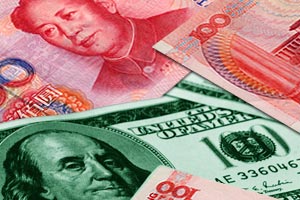 China's currency, unfortunately, is in a position of finding itself involved in the finger-wagging sessions that accompany this essentially American saga. China's currency, unfortunately, is in a position of finding itself involved in the finger-wagging sessions that accompany this essentially American saga.
Politicians and pressure groups representing the interests of US workers in some manufacturing industries have been trying to draw presidential candidates' attention to the Chinese currency, known as the yuan or renminbi.
Their argument is -- China has been manipulating the yuan to keep it at a low value. China's aim, they allege, is to help Chinese-based exporters, whose inexpensive products have made lots of American workers jobless.
The critics that believe China manipulates the yuan's value assume that every currency in the world should be floated in the market.
This assumption itself is porous.
In fact, most developing countries and even some of the developed economies do not fully float their currencies.
Many have a pronounced peg to a strong currency -- the US dollar, in most cases -- and the others allow their currency to float within a set range.
Which system a country chooses is a matter to be decided by the nation itself. It is fair. No international agreement forbids that.
In fact, China has been moving towards a market-oriented foreign exchange administration system. It used to set an unchanged exchange rate. Now it enforces the range it favours by selling or buying foreign currencies at the market.
It is true that the yuan's exchange rate follows very closely with the US dollar's value. But the intention for doing this is to avoid uncertainties for its economy rather than to seek an unfair competitive edge for its exports.
During the late 1990s, when the US dollar strengthened, the renminbi rose in tandem with it. When many Asian currencies devalued in the depths of the 1997-99 financial crisis, the yuan's rate also remained unchanged.
China's financial officials made it clear they would give the yuan's exchange rate more flexibility to cope with changes in the trade sector after the country joined the World Trade Organization in late 2001.
But the unfavourable conditions in the world economy since 2001 and the September 11 attacks again have delayed the process.
But what will happen if China allows the renminbi to appreciate now?
Will American manufacturers, who cry hardest on the issue, benefit from a revalued yuan?
Not likely.
The competitiveness of China's manufactured products mainly comes from the country's low labour cost. According to calculation by the World Labour Organization, China's labour cost in manufacturing industry is just 2.2 per cent of the US figure.
Even if the renminbi appreciates by 100 per cent against the US dollar, the Chinese goods' competitiveness relative to their American equivalent is still there. But products from other places in the world, whose labour costs used to be a bit higher than China's, may replace Chinese exports to the United States.
So a revalued renminbi really will not do much for the US economy, and may only make many consumer goods in the US market more expensive.
On the Chinese side, a more expensive renminbi will artificially hurt the competitiveness of China's exports and smash the rice bowls of the workers whose livelihoods rely on trade. (Maybe Americans have forgotten that China also has its own workers, who are much poorer than their American peers.)
There are still no instruments for hedging risks from a fluctuating renminbi, so an unreasonable adjustment of the currency's value will rock Chinese enterprises and the entire economy, which is among the few engines in the world economy still running in high gear and creating growing markets for the rest of the world's economies.
With speculation favouring an appreciating renminbi now at such a fever pitch, allowing a bigger trading band for the currency at the moment will add more pressure for the renminbi to go up further.
A more undesirable consequence might be the impression that international browbeating can effectively mandate China's forex policy.
Then, the next time some international dignitary says something about the renminbi, market players will follow his or her comments and put pressure on the currency in the direction.
Should China now give in to pressure only to face the dire consequence later?
No way.
|




