|
|
|
That awful Vietnam comparison
( 2003-11-06 16:20) (Economist.com)
This week's bold assaults on American forces, including mortars fired at coalition headquarters in Baghdad, are sending shudders through Americans back home. Could Iraq become President George Bush’s political Achilles heel?
"I'M TIRED of waking up in the middle of the night worrying about the war." So Lyndon Johnson reportedly told a friend during the Vietnam quagmire, which forced him to decline running for a second term as president. Few Americans think things are nearly so dire for President George Bush, six months into the occupation of Iraq. There have been no flag-burning mass protests; the number of soldiers killed is in the hundreds, not tens of thousands; and Iraq is not a chaotic jungle but a (sort of) stable country. Still, Mr Bush may not be sleeping as soundly as he would like. As more American soldiers lose their lives to shadowy militants half a world away, impatience on the home front is growing.
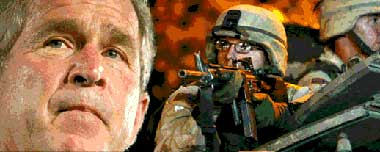 |
Last weekend's shooting down of an American helicopter, which killed 16 soldiers on their way home for leave, marked the start of another painful week. On Tuesday November 4th, three mortars hit America's Baghdad occupation headquarters, which is deep in the high-security “green zone”. Four people were injured. And few Americans will have forgotten that missiles fired last month at the Rashid hotel in Baghdad narrowly missed America’s visiting deputy defence secretary, Paul Wolfowitz. After the latest violence, Spain (an American ally) has ordered most of its diplomatic staff out of Iraq. Other organisations, like the United Nations and the International Red Cross, have also sent most of their foreign staff home. Clearly, the militants are getting bolder and using heavier weapons. Two months ago, the attacks mostly consisted of gunfire, car bombs or “improvised explosive devices” set along roads to trip up passing coalition vehicles. Most attacks are still of this kind, but the increasing use of long-range weapons, such as mortars and missiles, creates a headache for American commanders. They even pose a danger to Americans barricaded behind high-security fences: they are hard to guard against, except by means of intelligence (which is not the core strength of the Americans, few of whom speak Arabic).
Mr Bush’s administration has not changed its message in response to the new attacks. The more Americans (and Iraqi helpers) die, the more America emphasises that it is determined to succeed. “We're being tested, and America and our allies will not fail,” Mr Bush declared in his weekly radio address. Most Sundays, top advisers, such as Donald Rumsfeld, the defence secretary, or national security adviser Condoleezza Rice, take to the talk shows to pound home the same message.
But Americans are becoming more sceptical. A Washington Post/ABC poll, released this week, found that fewer than 15% of Americans think Iraq is the most important bit of the war on terror—a seeming repudiation of Mr Bush's argument that the country is a “central front” against terrorists. The cost of war is one worry. Congress recently approved $87.5 billion in extra spending for Iraq and Afghanistan (but mostly for Iraq); this money will increase America's already huge deficit. Families of American soldiers who return in body-bags are usually patriotic, but some are beginning to wonder why none of Saddam Hussein's chemical and biological arsenal has been found. "Nobody can find the weapons," the father of one soldier killed in the helicopter attack told a local news programme.
Ah, the weapons. In the run-up to the 2004 presidential elections, this issue may yet become thorny for Mr Bush. America went to war ostensibly to rid Saddam of his weapons of mass destruction. None has yet turned up, despite searches by hundreds of soldiers and trained inspectors. Congressional committees are investigating the quality of pre-war intelligence. In the Senate, Democrats on the intelligence committee are reportedly seeking an independent inquiry that would examine how the White House used intelligence (in other words, whether Mr Bush and his advisers exaggerated). Mr Bush has so far weathered evidence that he overstated Saddam’s efforts to obtain uranium and the links between the Iraqi regime and the September 11th attacks, but voters may ask harder questions as election day approaches.
To be sure, Mr Bush's political footing is otherwise fairly sound. The economy is zipping along; its 7.2% third-quarter growth rate has flustered Democrats who had hoped to criticise the president’s economic stewardship. Mr Bush's popularity ratings, while slipping, are still well above 50%. True, many Americans believe their country is headed in the wrong direction, but the lack of coherence among Mr Bush’s political opponents should give him consolation. This is especially true of Iraq: Democrats are still divided about whether going to war was a good idea or a bad one. They have been quick to denounce Mr Bush’s handling of the occupation but slow to suggest viable alternatives, aside from training and arming more Iraqis, which the administration is already doing as quickly as possible. (Paul Bremer, America’s administrator in Iraq, has recently come around to the idea of creating an Iraqi paramilitary force, according to the Washington Post.)
So Iraq is still far from Vietnam, both as a military venture and as a political concern. But unless the militants are somehow rooted out, it will become a sleep-depriving issue for Mr Bush on the campaign trail next year.
|
|
|
 |
|
|
|
|
|
|
|
| |
Copyright By chinadaily.com.cn. All rights reserved |
|
|
|



