Classic catering conflict: Culture vs caution
( 2004-01-12 08:07) (China Daily by Xin Dingding)
The Chinese love their food " and the way they eat it: sitting around a table with common dishes in the centre and everyone dipping their chopsticks in.
There's a sense of bonhomie, a feeling of togetherness engendered by this way of eating. And they wouldn't want to have it any other way " the Western way of eating seems cold and clinical.
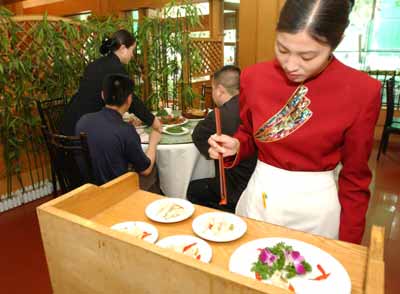
A waitress at a restaurant in Zhengzhou, Henan Province, serves a dish into separate plates during the SARS crisis last year. [Filephoto/newsphoto] |
But then struck SARS (severe acute respiratory syndrome) last year " and personal hygiene topped the menu.
The change in eating habits was revolutionary: Buffets gained popularity, separate portions were dished up or at least separate cutlery was used to help oneself from the dish.
But all these were not able to stop the catering industry, especially in SARS-hit cities like Beijing and Guangzhou, from bleeding.
There was a telling example: As traditional Chinese restaurants almost went under, the sole shining success was that of popular Western-style fast-food restaurants where individual servings are de rigeur.
Yes, centuries-old habits were changed to accommodate the scourge of the epidemic " as happened in the 1980s and mid-1990s when hepatitis was raging.
But barely was Beijing off the list of SARS-affected regions, residents resorted to the good (bad" ) old habits.
Separate servings were a distant memory when the news of this year's first SARS case sent chopsticks clattering in fear.
|
Sharing culture
Common servings started from the Tang Dynasty (618-907 A.D.) when Chinese ate around a table and used their chopsticks to pick up food from the same dishes, says Li Qiang, professor with the Sociology Department of Tsinghua University.
Before the Tang Dynasty, economic conditions did not allow common serving.
"Record show that ancient Chinese used to sit on the ground and eat behind a long and narrow table," he says.
It is the practice of making large tables and chairs that enabled common servings to become popular.
|
Habits, however, have a stranglehold.
One college student, aware that there was a good risk of infection, is still too shy to raise the subject.
"Even when I know one of my friends has got Hepatitis B and might infect me when we eat together, I hardly ask for separate servings,'' says Zhang Yinlei.
Her reasoning: It would be impolite to make the suggestion unless the friend himself did so.
Like last year, many people like Zhang are torn between asking for separate servings to protect themselves or keep mum for the sake of form.
Zhang Jun, assistant to the chairman of the China Hotel Association recalls the efforts of last year to raise the levels of personal hygiene.
"To minimize the impact of SARS, we decided in May last year to appeal to all restaurants to adopt separate servings; and even succeeded in making it a compulsory practice,'' he says.
The association, the guild of restaurants, reasoned that separate servings could help reduce the infection rate; and scared patrons readily complied.
"During the SARS period, only a few like McDonald's fast-food outlets or Western-style restaurants generated the same business as before.''
According to the rules formulated by the association, there are three types of separate servings for restaurants of various grades " the simplest requirement for restaurants is to provide a pair of chopsticks or a spoon in each dish that diners can use to serve food instead of using their own cutlery.
"This is a requirement that even small restaurants can afford,'' he says, adding that it does not cost much.
Old way dies hard
However, many restaurants are reluctant.
"I don't think that many Chinese people like separate servings,'' says Chen Wei, owner of a restaurant in Beijing, adding that some are downright hostile to the idea.
"Many people come here with families,'' he says. "Who ever serves food separately at home" ''
Chen's remarks are echoed by Chen Lixin, senior manager of Donglaishun, a chainstore group famous for mutton hotpot.
Chen Lixin says families feel they know each other's health status well, so they feel reassured when eating together.
"When we provide extra cutlery for them to pick up food, they simply do not like it,'' he adds.
Likewise for friends having dinner together, both say.
For many Chinese, suggesting separate servings to friends is tantamount to estrangement " soon after the SARS threat ended, the mention of infection was a no-no among friends.
"My husband and I went out for dinner with friends soon after SARS was under control. He suggested common servings before others could get a word in. It was clear from their expressions that they would not disagree even if they wanted separate servings badly,'' says Meng Yan, a media worker.
Zhang Jun with the China Hotel Association said that the phenomenon is closely linked to Chinese tradition.
"Collective serving has been regarded as a symbol of solidarity and friendship inside a circle,'' he says. "It is part of the Chinese culture.''
Li Qiang, professor with the Sociology Department of Tsinghua University, says it is so because the Chinese attach great importance to a friendly, joyful atmosphere when dining together.
"In addition, Chinese traditional eating habits strengthen relationships between people,'' Li says, adding that if it were not for this purpose, many would not even think of going out and eating together.
Separate servings, on the other hand, are part of Western culture, which stresses individuality, the professor opines.
"Eating habits, as an important part of Chinese culture, cannot be changed easily,'' Li says. "When SARS was brought under control and the fear is gone, it was natural for people to resume old habits.''
The temporary change of habits in the face of an infectious epidemic has a precedent. In 1989, when Hepatitis A was rampant in Shanghai, separate servings were widely adopted in the city for a while to avoid infection. But not long after, everything returned to what it had been before the epidemic, says Zhang Jun.
A dining mission
Separate servings are more common at high-level banquets.
"Our waiters divide food into dishes before serving each guest at a banquet. It has always been separate serving, no matter before or after SARS,'' says Xing Ying, vice-general manager of China Beijing Quanjude Group Co Ltd, famous for roast Peking duck.
"And so do Beijing's bigger hotels and restaurants. They always stick to separate serving.''
But providing the same service at smaller eateries is difficult, stresses Xing, citing the shortage of personnel.
While the current way of serving demands only one waiter for each table, dividing food for each guest will need at least two waiters, more tableware and time, he reasons.
In addition, insiders in the catering industry insist that a number of Chinese dishes do not lend themselves to be divided before being served.
Many restaurants, including Quanjude, claim that what they do now is to provide an extra pair of chopsticks for each dish and let diners divide food by themselves " the lowest requirement made by the association.
Even so, the implementation is not easy or satisfying.
Many consumers say restaurants provide separate tableware only when customers ask them to.
"I went to several restaurants soon after SARS was over, but to my surprise, none of these places provided shared tableware,'' says Ye Zhou, a college teacher.
But when asked whether she would not bother going back to those restaurants again, she replies that things are not "that serious."
She says she feels uncomfortable that those restaurant do not care enough for customers" health.
"Restaurants, of course, have the right to decide their service style according to customers" needs. But we need to change traditional eating habits and promote healthier alternatives. So, we need more restaurants with a strong sense of social responsibility,'' says Zhang Jun.
|




