
China and US tackle clean energy and environment problems
Updated: 2008-09-08 10:34
David Bohigian, US Commerce Assistant Secretary, is now leading the third US Clean Energy and Environment Trade Mission to China. Comprising 19 leading clean tech enterprises, the mission is another example of the allure of China's clean technology market.
The US government projected the market will increase to $186 billion in 2010 and to $555 billion in 2020 as the nation pushes forward the use of renewable energy and steps up efforts for environmental protection. Bohigian spoke with China Daily reporters Ed Zhang and Wang Xu about how the two nations can lift their cooperation on energy and environment protection to the next level.
Q: What are the results of meetings with Chinese officials?
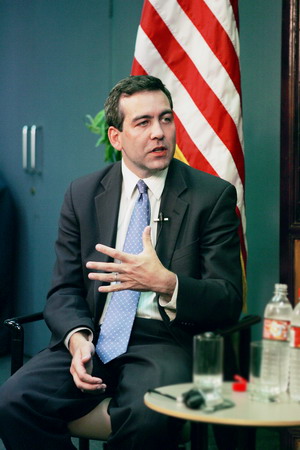 David Bohigian |
A: This morning, we met the new Minister of Environmental Protection. We also met a host of officials from the National Development and Reform Commission. They had important talks with our companies to help them understand better how to deploy clean energy technologies in China. It's really a great opportunity for the companies on the mission to understand some new regulatory and legal frameworks that you have here, whether it's the new Circular Economy Law, or the Renewable Energy Law. All of these provide great opportunities for US renewable energy and environmental protection companies.
Q: What are you focusing on with this mission?
A: This is the first time we have included environment technology firms with the clean energy firms. The first two delegations were mainly composed of clean energy firms. Now we bring a whole new sector here to help address some of the real issues China has had over the past several years. I think it's important to help these companies to meet Chinese businesses to make new deals. That's what's new and exciting about this delegation. Thanks to the previous two missions, hundreds of millions of dollars of technology have been deployed here. And we hope for similar results for this mission.
Q: Could you give us an example of achievements of the previous two missions?
A: One of the best indicators of interest from the previous mission is that we got a number of companies again on this mission coming back to China to deepen their relations with the business community and the officials. We have had real results as well. During the previous two missions, the Guangzhou Bus Company bought 20 clean energy buses from US-based Eaton Group. Since then there were 200 more clean energy buses, purchased by Guangdong Bus Company.
Q: In the near future, what's the focus of the 10-year energy and environment cooperation framework of the two countries?
A: The 10-year framework we put in place includes transportation technology, clean energy technology, clean water, clear air and forestry and wetland protection. All these five elements are crucial for our cooperation in the years ahead. What we are doing now in the first year of the 10-year plan is to develop deeper relations and really build the trust to make sure we meet our goals such as China's Five-Year Program.
Q: Which US technologies do you think have the greatest market potential in China?
A: If you look at China's energy mix, coal still provides the majority of China's fuel. So clean coal technology and carbon capture technology have a major opportunity in the years ahead really. When you look at China's renewable energy targets between 2006 and 2010, solar and wind play a large part. And hydropower also has real potential. Obviously, the work we have done together in civilian nuclear applications is a major area of cooperation.
And clearly there is great potential on environmental technologies, such as clean air and clean water technologies. Each one of the areas has real opportunities for cooperation.
Q: There are a lot of companies involved in energy protection, ranging from State-owned companies to those from private sectors. What are the majority of US clean tech companies' clients in China?
A: Later this week, we will be in Jinan, the capital city of Shandong province. The provincial government is holding a green exposition over there and there will be more than a thousand Chinese firms attending the expo. Then we are going to Guangzhou and Nanjing. With this schedule we see real opportunities at local levels. One thing important to know is the pollution prevention energy efficiency program that will be introduced later. That program enables end-users, industrial firms, and power producers to work on a polluter-pays principle. The benefit of the program is that the firms could deploy their technology at no cost to the users but they share the savings on pollution charges between the two of them.
Q: What are the areas that China can improve to boost the development of the clean tech sector?
A: Areas such as IPR, market-based pricing, and the ability for US companies to not merely transfer technology but to enter into different types of relationships with Chinese partners. Improvements in these areas will be important to help our relationship move further. Our companies are pleased with the policy opportunities such as the recently passed Circular Economy Law and the like.
See related stories at http://www.szjzcy.com/energy/