|
Home>News Center>China | |
|
|
|
|
|
|
|
|
|
|
|||||||||||||||||||||||||||||||||||||||||||||||||||||||||||||||||||||||||||||||||||||||||||||
|
|
Forced demolitions blur rights
Gagged, bound and blindfolded, Beijing resident Wang Zhiyong, along with his wife and son, were forcibly evicted from their house in the dead of night last fall.
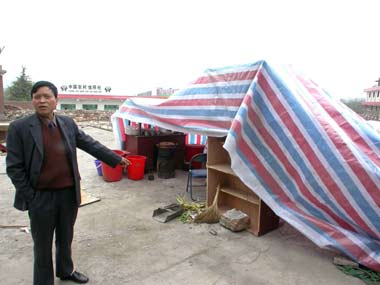
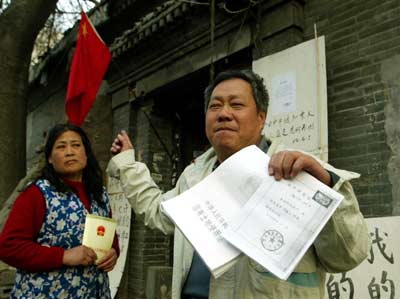
The men who broke into Wang's house then proceeded to pull it down with a bulldozer, burying all the family's property. This was an isolated case, certainly, and the transgressors, who turned out to be workers hired by the company that acquired demolition approval from the municipal government for a development project in Beijing's Haidian District, were ultimatedly punished. A total of 463 residents had to be relocated and 13,800 square metres of housing was demolished to make way for the project in 2000. After failing to reach agreement for compensation with Wang, the developer's demolition team broke into the house at 11 pm on September 19 and staged the savage farce. It was one of six typical cases of forced demolition of urban residents' houses released by the Ministry of Construction last year. The problems arising from moving homeowners out of their houses to make way for city expansion and relocation have attracted national attention in recent years. Complaints through letters and personal visits to related departments about forced demolition are on the rise. Media exposure of increasing complaints about forced demolitions has put an administrative decree - the Regulation on Urban Housing Demolition - in the spotlight. China has not got a sepecial national law to govern such activity. The regulation was initially made in 1991 and revised in 2001 by the State Council. Wang Zhenmin, a professor of administrative law at the Law School of Tsinghua University, said loopholes in the regulation have fused violation of the personal and property rights of owners of houses slated for demolition. Last year, the Ministry of Construction came out with guidelines for assessment of houses to be demolished and a set of rules on the administrative arbitration of disputes arising in the process. Those rules were set to sew up loopholes in the regulation on urban housing demolition in response to wide media coverage and hot public debate on how to curb forced demolitions and make removal of urban residents a fairer process.
However, legal experts said a national law is still needed to fundamentally address the problem. Inadequate compensation for removal is the core reason for the refusal to move by urban residents. China's urban land belongs to the State and residents own only the land use rights. Real estate developers do not recognize homeowners' right to use land in signing removal settlement contracts with the urban residents. But they include the price of land use right when they sell the houses they develop. In this way residents of old housing often find it difficult to afford apartments in the highrises built either on the site of their previous house or in nearby areas. Yuan Zuliang, a member of the National Committee of the Chinese People's Political Consultative Conference, suggested the regulation should be amended to compensate urban residents for their loss of land use rights. The regulation on urban housing demolition stipulates the administrative department in charge of housing demolition or local government should rule first when disputes arise. Both parties can sue if they do not agree with the ruling of the administrative authority, but demolition does not stop during the proceedings. Wang said the parties concerned should enjoy the rights of going to courts directly instead of having to go through administrative arbitration first, and demolition should cease once court proceedings start. He said the government could also sue urban residents when they refuse to move out to make way for public construction and let the court decide if the project in dispute is justifiable. "Putting administration before the judicial agencies in solving the disputes makes it difficult for the urban residents to protect their interests," Wang said.
"In case of business collaborating with government officials in commercial projects, the independence of administration is well in question," he added. Wang based his argument on the assumption urban residents have equal legal footing with developers and government bodies in reaching a fair resettlement agreement. The regulation also states demolition can be ordered by the government or the courts at the request of administrative authorities if the home-owners do not vacate the premises within a set time period after a confirmed order for their removal is issued. Wang contends that only the court has the right to take coercive measures against private property in a society that is ruled by law. Yuan said the government should not make use of its administrative power to force urban residents to sign unfair resettlement agreements. Many are now questioning the constitutionality of the regulation because the newly passed amendment to the Constitution explicitly stipulates the country respects and protects private property. Wang said a national law is needed to make regulations on urban housing demolition more neutral and scientific. "The government should not act as both the player and the judge in the game; that is unfair for the other party," he said. The problem of urban housing demolition was also a hot topic of debate among deputies to the 10th National People's Congress (NPC) earlier this year. Li Kuinan, an NPC deputy from Shanghai proposed the NPC Standing Committee, the country's top legislative body, work out a law to specify the roles of all parties in the process. Li said the urban residents should have full access to all information concerning demolition and be able to air their voices. NPC deputy Chen Yichu said the whole process should be more transparent and
open to the public. Yuan suggested that hearings be introduced from the
beginning of a project. |
|
|
|
|
||||||||||||||||||||||||||||||||||||||||||||||||||||||||||||||||||||||||||||||||||||||||||
|
|
|
|
|||||||||||||||||||||||||||||||||||||||||||||||||||||||||||||||||||||||||||||||||||||||||||||