|
Home>News Center>Life | |
|
|
|
|
|
|
|
|
|
|
|||||||||||||||||||||||||||||||||||||||||||||||
|
|
Lost phoenix returns to its nest
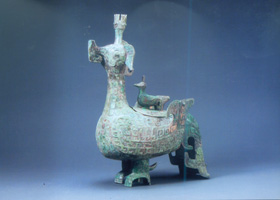
The Chinese started to worship the phoenix as the guardian spirit of the nation more than 3,000 years ago, even before they began to adore the dragon. However, it was believed that only two bronze vessels in the shape of phoenixes had been unearthed in the country, which are both said to be in collections in the United States.
But a third "phoenix" appeared on Thursday, with Beijing's Poly Art Museum showing it to the public after buying it from an overseas collector early this month and having it appraised and treated for preservation by leading Chinese experts on bronze artifacts. The extremely beautiful vessel, 49 centimetres tall and 41 centimetres long, is almost three times the height of the two thought to be in the United States, which are both apparently only 17.5 centimetres tall. It is included in an ongoing exhibition of major bronze artifacts in the museum's collection, many of which have been appraised as national treasures. Jiang Yingchun, curator of the museum, admitted the museum, affiliated with the State-owned Poly Group, paid a great price for the return of the "phoenix." "The wine vessel, or zun, cost more than the four famous 'animal heads' added together," he said, declining to give the exact price. The copper sculptures of an ox, monkey, tiger and swine head were lost with another eight animal heads that graced Yuanmingyuan (the Old Summer Palace), when invading British and French troops looted the palace in 1860. After wandering around the world for more than 140 years, the four came home to the collection of the Poly Art Museum respectively in 2000 and 2003 at an overall price speculated to be more than 40 million yuan (US$4.8 million). The "phoenix" is more expensive because it's really ancient, said Jiang. It can be dated back to the Western Zhou Dynasty (1046-771 BC), said Li Xueqin, director of the ancient Chinese history research centre of the Chinese Academy of Social Sciences. "Judging from its looks, it must have been unearthed in the past few years from an aristocrat's tomb in northern China, probably in Northwest China's Shaanxi Province, or Central China's Henan Province, before finding its way out of the mainland," he added. "It's pure luck to have tracked it down," said director Jiang. He heard from a friend of the appearance of "a phoenix" in a Hong Kong antique shop, but didn't believe at the time that it was an authentic piece, as he thought it unlikely that a vessel of such size could be genuine. "But the moment I saw it in Hong Kong I knew it wasn't a fake," Jiang said excitedly. "No modern man could make a fake bronze vessel of such delicacy, with no regard to the cost in time or money. We are all too busy in our era," he explained. The bronze wine vessel, about three millenniums old, is in the shape of a phoenix standing with its head raised, eyes opened wide, wings and tail spread. The "phoenix" has a crest in the shape of a blooming flower on the top of its "head." And on its "back" there is a smaller "phoenix" standing leisurely with its wings nestled against its "belly." The smaller bird functions as a handle on the top of the vessel's cover, which is part of the large bird's back. On the inner side of the cover there is an inscription of eight characters in two lines, reading "Pengji zuo zukao baozunyi" (Members of the Peng family had this precious wine vessel made to offer sacrifices to their ancestors). Complex and exquisite patterns, including dragons, cover the two birds' bodies. After discussions with the overseas collector, the Hong Kong shop allowed Jiang and his staff to bring the vessel to Beijing before making payment. Ma Chengyuan, former curator of the Shanghai Museum, Zhu Fenghan, curator of the National Museum of China, and Li Xueqin made appraisals and decided that "it's a real phoenix," said Li. "And the magical 'bird' is one of the best preserved bronze artifacts of such a great age," he added. Buddhist sculpture Jiang also told China Daily on Thursday that the severed heads of two 1,000-year-old Buddhist sculptures from the Longmen Grottoes of Luoyang in Henan, which have been outside the country for 80 years, will finally have the chance to rest again on their own shoulders within months as the result of collective efforts of a number of concerned organizations, including the museum. The Longmen Grottoes, a World Cultural Heritage Site, contain one of the largest and most impressive collections of Buddhist sculptures of the Northern Wei (AD 386-534) and Tang (AD 618-907) dynasties to be found in the country. |
|
|
|
|
||||||||||||||||||||||||||||||||||||||||||||
|
|
|
|
|||||||||||||||||||||||||||||||||||||||||||||||