|
Home>News Center>Life | |
|
|
|
|
|
|
|
|
|
|
||||||||||||||||||||||||||||||||||||||||||||||||||||||||||||||||||
|
|
Female workers feel the pinch
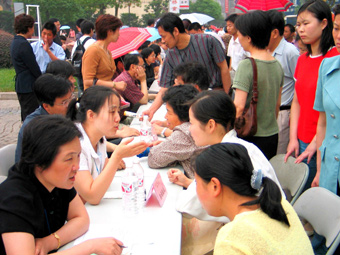
While economic reform has created a miracle in China, researchers find that female workers are more likely to fall victim to the so-called "agony of reform."
The federation recently released a 25-page report on the conditions of female employees, outlining ways to protect women's rights in the workplace. The report is the result of research conducted among female employees in Shanghai, Chongqing, Liaoning, Jiangsu, Zhejiang, Guangdong and Gansu. "Although the report is mainly based on figures from 1978-2002, many findings are still useful for the authorities to design policies to protect women's rights and interests," said Liu. Unemployment victims Along with the restructuring of enterprises and the reform of employment systems, the textile industry and other sectors where female employees formerly made up the bulk of the work force undertook large scale layoffs, thus producing more unemployed female workers, the report says. The number of female employees in cities was about 41.6 million in 2002, down 17.3 million from 1996. In 2002, 3.5 percent of female workers said they were or used to be jobless, while only 2.2 percent of men said so. Actually more than half of the laid-off workers were women, the report points out. The figures show the trend continued into the 1990s, while the employment rate of women between the age of 18 to 49 dropped 16.2 percentage points from 1990 to 2000. Also, it's more difficult for women to find another job. Only 39 percent of laid-off women are re-employed - 24.9 percentage points less than their male counterparts. Under increasing employment pressures, many women have to choose short-term or temporary jobs, or take on self-employed small businesses. "The variety of their job choices is helpful in improving their standards of living, but we have to pay attention to the negative impact," said Liu. With the temporary jobs, the payments often fall short of the minimum standard set by the government. Many women are excluded from social insurances, and many jobs are of lower levels, without much prospect of progress, she said. Widening gaps During the planned economy era people's salaries or wages were usually decided according to the period of their working years, and men and women had little difference on the same age level. Now more women are pushed to the low-end job market and therefore the gap of incomes between men and women is widening. From 1990 to 2000, the ratio of men and women's incomes fell from 100:77.5 to 100:70.1, which shows the gap grew 7.4 percentage points. Statistics in 2002 showed that below the 500-yuan (US$60) monthly income level, female employees were twice the number of males, while above the 2,000-yuan (US$240) level, men were 1.5 times the number of women. Gender discrimination is also reflected in the number of women in management of companies or government departments. In 2002, female leaders accounted for 1.3 percent of all employees in various organizations, while male leaders accounted for 5.9 percent. In terms of special labor protection for female employees, the ACFTU's survey in 1997 and 2002 indicated scanty satisfaction. About half the respondents thought protection at their companies was "just so so," and only about 7 percent thought it was "very good." Researchers found the situation at large State-owned enterprises was usually satisfactory, but medium- and small-sized new companies, mostly privately-owned, were often reluctant to fulfil obligations set by the government. The survey in 2002 showed 21.9 percent of the newly started companies refused to cover female employees' expenses in giving birth, and 16.2 percent did not allow female employees to have a maternity leave of at least 90 days. The report concludes the problems faced by female employees result from the influence of market economy and society's existing gender discrimination. To solve these problems, a set of laws and regulations must be established to effectively protect women's rights and special interests. Trade unions on all levels should play a more active role in representing workers' rights and urging employers to fulfil their obligations, the report says.
|
|
|
|
|
|||||||||||||||||||||||||||||||||||||||||||||||||||||||||||||||
|
|
|
|
||||||||||||||||||||||||||||||||||||||||||||||||||||||||||||||||||