|
Home>News Center>Life | |
|
|
|
|
|
|
|
|
|
|
|||||||||||||||||||||||||||||||||||||||||||||||||||||||||||||||||||||||||||||||||||
|
|
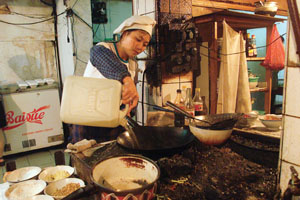
Food safety concerns disturb dinners
The first thing Shelly Xu does when returning home every day is soak the vegetables to be prepared for her supper in water.
"There are too many reports about farmers' overuse of pesticides and fertilizers," she said. "I'm really worried that I will get poisoned if I fail to soak them for at least half an hour." As a single woman who came to work in Shanghai three years ago, Xu used to dine out a lot to save herself the trouble of cooking. But now she dares not risk her stomach eating out, after hearing so many worrying reports about food safety. Not long ago, the Shanghai Youth Daily reported that some illegal producers were making tofu cakes from gypsum, paint and starch, then frying them in oil made from kitchen waste and swill. The "tofu" makers paid police about 10,000 yuan (US$1,205) a year to avoid being inspected, according to the newspaper which had sent two reporters to pose as tofu merchants to obtain the story. Xu was so appalled at the news that she decided to quit her habit of eating at roadside food stands. But cooking at home is not safe either. There were reports about toxic rice polished with paraffin, liquor made from methanol (a poisonous wood-alcohol) and seafood, such as squid, soaked in formalin to stop natural decay. Last week, there was another report of a scam involving shrimp in Taizhou of neighbouring Zhejiang Province where chemicals were used to make the shrimp look fresh. The chemicals, when later tested, were found to contain cancer-causing substances. "It is hard to know what you can eat any more," Xu said. She now buys most things from the original producers. "The distributors can't be trusted. There is so much fake stuff around - even fruit juice and noodles." A recent survey of 2,415 people in seven Chinese cities found that just 45 per cent have confidence in the safety of the food they buy. The rest ranged from highly skeptical to only marginally confident. In Shanghai, the number of complaints by local residents about food quality is also on the rise. Since last January, the Shanghai Consumers' Protection Commission has received 1,038 complaints about food. The figure for the same period last year was 936. "The complaints about food are increasing by at least 10 per cent every year," said Fan Qiang, from the commission. The problems are not solely found with small vendors - consumers complained that many big supermarkets were also selling food which had gone bad. Not long ago, supermarkets in Shanghai pulled many pickled vegetables from their shelves after reports that they contained toxic industrial salt and pesticides such as DDT. Pale penalties Public outrage has led to negligent officials being punished and inspection of food being stepped-up. Li Jie, an official with the Shanghai Health Inspection Institute, said that the food inspection effort was being boosted every year and this year some 3,000 to 5,000 samples selected from food markets would be analyzed. The institute, which shoulders the major inspection responsibly for food in local markets, has some 3,000 staff. They have to deal with the city's 110,000 food producers, restaurants and hotels. The great majority of the businesses are small sized which creates problems for the inspection work. "These small units, in contrast to the big enterprises, simply think about making money. Brand or market share are something too faraway for them," said Gu Zhenhua, vice-director of the institute. Although China has more than 700 standards covering food and food additives, they are often not well observed. Many of the shops making the unsafe food simply use sheds in the countryside as their workshops. "We can find these illegal sheds but we can't find their owners," Gu said. "They simply go away. As it is cheap to start such businesses, they can easily find another place to start the same business again." The penalties they face are far from severe when compared to the profits they can make. According to the law, the level of fines for those running unlicensed food shops is based on the illegal income they have made. If they haven't made any income, they can be fined between 1,000 yuan and 50,000 yuan (US$120 to US$6,000). "However, on many occasions the vendors just reduce their fines by hiding their real income," Gu said. "It is often the case that we make a huge effort to find out about these illegal operations, but the fines we are able to impose are so small thatthey don't even match the money we spent on the investigation." Li Gang, on the staff of the Municipal People's Congress, said that Shanghai did not have any specific regional law on food safety. "There are some stipulations about food quality in the Law on Products' Quality, but that is insufficient," he said. City government sectors observe either the national law or government regulations when carrying out food safety inspections and they are a little out-of-date these days, with dining out having become such a widespread habit among local residents. "The legislation on food safety is extremely complicated, since currently in Shanghai there are seven or eight different government sectors which have administrative power over food safety," Li said. How to weld these bureaux into a united and effective inspection system is still under consideration. "In the teething period of the new market economy when making money has become the ultimate goal of many companies, quality problems may just be inevitable, especially when making and selling unsafe food proves to be so lucrative," said Gu Zhenhua. |
|
|
|
|
||||||||||||||||||||||||||||||||||||||||||||||||||||||||||||||||||||||||||||||||
|
|
|
|
|||||||||||||||||||||||||||||||||||||||||||||||||||||||||||||||||||||||||||||||||||