|
Home>News Center>Life | |
|
|
|
|
|
|
|
|
|
|
||||||||||||||||||||||||||||||||||||||||||||||||||||||||||||||||||
|
|
Ancient stone horses take on a new look
Two ancient stone horses in Xi'an Beilin Museum recently reunited with parts of their bodies from which they had been separated for 86 years.
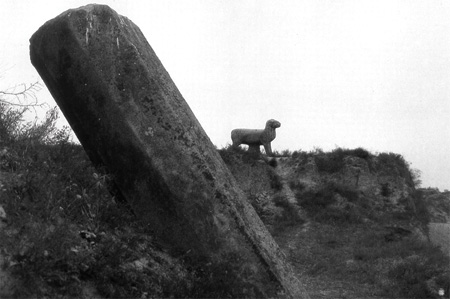
When archaeologists discovered the three pieces of sculptured stone they immediately suspected they belonged to the four bas-relief steeds kept in Xi'an Beilin Museum. The pieces belonging to Qing Zhui and Shi Fachi were successfully matched . But the third piece does not fit any of the steeds in the museum, and archaeologists are considering that it may be part of one of two steeds presently kept in the United States, the museum deputy director said. These relief sculpture stone horses, known among experts worldwide as the Zhaoling Liujun, were made in Tang Dynasty (AD 618-907) and were placed in front of Zhaoling, the mausoleum of Emperor Li Shimin (Tang Taizong), the second emperor of the Tang Dynasty. Located some 80 kilometres north of the dynasty's capital Chang'an (present-day Xi'an) in Shaanxi Province in Northwest China, the tomb was built in AD 636, following the death of Empress Wende. "When construction on the Zhaoling Tomb began, Emperor Li Shimin ordered six steeds be sculpted, named Sa Luzi, Quan Maogua, Shi Fachi, Bai Tiwu, Te Qinpiao and Qing Zhui, in memory of the six horses which served him in wars," Zhao said. Emperor Li loved these steeds very much because they had been with him fighting through numerous wars and had won decisive victories in the establishment of the Tang Dynasty. The stone horses were carved in various postures and look strong and vigorous. "These stone horses, in the relief sculpture style of Buddhist artisans, carved on six stone screens, each 2 metres wide and 1.5 metres high, with skillful technique and simple style to create liveliness, are of great artistic value," Zhao said. The ancient relics drew great attention, not only from archaeologists and artists, but also from thieves and robbers. In 1914, an American stole and shipped two of the six stone horses, Sa Luzi and Quan Maogua, to the United States, and the relics are now kept in the Museum of Pennsylvania University. In 1918, the remaining four stone horses were also taken by American thieves. However, they didn't go very far. The relics were reclaimed just as they were about to be shipped abroad. The treasures were sent back and have been kept in Xi'an Beilin Museum, Zhao said. "To transport the horses more easily, the robbers broke them into pieces first, and some pieces were apparently left on the spot," Zhao said. In May, an archaeological team headed by Zhang Jianlin, a section director of Shaanxi Provincial Archaeology Research Institute, found the parts of the stone horses on a routine excavation around the Zhaoling area. In AD 636 after Empress Wende died, Li Shimin chose Mount Jiujun as the site to build a mountain-like mausoleum. The construction of Zhaoling Mausoleum continued until AD 649 when Emperor Li Shimin died. The tomb was sealed after the emperor was buried in the same tomb with his Empress Wende. "After 13 years the tomb construction came to an end," Zhang said. Among the 18 imperial tombs of the Tang Dynasty in central Shaanxi, where the dynasty's capital area used to be, Zhaoling is the largest. The site reveals that a new method had been developed to use a hill as tomb site for dead imperial members in Tang Dynasty, Zhang said. "Taking a hill as a tomb site means choosing a natural peak of a mountain, chiseling a hole from the outside at the foot of the mountain to make a tunnel leading into the underground palace where the dead bodies are placed," Zhang said. Zhaoling cemetery is some 60 kilometres in circumference, covering an area of 20,000 hectares and surrounded by 167 satellite tombs. Emperor Li Shimin's resting palace is located in the northernmost part of the cemetery, like the imperial palace in the northern part of Chang'an, looking down at the other tombs from the peak. There used to be a large number of buildings in the mausoleum, which have gradually disappeared. The only things left are a few remains like the scarlet-bird gate, sacrificial hall, sacrificial altar and sima gate which have become present day tourist attractions. "The bas-relief sculpture stone horses were originally placed at the sacrificial altar and we discovered the parts of the stone horses outside the ancient sacrificial altar and sima gate," Zhang said. Because the stone horses were broken into pieces, the arrows originally engraved on the horses are not clear, and the words of praise by Emperor Li Shimin and the horses' names cannot be seen easily, Zhang said. "Fortunately, the grave stones erected by You Shixiong, a well-known literati and general in the Northern Song Dynasty (960-1127) remain intact, which tell us the details of the relief sculpture, the names, the hair features and the deeds of the six horses engraved on the stones using a line drawing technique, and the message of praise written by Emperor Li Shimin for the horses," Zhang said. It was traditional to install steles in front of tombs and put epitaphs in the coffin chambers during the Tang Dynasty, so there are steles in front of most Zhaoling tombs each with an epitaph in almost every coffin chamber. "These steles provide not only valuable material objects for Chinese calligraphy study, but also rare written data for further research on the Tang Dynasty," Zhang said. Aside from the world famous six stone horses, the most important ancient relics discovered in Zhaoling are the pottery figurines. Large in number and rich in variety, these stone, wooden and pottery figurines carrying colourful paint and glaze provide valuable information for the study of Tang culture and art, Zhang said. The Tang Dynasty was one of the most significant and prosperous of feudal societies in China and Emperor Li Shimin was considered one of the most capable and able-minded emperors in Chinese history. "Therefore, Zhaoling is regarded as the best-known mausoleum under heaven. In 1961, the State Council claimed it to be one of the most important historical monuments maintained under State protection, and Zhaoling Museum was built at the same time to house the unearthed ancient relics from the cemetery," Zhang said.
|
|
|
|
|
|||||||||||||||||||||||||||||||||||||||||||||||||||||||||||||||
|
|
|
|
||||||||||||||||||||||||||||||||||||||||||||||||||||||||||||||||||