|
Home>News Center>Life | |
|
|
|
|
|
|
|
|
|
|
|||||||||||||||||||||||||||||||||||||||||||||||||||||||||||||||||
|
|
What dreams are made of
In the middle of the night, we are all Fellini—the creator of a parade of fleeting images intended for an audience of one.
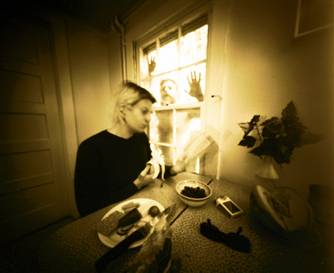
At times, it's an action flick, with a chase scene that seems endless ... until it dissolves and we're falling, falling, falling into ... is it a field of flowers? And who is the gardener waving at us over there? Could it be our old high-school English teacher? No, it's Jon Stewart. He wants us to sit on the couch right next to him. Are those TV cameras? And what happened to our clothes? In the morning, when the alarm rudely arouses us, we might remember none of this—or maybe only a fraction, perhaps the feeling of lying naked in a bed of daisies or an inexplicable urge to watch "The Daily Show."
This, then, is the essence of dreaming—reality and unreality in a nonsensical, often mundane but sometimes bizarre mix. Dreams have captivated thinkers since ancient times, but their mystery is now closer than ever to resolution, thanks to new technology that allows scientists to watch the sleeping brain at work. Although there are still many more questions than answers, researchers are now able to see how different parts of the brain work at night, and they're figuring out how that division of labor influences our dreams. In one sense, it's the closest we've come to recording the soul. "If you're going to understand human behavior," says Rosalind Cartwright, a chairman of psychology at Rush University Medical Center in Chicago, "here's a big piece of it. Dreaming is our own storytelling time—to help us know who we are, where we're going and how we're going to get there."
The long-range goal of dream research is a comprehensive explanation of the connections between sleeping and waking, a multidimensional picture of consciousness and thought 24 hours a day. In the meantime, dream science is helping us understand and treat depression, posttraumatic stress, anxiety and a whole range of other problems. Neuroscientists are gleaning insights into how we learn by studying the physiology of dreaming in adults and children. Psychologists are also studying dreams to learn how both ordinary people and great artists resolve problems in their life and work by "sleeping on it." For many of these researchers, accounts of ordinary dreams are a rich resource. Psychologist G. William Domhoff and his colleagues at the University of California, Santa Cruz, have meticulously cataloged and posted more than 17,000 dreams. That database (dreambank.net) is the source of the dreams printed here. History Of Dream Research I am with an older, "lecherous-looking" Freudian analyst who wants me to lie on the couch and recall the moment of my birth while he counts 1, 2, 3. I pretend and then tell him the truth. Then he gets undressed and wants to make love to me but just then Mother looks in by the door! And I lie very still; she closes the door. I awaken. (Then I remember wishing that I was still with my analyst.) Thousands of years ago, dreams were seen as messages from the gods, and in many cultures, they are still considered prophetic. In ancient Greece, sick people slept at the temples of Asclepius, the god of medicine, in order to receive dreams that would heal them. Modern dream science really begins at the end of the 19th century with Sigmund Freud, who theorized that dreams were the expression of unconscious desires often stemming from childhood. He believed that exploring these hidden emotions through analysis could help cure mental illness. The Freudian model of psychoanalysis dominated until the 1970s, when new research into the chemistry of the brain showed that emotional problems could have biological or chemical roots, as well as environmental ones. In other words, we weren't sick just because of something our mothers did (or didn't do), but because of some imbalance that might be cured with medication. After Freud, the most important event in dream science was the discovery in the early 1950s of a phase of sleep characterized by intense brain activity and rapid eye movement (REM). People awakened in the midst of REM sleep reported vivid dreams, which led researchers to conclude that most dreaming took place during REM. Using the electroencephalograph (EEG), researchers could see that brain activity during REM resembled that of the waking brain. That told them that a lot more was going on at night than anyone had suspected. But what, exactly?
Areas that generate internal imagery are active, providing visual detail, even though regions receiving signals from the eyes are shut down.
Emotional centers rev up, while areas involved in judgment wind down, perhaps giving free rein to unconscious feelings and drives, as Freud theorized.
Regions responsible for short-term memory become inactive, so the dreamer forgets what just happened and accepts rapidly shifting scenes or characters.
Sources: Allen Braun, M.D., NIDCD, National Institutes of Health; Thomas Balkin, Ph.d., Walter Reed Army Institute of Research ? Print this
Scientists still don't know for sure, although they have lots of theories. On one side are scientists like Harvard's Allan Hobson, who believes that dreams are essentially random. In the 1970s, Hobson and his colleague Robert McCarley proposed what they called the "activation-synthesis hypothesis," which describes how dreams are formed by nerve signals sent out during REM sleep from a small area at the base of the brain called the pons. These signals, the researchers said, activate the images that we call dreams. That put a crimp in dream research; if dreams were meaningless nocturnal firings, what was the point of studying them? More recently, new theories have made some scientists take dreams more seriously. In 1997, Mark Solms of the University of Cape Town in South Africa published the results of his study of people with damage to different parts of the brain; he found that there was more than one mechanism in the brain for activating dreams. Since then, Solms has argued that technology like functional magnetic resonance imaging (fMRI) and positron emission tomography (PET) might actually lend new weight to Freud's ideas because the parts of the brain that are most active during dreaming control emotion, the core of Freud's dream theory. Today, many therapists have a looser view of Freud, accepting that dreams may express unconscious thoughts, although not necessarily childhood conflicts.
Many others think the answer ultimately lies in a reconciliation of the different disciplines that study dreaming: neurobiology and psychology. "Both are useful, but they're different," says Glen Gabbard, professor of psychoanalysis and psychiatry at Baylor College of Medicine in Houston. "To have a truly comprehensive understanding of dreams, you have to be bilingual. You have to speak the language of the mind and the language of the brain."
|
|
|
|
|
||||||||||||||||||||||||||||||||||||||||||||||||||||||||||||||
|
|
|
|
|||||||||||||||||||||||||||||||||||||||||||||||||||||||||||||||||