|
Home>News Center>Photo Gallery>Life | |
|
|
|
|
|
|
|
|
|
|
|||||||||
|
|
Flightless New Zealand icon bird claws back from brink
An imaginative plan and a dose of national guilt could save New Zealand's flightless icon, the once abundant kiwi, from extinction.
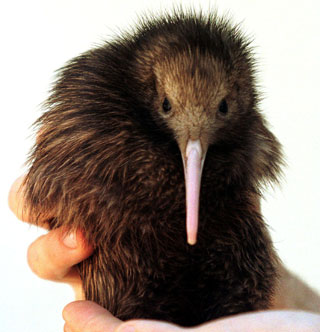
The kiwi should have already disappeared, like many native New Zealand species did after humans and other mammals arrived about 1,000 years ago. The population has plummeted to an estimated 60,000 from five million in 1920, as settlers cleared kiwis' forest habitat, and introduced predators that ate the young birds. "Given that trajectory, within 20 years they'd be gone, functionally extinct," says Paul Jansen, government conservation worker and co-ordinator of the Kiwi Recovery Programme. Creating pest-free havens on small islands to house "insurance" populations of the five kiwi species was the first step, a method pioneered in New Zealand 100 years ago. "New Zealand has a history of making refuges for wildlife ... saying, these things are in trouble, we'll scatter them around a few islands and we'll have some in reserve," Jansen says. About 5 percent, or 50,000 hectares (123,550 acres), of the total kiwi habitat is now under protection, including five offshore islands and unfenced "mainland" islands. Ordinary New Zealanders have joined in, realising they could lose the kiwi, which the indigenous Maori people call a treasure and whose coarse feathers they once used to make cloaks for their chiefs. Kiwi numbers are expected to fall for at least another five years. However, Jansen says a successful plea for funding to expand now proven conservation know-how, both from private sponsors and the government, means kiwi recovery is a reality. UNIQUELY NEW ZEALAND Among its treasure trove of fauna, New Zealand has other unique species such as the nocturnal, flightless kakapo, the world's largest parrot, of which only 83 remain. But it was the kiwi that came to represent New Zealand. The first specimens of kiwis, part of the ratite family which includes the Australian emu and the cassowary, were such oddities that biologists pictured them standing upright like humans, instead of hunched over with their beaks raking the ground. "A bird with a long beak like that, with nostrils at the tip, that couldn't fly but with vestigial wings, and big fat legs -- nobody had seen anything like that before," Jansen says. "That's why it was uniquely New Zealand." Kiwis vary widely in size, from a small domestic fowl to up to 45 cm (18 inches) tall. Named by the Maori for their eerie nocturnal call, they can outrun a human and attack predators with their clawed, three-toed feet, even flattening juvenile kiwis that wander into their territory. Dull-coloured and pungent-smelling, kiwis had a sporting chance against their original predators, such as the extinct Haast giant eagle. But they, and other native species, were not equipped for flightless hunters with teeth and a sense of smell, says Kevin Hackwell, conservation manager of 81-year-old conservation organisation Forest & Bird. "Because we didn't have mammals, we have birds that do what mammals do in other places," Hackwell says. New Zealand's isolation, and the inability of its native birds and other creatures to adapt to centuries of predation, means the country, about the size of the United Kingdom, has one of the world's most crowded lists of endangered species. FOCUS CHANGE New Zealand, which provided the scenic backdrop for the block-busting "Lord of The Rings" films, now markets itself as "100 percent pure". But until 20 years ago, government bodies responsible for the environment were crushing the kiwi's habitat, and dousing it with the chemical napalm, to create pine plantations and farmland. With work begun to protect the environment, the focus turned to repopulation, and "stoat-proofing" kiwis by taking eggs from nests and nurturing the birds before releasing them. Conservationists began their own large-scale poisoning and trapping of animals such as stoats, and possums -- imported from Australia for their fur but now destroying native forests. "Anything with four legs and fur shouldn't be there, it's alien to our ecology and invariably is doing severe damage to it," says Hackwell, who has a soft spot for the stoat in its own habitat, but not in New Zealand. Kiwi eggs are safe because they are too large for rats and stoats to get their jaws around, but predators kill about 95 percent of young birds. However, after nine months -- when they weigh about 1 kg (2.2 lb) -- most kiwis can fight off anything but a dog, and generally live for another 40 years. "I think we've got enough technology and ability to be able to hold on to a
few fragments," Jansen says. "None of the species of kiwi will go extinct -- we
will not let that happen." |
|
|
|
|||||||
|
|
|
|
|||||||||