|
Home>News Center>China | |
|
|
|
|
|
|
|
|
|
|
||||||||||||||||||||||||||||||||||||||||||||||||
|
|
Luxury boat too costly for lake
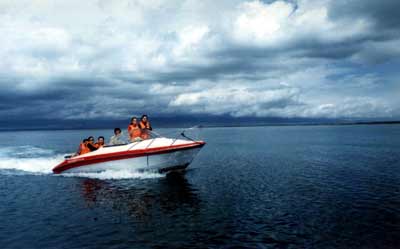
At a port on Qinghai Lake, the country's largest inland saltwater lake in the northwestern province of Qinghai, a grand luxury pleasure boat has been left half-finished.
The boat was designed to be a seven-storey, four-star floating hotel and was originally expected to set sail this month and open to the public in May next year. However, in early September, after four storeys were built, construction was suspended by the provincial government in response to protests from environmentalists and experts. Several members from the Chinese Academy of Sciences and the Chinese Academy of Engineering strongly opposed the building of the luxury boat on Qinghai Lake, where the very fragile biological system would be put in grave danger once pollution sets in. Tourism is one of the pillar industries of Qinghai, and Qinghai Lake is the province's main tourist site. Local tourist officials had expected the pleasure boat would bring more visitors, especially in the slack tourist seasons. Officials from boat sponsors Xiadu Tourist Group said in May that the vessel would upgrade the accommodation and entertainment infrastructure of the lake, bringing more development opportunities to the province. They promised that the boat would achieve "zero pollution" on the lake as high-tech rubbish collection and pollution control systems would be introduced. But Ge Mei, director of the Environment Protection Department of Shanghai Marine Science and Research Institute, argued that "zero pollution" is only a theoretical notion, and cannot be achieved even in some highly developed shipping countries, let alone China. Ge said that since operating those pollution control systems needs huge investment and man-power, many boats have installed the system but seldom use it. The present legal system does not have the power to control the discharge of waste into the lake. If this luxury liner were to be built, thousands of tourists and boat staff would inevitably add to the effluent discharged and threaten the ecosystem, said Jiang Youxu, a member of the Chinese Academy of Sciences. More than 40 rivers and numerous springs enter the inland lake, but there is no outflow. "Apart from evaporation, the lake has no discharge opening," Jiang said. "The lake would be totally ruined and impossible to clean if it was polluted. " The boat project was approved by the local authorities and building started earlier this year. Li Ling, director of Supervision and Management Division under the Qinghai Environment Protection Bureau, told China Daily that the project's feasibility plan passed the environmental impact evaluation last year. Yet the evaluation was later discovered to have been carried out by "a second-grade local institute," according to a report in the China Business Herald Weekly. Ma Haizhou, director of the Salt Lake Research Institute under the Chinese Academy of Sciences, said any development projects related to Qinghai Lake should be treated as a major development project and must be evaluated by top grade evaluation institutes. Qinghai has only one first-grade environmental impact evaluation institute and several second-grade ones. Officials with the Qinghai Environment Protection Bureau said they were organizing an expert team to re-assess the environmental impacts of the project. Gov't in the wrong boat As well as the environmental impacts of the boat project, the public is concerned with who will take responsibility for costs already incurred before the project is cancelled completely. The project design alone cost 74.3 million yuan (US$8.9 million) and it has already consumed roughly 30 million yuan (US$3.6 million) in building, said Ma Wenguang, an official from the Xiadu Tourist Group, who was in charge of the initial project. Ma said his group was bought by the State-owned Qinghai Provincial Investment Corporation in 2002 to become a subsidiary. The group has just been renamed the Qinghai Hotel Tourist Group. Ma said his group was mainly in charge of co-ordinating the project, and the real investor was the Qinghai Kunlun Leasehold Company, another subsidiary of the Qinghai Provincial Investment Corporation. Because the scheme was approved by the local government, it is they who will have to cover the costs - in other words, the public purse - said Professor Mao Shoulong from the Executive Management Research Institute under the Beijing-based China Renmin University. When project developers and the government have the same interests, over-development of natural resources and a lack of any real supervision are inevitable side-effects, Mao said. To balance the conflict between economic development and environment protection, the government should find its right role, he said. It should avoid getting directly involved in projects with shared interests and take its role as a supervisor and regulator seriously, Mao said. A pearl of the highlands Lying in the northeast of Qinghai Province, some 150 kilometres from Xining, the provincial capital, Qinghai Lake stretches endlessly through the highlands 3,200 metres above sea level. Qinghai means green sea in Chinese and the province was actually named after this lake. Covering an area of 4,635 square kilometres, the lake has an abundant supply of fish, which in turn attracts large flocks of birds including many migratory breeds. At the bank of the lake is Birds' Island, which covers an area of 0.8 square kilometres and is home to nearly 100,000 migratory birds. The 500-metre-long and 150-metre-wide island is known as the "Kingdom of Birds." Every April, dozens of bird species from south and southeast Asia come to reproduce and live there, including wild geese, gulls, cormorants, sandpipers and rare black-necked cranes. But since the 1960s, the lake has been shrinking due to reduced water inflow from major rivers, and local farmers have turned large tracts of lakeside grassland into farmland. To reverse the situation, the Qinghai provincial government had returned 33,300 hectares of farmland to pasture by the end of 2003 and set up three wetland monitoring stations. There was once much fish to be caught but resources have plum-meted, and the naked carp, once rare, now faces extinction. Fishing at least has been banned, but all other efforts, like the refusal to accommodate boat projects like this one, are vital to guarantee the lake a life. |
|
|
|
|
|||||||||||||||||||||||||||||||||||||||||||||
|
|
|
|
||||||||||||||||||||||||||||||||||||||||||||||||