|
Home>News Center>China | |
|
|
|
|
|
|
|
|
|
|
||||||||||||||||||||||||||||||||||||||||||||||||
|
|
A small but significant step forward
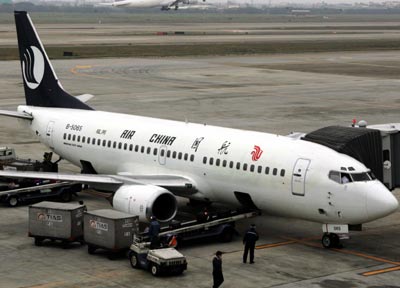
On Saturday, seven mainland charter planes landed on Taiwan for the first time since 1949, the start of cross-Straits charter flights for the 2005 Spring Festival. A month ago, few would have forecast the success of non-stop cross-Straits charters. At that time, discussions seemed locked in a stalemate as Beijing maintained the problem should be solved through non-government negotiations between airline associations while Taipei insisted on the participation of government officials during the talks.
On January 11, Pu Zhaozhou, executive director of the China Civil Aviation Association, extended a formal invitation to Lo Ta-hsin, chairman of the Taipei Airlines Association, proposing talks at "a place suitable to both sides." A day later, Taipei agreed to send a delegation to Macao on January 15, backing away from its earlier demand for official exchanges. It took less than two hours for civil aviation negotiators from both sides to reach a consensus on launching two-way, non-stop charter flights from January 29 until February 20. The agreement allows six mainland and six Taiwanese airlines to operate a total of 48 round-trip charter flights to carry mainland-based Taiwanese businessmen home and back over the Spring Festival holidays. The direct charter flight deal was widely taken as a sign for the inevitable trend of closer personal exchanges and economic links across the Straits. Wang Zaixi, vice-minister of the Taiwan Affairs Office of the State Council, described the historic charter flight arrangements as deserving congratulations. "The cross-Straits charter flights agreement for the 2005 Spring Festival is a breakthrough in three aspects," he told a press conference on Friday. First, both mainland and Taiwanese carriers are able to operate round-trip flights. Second, charter planes from both sides are allowed to fly through Hong Kong airspace without a stopover. Third, the charters are operated between multi-destinations on both sides, including the mainland's Beijing, Shanghai and Guangzhou and Taiwan's Taipei and Kaohsiung. This year's charter flight arrangements contrast with the 2003 indirect cross-Straits charter flight scheme under which only six Taiwanese airlines were allowed to operate 16 one-way flights between Taipei, Kaohsiung and Shanghai, with a stopover in Hong Kong or Macao. Wang said the success of charter flights this year will be a model for solving practical and business issues between Taiwan and the mainland. "This year's experience demonstrates both sides of the Straits can reach agreement through non-government consultations in the absence of official contact," said the vice-minister. "Such measures show we are determined to exert our utmost efforts to do whatever is conducive to the immediate benefit of Taiwan compatriots." Wang's comments were a reference to Beijing's long-standing position that economic and trade issues should be solved through non-government consultation. The mainland has ruled out any contact with the Taiwan authorities because Taiwan leader Chen Shui-bian refuses to accept the one-China principle that Taiwan and the mainland are both parts of China. Wang emphasized there are a number of other issues which can be similarly discussed and resolved. These include the sale of Taiwan agricultural products on the mainland, the establishment of closer economic partnerships across the Straits and the three direct links in trade, transport and postal services. Given the current favourable atmosphere, John Chang, who initiated the cross-Straits charter flight plan in 2002, optimistically forecast more progress in pushing forward the programme. "We hope the one-time cross-Straits charter flights may soon become routine to bring more convenience to people on both sides of the Straits," the Kuomintang "legislator" told China Daily. "We also expect an early realization of cross-Straits charter cargo flights." Chang expressed his confidence that this year's charter flights arrangement will have a positive impact on the implementation of full-blown three direct links across the Straits. Little impact on political ties Despite the success of the charter flight programme, officials and researchers played down its significance in improving political relations across the Straits. Li Weiyi, spokesman for the Taiwan Affairs Office, recently said the success of the charter flights does not spell the resumption of talks between Taiwan and the mainland. "The Lunar New Year charter flights are out of consideration for the interests of Taiwan compatriots and to make their return home convenient, safe and comfortable," said the spokesman at a recent press conference. "In no way does it mean that cross-Straits negotiations have resumed." He also warned that the cross-Straits situation remains grim because of Chen's escalating pro-independence activities. Chen has been pushing ahead with his plan to write a "constitution" for the island through referendum in 2006 and enact the document in 2008. Li said Chen's aim is to pursue de jure independence for the island.This threatens the peace and stability of not only the Taiwan Straits, but the Asia-Pacific region. Wu Nengyuan, director of the Institute of Modern Taiwan Studies under the Fujian Academy of Social Sciences, said it is unrealistic to expect the charter flight programme will help break the current political stalemate in bilateral ties. "We cannot play up the significance of this year's charter flight arrangement because its impact is largely limited to the economic field," he noted. "A breakthrough in cross-Straits ties ultimately hinges on whether the Taiwan authorities will abandon their pro-independence stance and stop separatist activities." Echoing Wu's views, Professor Cheng Ling-chen of Taipei-based Taiwan University, predicted that there will be little opportunity for the resumption of cross-Straits ties in the near term. The reason for that is the insistence by Chen of clinging to a separatist stance, and his refusal to recognize the one-China principle and the 1992 consensus which upholds it. Beijing considers the one-China principle the basis and premise for resuming bilateral talks that broke off in July 1999. In fact, Chen has stuck to a strong political ideology, even in respect of the three direct links issue. Although there is no technical problem for realizing direct transport links across the 160-kilometre-wide Taiwan Straits, his Democratic Progressive Party (DPP) administration has defended the decades-old ban, citing security concerns. Economic losses running into hundreds of millions of US dollars are incurred each year by the island due to transport re-routing. During the talks for this year's charter flights, the Taiwan authorities also tried to cram politics into the programme. Taipei first proposed letting charter planes fly via Ryukyu in Japan in an attempt to internationalize the domestic flight route, but met with the mainland's refusal. As for the scope of the passengers on the charter flights, Taipei insisted on transporting only mainland-based Taiwanese business people and their relatives. It refused to include others such as students from Taiwan studying on the mainland and even mainland spouses of Taiwanese. "Taipei's requirement in this regard is neither fair nor reasonable," said He Shizhong, director of the Economic Bureau with the Taiwan Affairs Office. "It fully demonstrated the Taiwan authorities' reluctance to fully open up transport links between Taiwan and the mainland." The official said only after Taipei abandons its attempts to interfere with business matters by insisting on the inclusion of political aggreements can cross-Straits economic exchanges maintain a steady progress.
(China Daily 01/31/2005 page3) |
|
|
|
|
|||||||||||||||||||||||||||||||||||||||||||||
|
|
|
|
||||||||||||||||||||||||||||||||||||||||||||||||