|
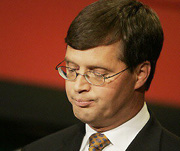 |
| Dutch Prime Minister Jan
Peter Balkenende reacts at the result of the Dutch referendum on the
European Union's first
constitution.(AFP) |
Slow economic growth in the Netherlands is seen as a key reason for
Wednesday's massive rejection of the European Union constitution, with
"no" voters listing gripes such as the high value of the euro, the cost of
EU membership and possible job losses to immigrant labour.
Last year the Dutch center-right government, led by
the Christian Democrat prime minister, Jan Peter Balkenende, announced
extremely unpopular austerity
measures to raise tax revenues and cut spending to
improve public finances.
At a time when the Dutch are asked to tighten their belts, the fact
that the country has gone from being a net receiver from its membership in
the EU to becoming the biggest net contributor is not sitting well with
many voters.
"The most important reason for voters to reject the EU's constitution
treaty was the belief that the Netherlands pays way too much for EU
membership," progressive Christian newspaper Trouw said in an analysis
Thursday.
Some 62 percent of "no" voters named the high Dutch contribution to the
EU budget as a reason to reject the treaty, according to a poll conducted
Wednesday.
Even though the Dutch government won praise in Brussels for wrestling
down its deficit to comply with EU budget rules, voters could not stomach
that France and Germany had flaunted those very same rules and got away
with it when EU members earlier this year agreed to water down their 1997
Stability and Growth Pact.
"People do not want to pay money to Europe that we could put to better
use in the Netherlands for care of the elderly or security measures, for
instance," far-right member of parliament Geert Wilders, a prominent "no"
campaigner, summed up the mood Thursday in a parliamentary debat.
Ahead of the debate Balkenende insisted that the discussion on the
Dutch contribution to the EU should be reserved for an EU meeting on the
overall budget for the period 2007 to 2013.
"This is a different discussion that is separate from the
constitution," he said.
Gripes over the euro also played an important role for many "no"
voters, according to several polls.
At the beginning of the referendum campaign, voters were shaken when
the head of the central bank admitted that the country's former currency,
the guilder, had been undervalued compared with the German mark just
before the switch to the euro.
This backed up long-held consumer charges that the move to the European
common currency had led to massive price hikes.
"The euro is bad for us. The Netherlands pays through the nose for
the EU while Spain is still receiving money," lab technician Rene Moors
told AFP ahead of the vote.
Anti-immigrant sentiment was also closely linked to the economic
situation in the Netherlands.
The Dutch economy grew only 1.4 percent in 2004 and employment dropped
by 1.7 percent, the largest drop in over 20 years, according to the Dutch
Central Bureau of Statistics. Despite this gloomy picture the Netherlands
still has one of the lowest unemployement rates in Europe, at 6.9 percent.
In this climate many Dutch fear they may lose their job. The prospect
of a huge influx of often cheaper immigrant labour, as conjured up by
far-right campaigners in the "no" camp, tapped into basic fears.
"The Dutch have the idea that everything that is not Dutch threatens
their identity," Sophie Vanhoonacker, director of Maastricht University's
European Studies program, said.
"The Dutch worry the eastern Europeans will come 'to steal our jobs'.
They fear the loss of employment and prosperity," she explains.
(Agencies) | 


 Updated: 2005-06-03 10:31
