|
Home>News Center>World | |
|
|
|
|
|
|
|
|
|
|
|||||||||||||||||||||||||||||||||||||||||||||||||||||||||||||||||||||||||||||||||||||||||||||||||||||||||||||||||||||||||||||||||||
|
|
Americans, German win Nobel physics prize
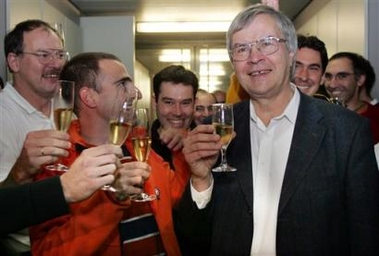
Americans John L. Hall and Roy J. Glauber and German Theodor W. Haensch won the 2005 Nobel Prize in physics Tuesday for work that could lead to better long-distance communication and more precise navigation worldwide and in space.
The prize was given to the three for their work in applying modern quantum physics to the study of optics. Engineers have used their observations to improve lasers, Global Positioning System technology and other instruments. Glauber, 80, of Harvard University, took half of this year's Nobel for showing in the 1960s how the particle nature of light affects its behavior under certain circumstances. Although those conditions are rarely observed in nature, they are often relevant in sophisticated optical instruments. Hall, 71, of the University of Colorado, and Haensch, 63, of the Ludwig-Maximilian-Universitaet in Munich, won "for their contributions to the development of laser-based precision spectroscopy, including the optical frequency comb technique." Their research determined the color of light at the atomic and molecular level. Haensch used evenly spaced laser pulses to determine the frequencies and Hall refined the technique. Hall and Haensch will split one half of the $1.3 million prize, with Glauber receiving the rest. "It's a huge surprise, a great pleasure," Hall said, noting the work was a team effort. Speaking from his office in Munich, Haensch called the award a high point of his career. "I was speechless but of course very happy, exuberant," he said. "Now, I am trying to get used to this." He said the fruits of their work could eventually be applied to improving communication across the globe and beyond. The research could also be useful in helping spacecraft navigate more accurately on long journeys, or creating better digital animation. "Eventually, we may be able to enjoy three-dimensional holographic movies," Haensch said. "The important contributions by John Hall and Theodor Haensch have made it possible to measure frequencies with an accuracy of 15 digits," the academy noted. "Lasers with extremely sharp colors can now be constructed, and with the frequency comb technique precise readings can be made of light of all colors. "This technique makes it possible to carry out studies of, for example, the stability of the constants of nature over time and to develop extremely accurate clocks and improved GPS technology." Borje Johansson, a member of the Royal Swedish Academy of Sciences, called the academy's choice "a typical physics prize." "First someone breaks down a barrier, and then things happen," Johansson said. "The common man can have great use of this." Sune Svanberg, chairman of the Nobel Committee for Physics, said Glauber can rightly be considered the father of quantum optics, and that his theories paved the way for the discoveries made by Hall and Haensch. Until Glauber published his theories in 1963, scientists had dismissed the idea that the quantum theory, originally developed by Albert Einstein, could be applied to the field of optics. "There were completely different ideas back then about how to view this," Svanberg said. "His results are fundamental for our modern understanding of the behavior of light." Hall works for JILA, an institute run by the University of Colorado and the National Institute of Standards and Technology. Two other JILA physicists, Eric A. Cornell and Carl E. Wieman, won the Nobel in physics in 2001. JILA originally stood for the Joint Institute for Laboratory Astrophysics. However, JILA's fellows decided to keep the name but drop the meaning in 1994 as the scope of its research widened. Of the six Nobels, the physics prize has perhaps the broadest scope of research, making speculation ahead of the announcement difficult. Alfred Nobel, the wealthy Swedish industrialist and inventor of dynamite who endowed the prizes, left only vague guidelines for the selection committee, saying in his will that the prize should be given to those who "shall have conferred the greatest benefit on mankind" and "shall have made the most important discovery or invention within the field of physics." In the past decade, winning physics discoveries have ranged from explaining the makeup of faraway galaxies to creating high-speed electronics that led to breakthroughs in how information is transmitted worldwide at superfast speeds. Last year's prize was given to Americans David J. Gross, H. David Politzer and Frank Wilczeck for their explanation of the force that binds particles inside an atomic nucleus. The prize is the second Nobel to be announced this week. On Monday, Australians Barry J. Marshall and Robin Warren won the 2005 Nobel Prize in physiology or medicine for proving, partly by accident, that bacteria and not stress was the main cause of painful ulcers of the stomach and intestine. The awards for chemistry, peace and literature will be announced through the end of the week, with the economics prize to be awarded Oct. 10. The prizes will be awarded by Sweden's King Carl XVI Gustaf at a ceremony in Stockholm on Dec. 10.
|
|
|
|
|
||||||||||||||||||||||||||||||||||||||||||||||||||||||||||||||||||||||||||||||||||||||||||||||||||||||||||||||||||||||||||||||||
|
|
|
|
|||||||||||||||||||||||||||||||||||||||||||||||||||||||||||||||||||||||||||||||||||||||||||||||||||||||||||||||||||||||||||||||||||