|
Saddam trial plunges into deeper disarray
(AP)
Updated: 2006-01-25 08:35
Judges in the trial of Saddam Hussein tried to remove a newly appointed chief
judge Tuesday, a dispute that forced an abrupt postponement of the proceedings
and deepened the turmoil in what was supposed to be a landmark in Iraq's
political progress.
Saddam's lawyers were quick to capitalize on the disarray, saying the
confusion provided fresh evidence the former leader could not get a fair trial
in Iraq. Former U.S. attorney general Ramsey Clark, a member of the defense
team, said the trial should be abandoned.
Since its Oct. 19 start, the trial has been defined by delays, chaotic
outbursts by Saddam, the assassination of two defense lawyers and a judge's
decision last month to step down after learning that one of the defendants may
have been responsible for his brother's execution.
After the trial's last session on Dec. 22, the confusion worsened.
The chief judge resigned, complaining about criticism by politicians that he
was not doing enough to rein in Saddam. Saeed al-Hammash, the member of the
five-judge panel initially named to replace him, was suddenly removed, and a new
chief judge, Raouf Rasheed Abdel-Rahman, was brought in.
After a nearly five-hour delay Tuesday, court official Raid Juhi told
reporters the hearing had been put off until Sunday because several witnesses
and complainants were performing the hajj pilgrimage in Saudi Arabia and could
not appear in court.
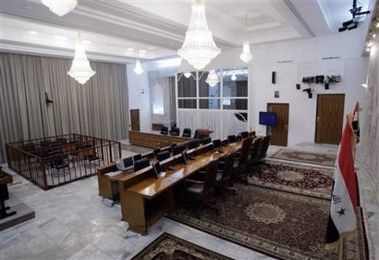
This general view of the interior of the
courtroom where the trial of Saddam Hussein and seven co-defendants is
being held, at an undisclosed location in the heavily fortified Green Zone
in Baghdad Iraq, seen in this Dec. 8, 2005 file
photo.[AP/file] | The annual Muslim ritual ended nearly two weeks ago, and Tuesday's session
had been scheduled more than a month ago. Juhi refused to take questions.
But two judges involved in the case told The Associated Press the real reason
for the delay was disagreement over who should replace chief judge Rizqar
Mohammed Amin, a Kurd who had shown patience and composure in dealing with
repeated attempts by Saddam and others to delay the proceedings.
According to one judge, some judges wanted al-Hammash reinstated while others
supported Abdel-Rahman's appointment.
The second judge appeared to complain about outside interference with the
court. When asked what the problem was, he replied: "Matters are not in our
hands," — a possible reference to the influence of U.S. officials providing
legal and logistical support to the Iraqi High Tribunal set up to try crimes
committed by Saddam and officials of his 23-year regime.
The two judges were members of the tribunal, though not necessarily sitting
on the panel hearing the current case. They spoke on condition of anonymity
since court rules bar most judges from being named or speaking to the media.
"There's too much violence in the country, there's too much division and too
much pressure on the court," Clark told CNN after Tuesday's postponement. "The
project ought to be abandoned. It was a creature of the United States in the
first place."
He said political pressures on the court "make it impossible for fairness"
and warned failure to hold a fair trial will "lead to more war, no possibility
of reconciliation."
Saddam, his half brother Barzan Ibrahim and six other defendants are on trial
in the killing of more than 140 Shiite Muslims after a 1982 attempt on Saddam's
life in the town of Dujail. They could face death by hanging if convicted.
U.S. and Iraqi officials had hoped the trial would mark a political turning
point for the violence-torn country, helping it deal with its past and look
forward to a new political system.
Instead, it has heightened divisions. Sunni Arabs sympathetic to the former
leader, their patron, were heartened by Saddam's outbursts during the hearings,
which are televised nationwide.
But Shiites and Kurds, who make up about 80 percent of Iraq's estimated 27
million people and bore the brunt of Saddam's oppression, found the relative
freedom he has had in the courtroom an affront.
"This doesn't serve the people, it serves the dictator Saddam," said school
teacher Abdul-Waheed Shawkat, a 28-year-old Shiite from the northern city of
Mosul.
"It's a political game," said Khaled Khalil Mohammed, a Sunni Arab
construction worker from Fallujah, west of Baghdad.
"This trial is a farce... Its final verdict already has been made and it's in
the hands of the Americans," said Aqeel Omar Mohammed, a retired Sunni Arab
lecturer from Tikrit, Saddam's hometown.
The Dujail case is one of several being prepared against Saddam and members
of his regime. They include the 1990 invasion of Kuwait, the suppression of
Kurdish and Shiite revolts in 1991 and the alleged 1988 gas attack by Saddam's
army against the Kurdish town of Halabja. Some 5,000 people died in that attack,
including several relatives of the Halabja-born Abdel-Rahman, the judge named to
take over from Amin.
The Dujail case, chosen expressly because officials believed it would be
quick to try, has not been the best of starts.
More than a dozen witnesses have been heard, recounting torture at the hands
of Saddam's security forces. But Saddam and his half brother have frequently
interrupted the court with speeches and complaints. And Saddam refused to attend
one session.
|