|
CIA boss: Iraq never an imminent threat
(Agencies)
Updated: 2004-02-06 08:42
Intelligence analysts never told U.S. President George W. Bush before the invasion of Iraq that Saddam Hussein's rule posed an imminent threat, CIA Director George Tenet said Thursday in a heated defense of agency findings central to the decision to go to war.
The urgency of the Iraqi threat was Bush's main argument for the war. But the president said Thursday he still would have invaded Iraq if he'd known no weapons stockpiles existed — adding a new element to the much-debated question of whether the United States went to war based on faulty assumptions.
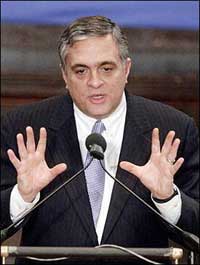 |
| CIA Director Geprge Tenet speaks at Georgetown Univeristy in Washington Thursday, Feb. 5, 2004. In his first public defense of prewar intelligence, Tenet said U.S. analysts never claimed before the war that Iraq posed an imminent threat. [AFP] |
Tenet, addressing such questions for the first time after weeks of silence, acknowledged that analysts believed before the war that Saddam had chemical and biological weapons, although none have been found. He said he believes some of what U.S. intelligence predicted about Iraq will turn out to have been right — and some wrong — as is often the case in such matters.
He made clear that analysts differed among themselves all along on important aspects of Saddam's chemical, biological and nuclear programs and spelled out those disputes in an October 2002 intelligence estimate given to the White House.
"They never said there was an imminent threat," Tenet said in a speech at Georgetown University. "Rather, they painted an objective assessment for our policy-makers of a brutal dictator who was continuing his efforts to deceive and build programs that might constantly surprise us and threaten our interests."
Tenet's remarks hit back at his former special adviser on Iraqi weapons, David Kay, who said last month "we were almost all wrong" about Iraq's weapons of mass destruction.
The comments also seemed designed to inoculate the CIA from becoming a scapegoat in the fight over whether the war was justified.
Speaking in Charleston, S.C., Bush acknowledged that the weapons have not been found, although investigators have discovered evidence of possible programs. He said the war was still justified.
"Knowing what I knew then and knowing what I know today, America did the right thing in Iraq," Bush said.
Tenet, in his 40-minute defense, never said in detail how the Bush administration, citing U.S. intelligence, might have painted an inaccurate picture of Iraq's weapons arsenal. He insisted that the intelligence analysts had not tailored their findings for any political purpose.
That leaves the door open for Democrats to demand more investigation and explanation, and for many to question the basis of the administration's pre-emptive strike doctrine.
"It goes to the core of why a nation went to war," said Democratic presidential front-runner, Massachusetts Sen. John Kerry (news - web sites).
Before the war, Bush and his senior advisers made clear they viewed the threat from Saddam as urgent.
In October 2002, Bush told an audience in Ohio that "the danger is already significant and it only grows worse with time. If we know Saddam Hussein has dangerous weapons today — and we do — does it make any sense for the world to wait to confront him as he grows even stronger and develops even more dangerous weapons?"
On Sept. 13 of that year, Bush said of Saddam, "He's a threat we must deal with as quickly as possible."
White House aides have pointed out that Bush, while he cited the urgency of Saddam's threat, never called the threat "imminent."
In his State of the Union address in January 2003, Bush said: "Some have said we must not act until the threat is imminent. Since when have terrorists and tyrants announced their intentions, politely putting us on notice before they strike? If this threat is permitted to fully and suddenly emerge, all actions, all words and all recriminations would come too late."
In general, the Bush administration before the war cited three main justifications for military action: preventing Iraq from using weapons of mass destruction, protecting America from terrorists and liberating Iraqis from a repressive regime.
Tenet's speech came at a sensitive time.
Bush was expected to announce Friday a nine-member panel to look at the Iraq intelligence and weapons proliferation issues worldwide. An administration official, speaking on the condition of anonymity, said Sen. John McCain, R-Ariz., would be a member. Republicans on the Senate Intelligence Committee, led by Pat Roberts of Kansas, are also completing work on a report detailing intelligence mistakes. They shared it with members in a closed session Thursday.
Democrats want to focus on whether analysts were pressured by the White House to justify an invasion. At the Carnegie Endowment for International Peace on Thursday, Kay said he doesn't believe analysts' arms were twisted, but he said the president's commission should look into whether political leaders manipulated the intelligence data given them. "I think that is an important question that needs to be understood," he said.
Tenet, who was appointed by former U.S. President Bill Clinton, made his own pre-emptive strike: "No one told us what to say or how to say it."
Like Bush and other administration officials, Tenet wouldn't rule out that weapons still may be found. "Despite some public statements, we are nowhere near 85 percent finished," he said rebutting Kay's figure.
As chief of the CIA and 13 other agencies that make up the intelligence community, Tenet conceded that there were mistakes. Analysts, for instance, overlooked a notice that one source providing information on Iraq's weapons of mass destruction was unreliable, he said.
On chemical and biological weapons, Tenet said analysts believed before the war that Saddam had programs and perhaps stockpiles, but investigators have found no evidence of such production. He said two sources with high-level access told the CIA in fall 2002, shortly before the war, that Iraq was producing biological and chemical weapons.
While Tenet conceded that U.S. intelligence agencies never penetrated Saddam's inner circle, those sources solidified his personal view that Saddam was a danger, he said. "Could I have dismissed such reports at the time? Absolutely not," he said.
Going into more detail than intelligence chiefs normally do, Tenet also claimed agency successes, including:
_ The U.S. penetration of Libya's network of foreign suppliers for its weapons of mass destruction. That led the agency into developments indicating Libya's programs were no longer on a back burner, Tenet said.
_ A CIA spy who led the U.S. to Khalid Shaikh Mohammed, the al-Qaida mastermind of the Sept. 11 attacks.
_ Human sources that led to the arrest of Nashiri, al-Qaida's operational chief in the Persian Gulf who planned the USS Cole attack, and to the capture of Hambali, a chief terrorist in South Asia.
"A blanket indictment of our human intelligence around the world is dead wrong," Tenet said. "We have spent the last seven years rebuilding our clandestine service."
|