|
TV images driving public discourse on war
(Agencies)
Updated: 2004-05-14 09:02
Until stomach-churning pictures emerged of naked Iraqi prisoners stacked like firewood or held at the end of a leash by their American captors, wartime prison abuse was a virtual non-story.
Similarly, the death of American Nick Berg in Iraq may have been little more than a footnote until video was posted Tuesday showing an executioner cutting off the man's head with a knife.
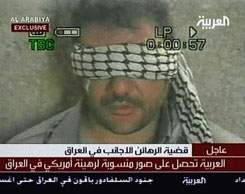
A blindfolded man described as an Iraqi-American held prisoner in Iraq is shown here in this image aired by the Arab television station Al Arabiya, Thursday, May 6, 2004. The man speaking in English, gave his name as Aban Elias and said he worked with the Pentagon as a civilian engineer. [AP] |
To most of the world, Iraq is a war of images. Pictures can drive public opinion and policy: the statue of Saddam Hussein toppling in Baghdad, U.S. President Bush standing on an aircraft carrier in front of a "mission accomplished" sign, the charred bodies of four contractors who had driven into disaster.
"It doesn't become real for a lot of people until they see it," said Edward Trayes, a photojournalism professor at Temple University. "It's truth in a way that even words don't describe."
Past wars have produced similar iconic images. The soldiers raising the American flag on Iwo Jima in World War II became a symbol of determination and triumph, while a naked girl running away from a napalm attack spoke to Vietnam's inhumanity.
Historians don't discount the cumulative impact of nightly news reports on American deaths in turning many Americans against the Vietnam War.
A ban on media coverage of coffins arriving from Iraq also shows the government's awareness of the potency of images.
What makes Iraq different is there are so many more potential sources for images, and technology — digital cameras, the Web, live television cameras — can make them available almost instantaneously, said Jay Rosen, a journalism professor at New York University.
That's coupled with a deeply divided world eager to seize on images that prove their political points, he said.
Berg's body was found last Saturday. The first media reports of the discovery were filed Tuesday, only hours before existence of the video became known. Few, if any, media outlets showed the beheading, although some depicted a knife held to Berg's head. The ominous, hooded assailants and Berg's obvious terror told the story visually.
In the two weeks since CBS' "60 Minutes II" first broadcast pictures of American soldiers allegedly mistreating Iraqi prisoners, there's been a congressional probe, calls for the ouster of Defense Secretary Donald Rumsfeld and worldwide expressions of revulsion.
Yet the military had known about the allegations for months. Newspapers and television didn't ignore the story, but it was generally off the public radar.
"What would have happened to this story if there weren't pictures?" asked Jeff Fager, executive producer of "60 Minutes II. "I bet you not much would have come of it."
"60 Minutes II" began its investigation not after hearing abuse reports, but after hearing there were photos, Fager said.
Army private Lynndie England was shown in one picture smiling and pointing to the genitals of a prisoner. England, who said she was following orders, has become a visual symbol of the scandal.
A poll released Wednesday by the Pew Research enter found that 76 percent of Americans had seen the pictures.
The Pew poll indicates they've had an impact. After the pictures were released, a majority of Pew survey respondents — 51 percent — said for the first time that the war in Iraq was not going well.
Like many newspapers, the News-Sun in Springfield, Ohio wrote little about the charges until there were pictures, said editor Karla Garrett Harshaw.
"When you see those images, it just has a different feel," Harshaw said. "It evokes more emotion because you see it. (You think) my goodness, how could they do that?"
The Associated Press reported in detail last fall about former Iraqi prisoners complaining of abuse, including attacks by dogs and people being tied up and punished by spending hours in the sun.
Similarly, CNN reported on a military investigation into alleged abuses on Jan. 16. The report mentioned the possibility of photos, although CNN didn't get the pictures.
Rumsfeld, during his May 7 testimony to Congress, mentioned those reports: "Everyone knew it," he said. "CNN was there, asking questions."
Even after the "60 Minutes II" report, there was an odd public pause before the impact sunk in. ABC's "World News Tonight" didn't know how to respond and waited two nights to do its first story on the controversy, its chief producer said.
It seemed to hit the news more quickly in Europe, CBS' Fager said.
"I was surprised," he said. "I thought it would get a much bigger initial reaction than it did."
CNN Pentagon reporter Barbara Starr, who reported on the alleged abuse at least four times before the pictures came out, said they illustrated a breakdown in military discipline that hadn't been seen in generations. The U.S. military was cast in the unfamiliar public role of bad guys.
The episode should be a lesson for the news media, Starr said.
"It's very clear that potentially terrible abuses were taking place," she said, "and it didn't become a big story until people could see these virtually pornographic images."
|