|
More Japanese oppose Koizumi's shrine visit
(Agencies)
Updated: 2005-06-14 11:48
TOKYO - Japanese prime minister faced growing pressure Monday to scrap visits to a war shrine that anger neighboring Asian nations, and a poll showed dwindling public support in Japan for the trips.
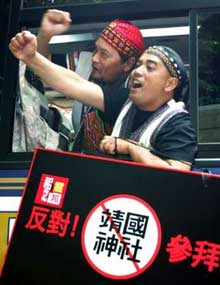
A group of Taiwanese indigenous people raise their fists and hold a banner protesting against the Yasukuni Shrine in Tokyo June 14, 2005. They were prevented by Japanese police from approaching the shrine, where some two dozen members of Japanese right-wing groups faced off with around 10 police outside the massive 'torii' archway at the entrance. [Reuters] |
Tokyo's relations with China and South Korea have hit a new low in recent weeks over Prime Minister Junichiro Koizumi's annual visits to the Yasukuni Shrine, which honors Japan's 2.5 million war dead, including convicted war criminals.
His four visits since taking office in 2001 have outraged Asian countries that suffered during Japan's brutal conquest of the region.
Koizumi was cautioned this month over his Yasukuni visits by senior officials in his own party, a group of former prime ministers and a powerful conservative group representing families of the war dead.
A new poll Monday showed more Japanese now oppose his visits than support them, said Nippon Television Network Corp.
In a survey conducted over the weekend, 46 percent of respondents disapproved of his visits, while 40 percent approved of them. Of those against, 57 percent said Koizumi needs to consider Japan's relations with China and South Korea.
"(Koizumi) is aware that public approval is changing," Chief Cabinet Secretary Hiroyuki Hosoda told reporters Monday.
"I believe he will make an appropriate decision" about whether to go again this year, Hosoda said.
Later Monday, Koizumi reiterated his stance that he would make "an appropriate decision," but didn't say whether he would stop the visits.
"I don't visit the shrine because I am asked to do so," he told reporters. "How Japan should mourn its own war dead is for us to decide."
Asked if he thought his visits would be backed by the Japanese public, he said: "I think they would."
China and South Korea have called Koizumi's Yasukuni visits the crux of a larger issue about Tokyo's refusal to face up to wartime atrocities, including the use of forced laborers and sex slaves.
A Taiwanese "lawmaker" arrived in Tokyo on Monday along with more than 50 relatives of Taiwanese aboriginals who also were enshrined at Yasukuni after being drafted into the Japanese military and dying during the war.
The Taiwanese said they want their relatives' names removed from memorial plaques there because it is "morally unpardonable that murderers and victims are honored at the same place."
Thousands of Taiwanese were forced into serving in the Japanese military during Japan's colonization of Taiwan. About 28,000 Taiwanese war dead are enshrined at Yasukuni under Japanese names they were forced to assume.
Japan's government came under fire Monday for comments by the education minister suggesting that textbooks should avoid the issue of foreign sex slaves forced to work in wartime brothels for Japanese forces.
Education Minister Nariaki Nakayama said that it was problematic for the books to use the term "comfort women," as they are widely known, because the phrase did not even exist during the war and it was an "incorrect description."
"Something that did not exist before was (being used) in textbooks, which was a problem," he said. Nakayama later said he was "fully aware that these people endured extraordinary suffering" and "indescribable difficulties."
Historians say the term "comfort women" comes from a phrase used by Japan's military before and during World War II. Japanese troops referred to the women forced into sex with soldiers as "Chosen P" — short for Korean prostitutes — and set up "comfort stations" in Asia where the women were held as the invading army advanced, said Shinichi Arai, history professor emeritus at Ibaraki University, in eastern Japan.
Hosoda said he would ask Nakayama what exactly he meant by the comments but that the Japanese government acknowledges the pain the issue has caused.
"The problem is not the wording but the reality," Hosoda said. "The government acknowledges that the issue of so-called comfort women hurt many women's honor and dignity. Our position remains unchanged."
Kyodo News reported a South Korean Foreign Ministry official called Nakayama's comments "extremely inappropriate" and said Japan should prevent a recurrence of such remarks.
The NTV poll about the shrine visits questioned 1,000 people on May 10-12. It did not provide a margin of error.
|