 ?
?
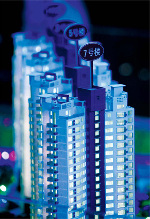
Miniatures of housing projects on display in Nanjing, Jiangsu province, at a trade fair. Real estate markets in Chinese second-tier cities such as Nanjing are now growing faster than large cities, presenting investors bigger opportunities. [CFP]
Wuhan, Chongqing and Chengdu aren't exactly names that roll off the tongue for foreign investors in China's real estate.
But these cities may offer more bang for the buck than their more famous coastal cousins or the capital city of Beijing.
Helped partly by the government's "Go West" policy and their less export-focused economies, Chinese cities in the country's interior have posted higher per-capita income growth than Shanghai, Beijing, Guangzhou and Shenzhen in the past year.
Along the coast, the port city of Tianjin is fast becoming the business center for northern China as authorities move to revitalize what was once the country's industrial heartland.
Dalian and Shenyang are other northern cities growing rapidly.
Michael Klibaner, head of research at Jones Lang LaSalle in Shanghai, said burgeoning growth in these second-tier cities will push up local demand for real estate and raise the capital value of commercial and residential properties.
| ?
|
|
Miniatures of housing projects on display in Nanjing, Jiangsu province, at a trade fair. Real estate markets in Chinese second-tier cities such as Nanjing are now growing faster than large cities, presenting investors bigger opportunities. [CFP] |
"From a property perspective, these cities derive more demand from domestic companies than many Tier 1 and coastal cities," Klibaner said.
Chinese developers
Nicole Wong, head of Hong Kong and China property research at CLSA, said the best way to tap the faster growth in second-tier and third-tier cities will be to buy shares of major Chinese developers that have expanded there, such as China Vanke and China Overseas Land.
"You'll have the best players mirroring the difference in growth rates by changing their geographical exposure to have a stronger presence in second-tier cities," she said.
China's 600-plus cities are divided into six different categories.
The top tier comprises the more developed metropolises of Beijing, Shanghai, Guangzhou and Shenzhen.
A second tier of around 15 large cities comprises the independent municipalities of Tianjin and Chongqing and many of the provincial capitals.
Tier 1 cities now account for about 32 percent of Vanke's projects in terms of gross floor area, down from 40 percent in 2002.
For China Overseas, the ratio has dropped to about 33 percent from 71 percent.
Jones Lang LaSalle estimated that Tier 1 cities accounted for about 27 percent of commercial real estate activity in China in 2007, down from 37 percent a decade earlier.
The percentage could fall to below 10 percent by 2010 as smaller cities develop.
"The construction sectors in first-tier cities have become somewhat mature, with housing starts in Beijing and Shanghai consistently falling since 2004," the Australian securities firm, Macquarie Securities, stated in a recent report.
Infrastructure
China has been busy building roads, rail and other infrastructure in its interior and north since 2000 to narrow the income gap between cities along its southeastern seaboard and the rest of the country.
That process has quickened in recent months after the launch of China's near $600 billion economic stimulus package last year.
Chinese cities such as Tianjin, Chongqing and Wuhan last year reported economic growth in the mid-teens compared with the 9 percent-plus expansions in Beijing and Shanghai.
Property prices in China's inland cities are also a lot cheaper, offering upside potential as these regions narrow the gap with cities along the coast.
A typical apartment in Chongqing costs 3,757 yuan per sq m compared with 5,048 yuan in Wuhan and 11,271 yuan in Beijing, according to Nomura estimates.
Tier 1 investments
Even as China's major developers move aggressively into Tier 2 cities amid a recovery in the housing market, many overseas investors remain wary of going beyond the familiar and have not ventured beyond Tier 1 cities.
The reasons cited include unfamiliarity with cities in the interior. In addition, price falls have made property in the primary cities more attractive.
"Before the financial tsunami, it was difficult for Western funds or even developers to buy land in the primary cities at reasonable cost... Projects in the primary cities are now coming back on the market," said Wilfred Wong, executive chairman for China at Pacific Star, a Singapore real estate investor.
"If you're a foreign investor, it's always easier to exit projects in primary cities because of the more liquid markets, he said, adding that another benefit was the transparency of management and government administration.
But while the risks are higher, there's no denying the greater opportunities offered by the faster-growing cities of western and northeastern China.
Some overseas firms are jumping on the bandwagon.
The focus on China, including its smaller cities, has yielded rich rewards for Singapore's CapitaLand, Southeast Asia's biggest developer.
CapitaLand's China operations accounted for 45 percent of total earnings last year versus 24 percent in 2004.
Lim Beng Chee, CEO of CapitaLand's retail arm, said the firm's strategy was to build suburban malls in Tier 1, Tier 2 and Tier 3 cities to tap China's rapid urbanization and fast-growing middle class.
CapitaLand Retail, which has projects ranging from Harbin in the north to Dongguan in the south, expects to open seven Chinese malls this year and another 20 in the coming years, bringing its total to 58.