|
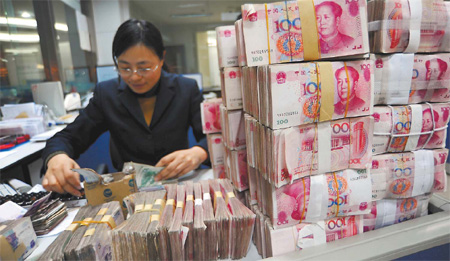
A bank worker counts piles of renminbi. A combination of stimulus measures by the central government helped the Chinese economy through the worst of the global slowdown, but tough times could still lie ahead. [China Daily] |
|
A bank worker counts piles of renminbi. A combination of stimulus measures by the central government helped the Chinese economy through the worst of the global slowdown, but tough times could still lie ahead. [China Daily] |
When he invested in a new apartment in Beijing last May, Zhang Xiaoliang had no expectations of making a quick profit. But little more than six months on, the value of his new home has soared 40 percent.
"I made the right choice," said the 30-year-old manager of an electric appliance sales company in Beijing. "If I had not bought when I did, I would not be able to afford it now."
Like thousands of young people in the capital and other major Chinese cities, the rapid V-shaped upturn in house prices came as a surprise.
Investment in the sector accounted for about a quarter of China's fixed-asset investment last year, which in turn made up about 90 percent of its economic growth; shaking off the pessimistic fears of early 2009 when the economy hit a trough.
Thanks to the central government's forceful measures, a fiscal stimulus equal to 13 percent of gross domestic product (GDP) and $1.2 trillion in credit were pumped into the economy.
The government lowered sales taxes on small cars and imposed appliance subsidies worth billions of yuan; moves that saw China become the world's largest auto market and sparked a rise in household consumption respectively.
During the first three quarters of 2009, retail sales added 4 percentage points to GDP growth, contributing to more than 40 percent of GDP. Economists expect year-on-year GDP growth will be higher than 8 percent, the goal set by policymakers early last year.
The other major growth driver is State-funded investment spending on infrastructure, which is estimated to have exceeded 900 billion yuan ($130 billion) in 2009. Industrial output, a major indicator for manufacturing, grew by 19.2 percent year-on-year in November, while fixed investment growth slowed to a relatively 32.1 percent, both impressive compared with the level in the pre-recession years.
A slump in exports hit the overall economy, causing a drop of 3.6 percentage points of GDP growth for the first three quarters. However, it has shown solid signs of improvement recently, including in export orders, which are up according to the official purchasing managers' index, a main gauge of economic activities.
The December trade figures, which were released Sunday, with export expanding by an unexpected 17.7 percent year-on-year, further consolidated the country's economic growth uptrend.
As the economy steamed out of the crisis, economists have become upbeat about the country's prospects this year.
"All indicators promise solid growth in the first and second quarters of 2010," said Virendra Singh, director of the Moody's Economy.com, which offers independent financial analysis. "The sharp decline in trade has been stemmed, the rise in urban unemployment has ended, and producers and consumers are feeling more optimistic."
China's economy is marching at a healthy clip. "The fiscal stimulus and loose monetary policy are doing their job," said Singh in a recent report.
While a sound growth is expected this year, uncertainties remain, such as possible serious inflation led by easy credit.
Inflation has been kept low so far, thanks to the crisis, which reduced overall demand. The country's consumer price index (CPI), the major gauge of inflation, lingered in negative territory from January last year until November, when it rose 0.6 percent.
However, the recent snow and icy weather in the north and central regions, which reminded people of the weather-triggered inflation spike in early 2008, has made many ordinary people worry about inflationary prospects.
Most of the economists and government officials are staying relaxed.
Although inflation may continue to rise, the "stable growth, low inflation" scenario may continue well into this year, analysts said.
"Inflation could continue to rise but it will not rise sharply for the whole year," said Zhang Xiaojing, senior economist for the Chinese Academy of Social Sciences. "It takes time for the overall demand - the ultimate cause of inflation - to pick up. It (serious inflation) will not happen in 2010."
Economists have said CPI could rise "very high" in some months this year, possibly in the second half, which would be a cause for concern. However, it is likely to be kept under 4 or even 3 percent for the year. It is widely expected the government will set a goal of 3 percent for CPI growth in 2010.
Ample liquidity has been behind the rising consumer inflation. China has initiated a series of economic stimulus measures since late 2008 and new yuan lending is estimated to have hit 9.5 trillion yuan ($1.4 trillion) by the end of last year, almost double that of 2008.
"There's too much liquidity in the system," said Ardo Hansson, lead economist for the World Bank in China.
But a prompt exit of the stimulus measures could bring another problem - an aborted economic recovery, as the authorities have repeatedly warned against the "unstable basis" for the country's economic recovery.
The stock market slump last Thursday was a result of investors worrying about an interest rate hike, analyst said.
China's central bank is expected to raise the rate by summer, but the unusual rise in the interest rate of the central bank bills last week ruffled investors. They interpreted it as a sign that an interest rate hike is in the pipeline.
Apart from a possible interest rate adjustment, China is expected to reduce new yuan lending by about 20 percent this year to prevent credit bubbles.
The move would make economic growth more sustainable and have no impact on recovery, since it is already a big sum compared with the amount in 2008, analysts said.
China issued a slew of new measures at the end of 2009 to cool down the real estate boom. It has also vowed to earmark more resources for such key sectors as environmental protection and new energy development, as well as those related to domestic demand stimulation.
"China must strike a balance between maintaining investment (as a means to boost growth) and price control. It's in a dilemma," said Zhang.
But from the long-term perspective, China must make a choice, added Chen Gong, chief economist for Anbound Consulting in Beijing.
China's fast urbanization has put increasing pressure on its environment, he said. Although economic growth is not a concern this or the coming years, there are many potential problems, such as environmental degradation, which require a change in the country's development mode.
"Otherwise, available resources won't be able to sustain such growth," he warned.