|
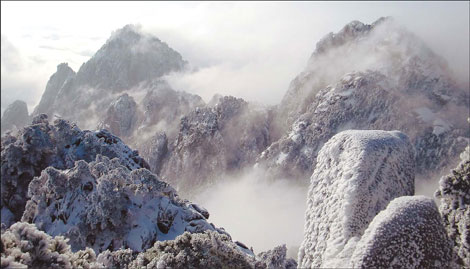
Covered in ice and snow, Huangshan in winter is like a crystal wonderland. Every peak is clothed in white and every rime-covered tree looks like a white coral reef. |
|
Covered in ice and snow, Huangshan in winter is like a crystal wonderland. Every peak is clothed in white and every rime-covered tree looks like a white coral reef. |
The Chinese will have you believe there is no mountain worth visiting after you have seen Huangshan. Ou Shuyi discovers why
The temperature hovered near zero and a thick mist hung in the air. My husband and I were alone, making our way up the twisting trail to the Summit of Brightness, one of the highest peaks of Huangshan Mountain.
My face - and brain - were frozen from the biting cold wind, and as I looked at the endless steps in front of me, I felt a growing desperation.
We decided to visit this World Heritage site during the Spring Festival, hoping for a quiet hideaway far from the ear-splitting fireworks of Beijing, to usher in the Year of the Tiger by scaling the country's most recognizable peak.
But this climb was far more challenging than what we had expected.
We had already trekked for three hours from the cable car station to the summit, which was supposed to take about one and a half hours. Yet, we felt like we were in the middle of nowhere.
Finally, the mist that had swaddled us all morning began to fall away. The clouds that had blanketed the mountains began to part, as if guided by an invisible hand, probably that of the deity believed to be residing in the mountains.
Huangshan slowly revealed itself, in all its glorious splendor. The snow had turned it into a crystal wonderland. Every peak was wearing a coat of purest white; the rime-covered trees looked like pure white coral reefs. In the distance, dozens of finger-like peaks pierced through the boiling mist.
Huangshan, which means "Yellow Mountain", is named after Huangdi, or the Yellow Emperor who is considered the progenitor of the Chinese people. According to legend, he once lived on the mountain in search of enlightenment and immortality.
The mountain is a cluster of 72 peaks, all standing more than 1,000 meters above sea level, in a 152-sq-km area of southern Anhui province. As a Chinese saying goes, "you don't need to see any other mountains after visiting Huangshan".
For centuries, Huangshan has been a source of inspiration for Chinese art and literature. The beauty of the mountain has been immortalized in numerous poems and paintings. More recently, filmmaker James Cameron admitted to drawing on its majesty for his blockbuster Avatar.
The magic of Huangshan lies in the ever-changing mist and clouds shrouding its peaks. As the mist thickens and dissipates, clouds drift in and out, changing the scenery from minute to minute. Even as we admired the "floating mountains" in the distance, the rising mist from the valley gathered around our legs. But we had hardly taken out the camera, when new clouds rolled in and seconds later, we found ourselves covered in mist again.
Climbing became more difficult - visibility was so low that we could hardly see beyond 20 meters.
The trail is strenuous, continually rising and falling, and sometimes twisting around the mountainsides via narrow walkways clinging to sheer cliffsides, with a steep drop. At some points, the trail, squashed between two rock faces is so narrow that only one person can make his way down its steep, slippery steps.
During peak season, in the spring and summer months, the place hums with more than 30,000 people every day. But during winter, between November and March, it is a quiet and tranquil paradise.
We spent hours walking up the mountain alone in splendid isolation. Rarely did we spot any tourists. Occasionally, we met porters carrying loads heavier than their own body weights but walking as swiftly as if they were on a flat road.
Most of their loads were supplies for the hotels on the summits, ranging from sheets and food to furniture. The high cost of accommodation, water and food are due in large part to the challenge of transporting these items up the mountain.
Baiyun Hotel, where we stayed for two nights, is one of the most popular hotels on Huangshan. The room rates in winter are rather high - about 900 yuan ($132) per night.
But we barely gave the prices a second glance. After a marathon-like climb, all we wanted was a warm, clean room to rest our aching legs, a hot shower and a piping hot, delicious meal.
Our exploration of the mountain over the next two days turned out to be quite a pleasant experience, thanks to the unexpectedly sunny weather. Having two sunny days in a row is quite a rarity in Huangshan - up to 250 days a year are either rainy or misty.
Bizarre rock formations, one of the biggest draws in Huangshan, appeared even more dramatic against the clear blue sky. Each of them, sculpted by centuries of wind and rain, looked like a piece of art.
The walkway connecting the three highest and scalable peaks - Summit of Brightness, Lotus Peak and Celestial Peak, all rising over 1,800 meters above sea level - was a visual treat.
We climbed over the "100-Step Ladder on the Clouds", then came to Turtle Peak, where a huge "turtle" stood facing a small "snail" open-mouthed. We also got a clear sight of "Stone Monkey Gazing over a Sea of Clouds" and the Flying Rock, the oft-depicted icon of Huangshan.
Sprouting on these rocks and peaks are the famous Huangshan pine trees, called yingke song or "greeting guest pines", named for their branches that look like a hospitable host welcoming guests with extended arms.
With their twisting branches and flat crowns, these pine trees are deeply rooted in the cracks of the rocks and stand firm on the cliffs or steep slopes, against the gusts and blizzards.
For centuries they have been depicted as a symbol of endurance and perseverance in Chinese culture.
No trip to Huangshan is complete without catching sight of the sunrise on the mountain. We were up at 5 one morning, waiting for more than an hour on the freezing summit. We were not lucky - it was too cloudy to see much.
What a pity! But that just gives us the perfect reason to visit again.
(China Daily 03/18/2010 page19)