Comments
  Print
Print  Mail
Mail  Large Medium Small
 |
|
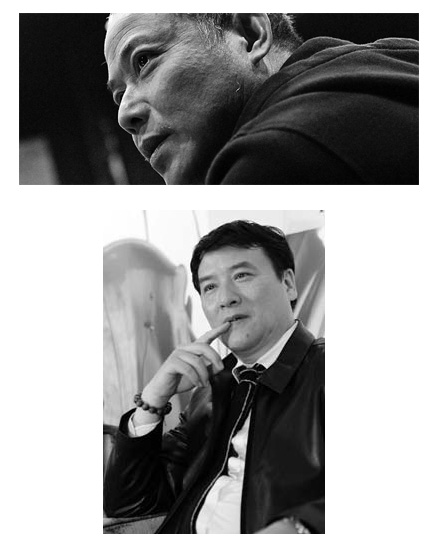
Chinese composer Ye Xiaogang (above) and theater director Li Liuyi (top) jointly present A Feast for Eyes and Ears, dedicated to the 100th anniversary of the death of Mahler. Photos by Jiang Dong / China Daily |
The Beijing Music Festival program A Feast for Eyes and Ears features Mahler's The Song of the Earth and Ye Xiaogang's work of the same title. Mu Qian reports.
A Feast for Eyes and Ears involves a cultural dialogue transcending time and space, between Tang Dynasty (AD 618-907) poet Li Bai, late-Romantic Austrian composer Gustav Mahler (1860-1911), contemporary Chinese composer Ye Xiaogang, and Chinese theater director Li Liuyi. Playing on Sunday at the Poly Theater, it is a project of the 14th Beijing Music Festival, dedicated to the 100th anniversary of the death of Mahler. Conducted by Yang Yang, China Philharmonic Orchestra will perform Mahler's Das Lied von der Erde (The Song of the Earth) and Ye's work of the same title. At the same time, under the direction of Li, a group of dancers and actors will perform against the backdrop of a video interacting with the performance.
"The performance will try to visualize the abstract images from the musical works, in the hope that we may 'see' music," says Li, who is best known for his collaborations with composer Guo Wenjing on innovative Peking Operas and a ballet adaptation of The Peony Pavilion with the National Ballet of China.
Nine performers, including ballet, contemporary and traditional Chinese dancers, as well as Peking Opera actors, will take the stage of The Song of the Earth, alongside vocalists Yuan Chenye, Xu Xiaoying, Warren Mok and Liao Changyong.
An actor, at times an alienated outsider and then a more involved character in the performance, will recite Tang Dynasty poems in both Chinese and English.
It was in 1908 that Mahler conceived The Song of the Earth, after being inspired by a compilation of translated Tang Dynasty poetry by German poet Hans Bethge.
At the time, Mahler had just resigned the artistic directorship of the Vienna Court Opera, and was suffering from his eldest daughter's death and his own congenital heart defect.
The collection of Chinese poems, depicting various stages in life, resonated with Mahler's increasing awareness of mortality, and he chose seven of them to be lyrics for The Song of the Earth, which he termed "a symphony for tenor and alto (or baritone) voice and orchestra".
Mahler's use of pentatonic scales in the third movement Of Youth (Von der Jugend) is an example of musical "Chinoiserie" - a recurring theme in European artistic styles that reflect Chinese artistic influences.
The text of The Song of the Earth was not a strict translation of Chinese poems, but Bethge's own rendition. Thanks to the research of Chinese scholars, the original Chinese poems that Mahler used have been identified: Li Bai's Tale of Sorrowful Song, Banquet at Tao Family's Pavilion, Song of Lotus Picking and Feeling upon Awakening from Drunkenness on a Spring Day, Qian Qi's Imitation of Old Poem: Long Autumn Night, Meng Haoran's Staying at Teacher's Mountain Retreat,Awating a Friend in Vain, and Wang Wei's Farewell.
Mahler's wife Alma wrote in her memoir that The Song of the Earth expressed Mahler's sadness and fear. The composer did not live to see the first performance of the work, half a year after his death.
Because of its use of Chinese poetry, The Song of the Earth has been a popular work among Chinese orchestras and music lovers. China Philharmonic Orchestra has performed the work three times, in 2002, 2003 and 2008.
The work also inspired Chinese composer Ye to write a work of the same title, which was completed in 2009, 98 years after the premiere of Mahler's work. Ye based his work on the same poems that Mahler used, but changed the order.
"My work is not to challenge Mahler's, but is an interpretation of the Chinese poetry from our own cultural background," Ye says. "While Mahler's work is full of disillusion and agnosticism, my work is more of a liberated attitude toward life, like that of Li Bai."
Ye's work adopts the stylistic recitation of traditional Chinese operas for the poems.
Because the original Chinese poems are so succinct they only comprise a few lines or even a few words, while the German counterparts used by Mahler are wordy and lengthy. Ye's work is only about half of the duration of Mahler's.
For stage director Li Liuyi, Mahler's and Ye's works can be compared to Western oil paintings and Chinese ink paintings, whose visual contrast will be presented in the performance.
The nine dancers and actors represent different segments of the composers' and poets' minds. The content of the original poems will be represented in the performance, but not in a direct way; rather the dancers and actors will try to perform the spiritual core of the poems, Li says.
A Mahler fan for many years, Li is especially fond of the sense of uncertainty and theatrical tension in Mahler's works.
"In directing this performance, I have put in my feelings about not only Mahler's The Song of the Earth but also his other works," he says. "As for Ye, I did not really discuss with him his ideas for the composition, but will base the part on my own understanding of his work, which is my way of showing respect to the artist."
Li says he hopes the result of combining music with theater will be more than one plus one equaling two. There will be something beyond the two music works, like the conflict of different cultures when Peking Opera meets contemporary ballet.
A video will be projected onto a screen and run throughout the performance, with materials including original shots, historical films, and distorted images created by a computer program.
"I have an empty platform to display my understandings of Mahler - a composer in the past, and Ye - my contemporary. This is a dialogue between the players, composers, and me," Li says. "In this journey of artistic expression, we shall praise nature and sing along with the Earth."


Copyright 1995 - . All rights reserved. The content (including but not limited to text, photo, multimedia information, etc) published in this site belongs to China Daily Information Co (CDIC). Without written authorization from CDIC, such content shall not be republished or used in any form. Note: Browsers with 1024*768 or higher resolution are suggested for this site.
License for publishing multimedia online 0108263 Registration Number: 20100000002731