Comments
  Print
Print  Mail
Mail  Large Medium Small
 |
|
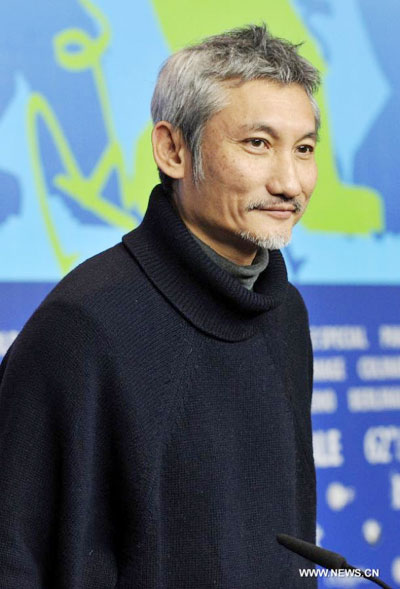
Director Tsui Hark attends the press conference of his movie Flying Swords of Dragon Gate at the 62nd Berlinale film festival in Berlin, capital of Germany, on Feb 17, 2012.[Photo/Xinhua] |
At the end of 2011, wuxia movie 'Flying Swords of Dragon Gate' was hailed as 'the first IMAX 3D wuxia movie', and hit the big screens all over China. Equipped with 3D technology, Hong Kong director Xu Ke (Tsui Hark) returns to the 'wuxia' genre that he helped redefine. 'Wuxia' is a popular Chinese cinema and literature genre that contains themes of martial arts and chivalry. And, once again, Xu's wuxia movies are the talk of the town.
Xu Ke was born and raised in a large Chinese immigrant family in Saigon Vietnam in 1951. He showed an early interest in cinematography. At the age of 13, he used an 8mm camera to make videos. In 1984, he and his wife Shi Nansheng formed a production company. Xu earned international fame with films such as 'A Better Tomorrow', 'A Chinese Ghost Story', 'Once Upon a Time in China', and consequently created a new age in cinematography. Around the end of the 70s and early 80s, Xu Ke, and other iconoclastic directors such as Xu Anhua (Ann Hui) and Tan Jiaming made waves in the Hong Kong movie scene, lifting the movie industry from a dangerous low. As a consequence, the media dubbed them members of the 'New Wave'.
Prior to the New Wave directors, Hong Kong directors usually learned their craft from the studios. Whereas the directors of the New Wave brought a breath of fresh air to the industry. Sha Dan, researcher at the Chinese Film Library says, "Xu Ke belongs to the generation of New Wave directors in Hong Kong cinema. They are a generation of intellectuals, as most have studied abroad. Xu Ke obtained a degree in film production at the University of Texas at Austin. When they returned from abroad, they did not enter the movie studios, but the TV stations."
Xu Ke got his feet wet in the industry with popular TV dramas like 'Love' and 'Hate of the Golden Blade'. In 1979, he made his movie debut with 'The Butterfly Murders', a film chockfull of suspense and fantasy. It laid the bedrock for Xu Ke's future films.
Because of the involvement of this new generation of intellectuals, many innovations were made in various aspects of these New Wave films. The cream of the crop was probably Xu Ke, who reinvented the Chinese wuxia movie genre. Movie critic, Li Xiaofei says, "his movies made breakthroughs in cinematography. Most of the previous wuxia movies were shot in studios, but his were often shot outdoors. His movies contained many modern concepts, especially because he was an intellectual who received his education in the West. So, his movies could be said to be using Western methods to express oriental culture."
Researchers believe Xu Ke represents a technological high point in Chinese cinematography. He used then modern special effects to create a series of wuxia Chinese movies. The 1983 'Zu Warriors from the Magic Mountain' is often considered one of the highest achievements in the world of special effects prior to computer generated effects. Many of this film's special effects still look advanced today. In 'Flying Swords of Dragon Gate' that came out at the end of last year, Xu Ke pioneered the idea of shooting Chinese wuxia, this time, in 3D.
This pursuit for better technology helps Xu Ke's visions to be better translated onto the big screen. Although his 2000 movie "A Legend of Zu" did not do well at the box office, his imagination in the work still astounds audiences. Movie critic Li Xiaofei says, "both his vision of the world and his imagination are unfettered. His imagination is ahead our time, ahead of the ordinary folks. Ten years from now, we may be able to reach his heights technology-wise, but may fail to catch up with his imagination."
Xu Ke's love for Chinese culture is visible in every aspect of his wuxia films. The poems cited in Xu's wuxia films leave a profound impression in the minds of Xu's wuxia movie fans. Many of these romantic words are written by Xu himself. Film researcher Sha Dan says, "despite the fact that he was under western influence when he was young, and often mesmerized by technology, he never neglected the importance of Chinese ancient culture."
Xu Ke's innovation in wuxia movies is seen in his scripts. Some of his movies are derived from literature, but when they appear up on the big screen, a strong Xu Ke style is evident in the movies. The series 'The Swordsman' is an adaptation of novels by Louis Cha and Jin Yong's wuxia novels. However Xu Ke veers off the original storyline and reinvents the entire story. Sha Dan believes this kind of adaptation is the perfect example of his style.
"He rewrites the concept of 'jiang hu' (the ambience of the wuxia setting) and the world of wuxia. This is where his individuality lies and why he is nicknamed the 'elderly weirdo Xu'," said Sha.
Xu Ke, the leading figure of Hong Kong's New Wave movies in the 1980s, pioneered a new wuxia genre in the 1990s. Fast-pace editing, ever-changing style, consistently amazing special effects, a one-of-a-kind imagination and a mixture of cultures makes Xu Ke and his wuxia movies cinematic legends.


Copyright 1995 - . All rights reserved. The content (including but not limited to text, photo, multimedia information, etc) published in this site belongs to China Daily Information Co (CDIC). Without written authorization from CDIC, such content shall not be republished or used in any form. Note: Browsers with 1024*768 or higher resolution are suggested for this site.
License for publishing multimedia online 0108263 Registration Number: 20100000002731