Comments
  Print
Print  Mail
Mail  Large Medium Small
After working with Hollywood companies at a basic level for many years, it is only a matter of time before Chinese capital takes a share in the major six Hollywood studios. Liu Wei reports in Shanghai.
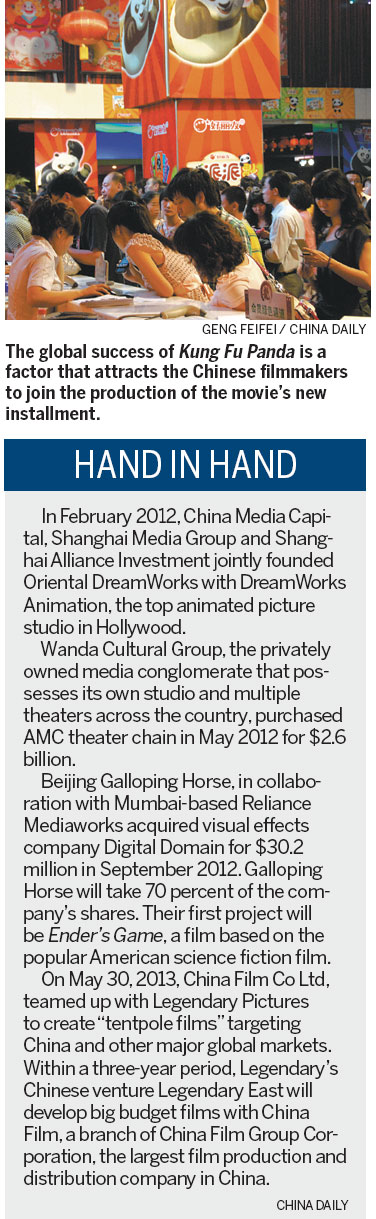
The next Kung Fu Panda will be the brainchild of both American and Chinese filmmakers and production will start in August, says Peter Li, managing director of China Media Capital, co-investor of Oriental DreamWorks, a joint venture with DreamWorks Animation. CMC co-founded Oriental DreamWorks in 2012 with DreamWorks, Shanghai Media Group and Shanghai Alliance Investment, with the aim of producing and distributing animated and live-action content for Chinese and global markets.
The Chinese team contributes not only investment to Kung Fu Panda 3, but also the script, by collecting material about the Chinese elements to be featured in the new installment of the global hit, scheduled for release in 2015, says Li on the sidelines of the ongoing Shanghai International Film Festival, which runs from June 15 to 23.
Chinese staff will also take part in production and learn from the world's top animators in process management and story telling.
"To learn from Hollywood animation artists by working together with them is the only way for Chinese animators to grow stronger," Li says.
CMC is not the only Chinese film industry player to partner Hollywood and it is a growing trend.
"China's film market grows so fast that the annual box office revenue will reach 20 billion yuan ($3.3 billion) this year and 30 billion yuan in two or three years, which will be about half of the box office of the United States," says Wang Ran, CEO of China eCapital Corporation.
"The gap between the Chinese and US film markets is being narrowed down. In two or three years more Chinese companies will be able to acquire second-tier Hollywood companies."
Ben Ji, managing director of Reach Glory Media Group, says so far acquisitions of Hollywood companies by Chinese are at the lower end of the industry chain, such as post-production companies or theaters.
Ji calls the trend a "Long March", referring to the 1934-36 trek by the Chinese Red Army over snowy mountains and marshes.
"It is a long way to go," he says, "but I believe as the Chinese film market keeps growing so fast, it is totally possible that Chinese capital will hold shares in the major six Hollywood studios. It is just a matter of time."
China's Wanda Cultural Group is one of the pioneers in this process. In 2012 Wanda acquired AMC, the second largest theater chain in North America, for $2.6 billion.
What Ye Ning, the group's vice-president, has learned from the following integration is, first of all, trust and respect.
"The managing team of AMC was worried that we would send a group of yellow faces to replace them," Ye says, "but we studied their resumes and found most of them had worked for the company for more than 10 years and know well how to run theaters, so we kept most of them in their positions."
Wanda's logo, he says, was not added before AMC in any of its theaters.
What should not be imposed on a purchased Hollywood facility are different values, in the opinion of Sid Ganis, former president of Sony Pictures. Ganis held various positions at Sony Pictures, including vice chairman of Columbia Pictures, after the Japanese company bought it in 1989. "It is more about integration, not conquering Hollywood," he comments on the Beijing's entry to Hollywood.
One of the reasons that Columbia Pictures retained its momentum after being purchased by Sony is that the parent company seldom imposed its values on film projects. Ganis says there was just one such case that he recalls.
"We were making a comedy about judo, and they asked, very nicely, 'don't make fun of our culture'. It was not an order, but a request," Ganis says.
"If Akio Morita (co-founder of Sony) tried to impose Japanese values on a US institution, he would soon find what he bought were just empty soundstages."
Therefore, ambitious Chinese companies that try telling Chinese stories and delivering Chinese culture in their work with their Hollywood partners should be patient and savvy.
CMC is working with DreamWorks and China Film Group to adapt The Tibet Code, a popular novel that has sold over 10 million copies in China. It tells of the treasure-hunting journey of an expert on Tibetan mastiffs.
Peter Li of CMC says the film will have Chinese and English versions, though the story content is the same. "US audiences are not used to reading subtitles, and most global hits are in English. We have to admit it," he says.
At the 2013 Fortune Forum in Chengdu that ended in early June, Jeffery Katzenberg, CEO of DreamWorks, referred to the film as China's Indiana Jones and The Da Vinci Code. Li could not agree more.
"It is a totally Chinese story, but we tell it in the Hollywood way, which has proven successful across the world. And in making this film together, we learn the way."


Copyright 1995 - . All rights reserved. The content (including but not limited to text, photo, multimedia information, etc) published in this site belongs to China Daily Information Co (CDIC). Without written authorization from CDIC, such content shall not be republished or used in any form. Note: Browsers with 1024*768 or higher resolution are suggested for this site.
License for publishing multimedia online 0108263 Registration Number: 20100000002731