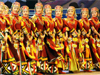
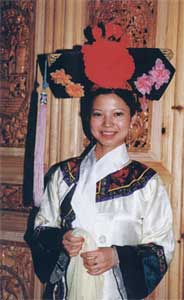
| The Manchus mainly reside in Heilongjiang, Jilin, and Liaoning provinces. The Manchus have their own language and letters. They are adept at dancing and singing. Many of the ancient dances were from hunting and fighting.
Spring Festival
Nowadays, festivals of the Manchu people are similar to those of the Hans, but customs and traditions between the two are different. The Manchu Spring Festival has its special features. As the Spring Festival approaches, every family will tidy up the house and courtyard. They will make their traditional snack -- Saqima, which, by local practice, is made of refined flour, eggs, sugar, sesame, fruits and melon seeds. It looks nice and tastes delicious.
On the eve, people will paste Spring Couplets, paper cuts, and portraits of Door Go, etc, and wear pouches. The lantern poles are erected in the courtyard of each household to hang up lanterns and light up the night.
On the eve of the Spring Festival, people will make dumplings. The edge of the dumpling should be made pleated instead of flat, which might make the dumplings look like a monk's head. Dumplings should not be arranged in a circle, a shape representing no way out. The dumpling is cooked between 11 p.m. and l a.m. While cooking, the host has to cry out, You, life! Did you all get up? The others answer: Yes, we did! They regard the floating of the dumplings from the pot bottom as the life prosperity. Afterward, the kids climb up the cabinet and jump three times, symbolizing that the new life will be improved.
On the evening, the junior should kowtow to the senior. Parents will give money to children. The relatives of kindred also pay each other the New Year's call. Friends will feast each other. They recall the past and talk about the future. On the eve, people have to worship the ancestors and receive the gods. While welcoming the gods, a wood bar is to be placed at the door to prevent evils from coming in.
On the eve of the Spring Festival, people eat dumplings. They put a coin in one of the dumplings, and the one that has it will be lucky throughout the year. Boys in crowds set off fireworks and firecrackers and play a mobile chair or cheerily skate; girls and young ladies dress up and play a kind of toy made of the knee joint bones of pigs or cows.
Between 11:00 p.m. on the eve and 1:00 a.m. of the next day (the first day of the first lunar month), every family sets firecrackers to see off the old and welcome the new. In the meantime, they set the offerings in front of the sacrificial tablet of the ancestors besides the west wall, burn joss sticks and kowtow to the forebears and pray to the gods for safety and good luck in the New Year. On the 1stday of the New Year, every family gets up early, put on new clothes and greet each other.
From the 1stto the 5thday, people gather together. They sing and dance, walk on stilt and enjoy themselves as much as they like. In some areas, young men organize performance tour in the villages, adding to the festal atmosphere.
Dragon Boat Festival
Manchus celebrate the Dragon Boat Festival on the fifth day of the fifth lunar month, and refer to it as the May Festival. They celebrate the festival for the purpose of keeping off disasters and pests instead of memorizing Qu Yuan (a scholar in ancient China) as the Hans do. It is said that long ago, the God of the Heaven sent officers to the human world to people's situation. On the fifth day of the fifth month, one officer disguised himself as an old oil peddler and hawked in the street, One kg, one bottle of oil! 1.5 kg, 2 bottles! People scrambled to purchase the oil. There was only one old man who did not buy any and told the disguised peddler that he had made a mistake.
After the peddler sold out the oil, he followed the old man and told him: You are honest. The God of Plague is going to bring about the pestilence to the world. You'd better plant wormwood on the house eaves to avoid the disaster! The old man told other people this remedy and they survived from the disaster.
From then on, the Manchu families planted the wormwood on the eaves of the house; and everyone carried porches containing arsenic sulphide powder, which serves as disinfectant. They will go to the outskirts. They wash up their face and hands with dew, and drink brook water to keep off eye disease. It is said that to wash face, head and eyes with the dew on the very day can keep off sore, eye disease and abdominal pain. To take cooked eggs on the morning will prevent one from becoming emaciated due to less eating in summer.
Bala Festival
The Bala Festival is a common traditional festival of the Manchus. The Bala Festival is also termed as the Laba Festival. It is said that Sakyamuni achieved his religious cultivation on the 8thday of the twelfth lunar month. The ceremony of the scripture chanting is to be held in the Buddhist temples. People used fresh paddy and fruits to cook porridge, called Laba Porridge, to fete Buddha. After Nurhaci set up the capital in Hetuala, he ordered to construct many temples, where people could chant scriptures and offer porridge on the 8thday of the 12thlunar month.
Taking advantage of this opportunity, people gradually formed the custom of celebrating the festival. Every year when the 8thday of the twelfth lunar month draws near, the Manchus make the Laba porridge with eight sorts of the cereals, such as glutinous sorghum and beans, to offer to Buddha and the ancestors first, then friends and relatives, and at last themselves. In countryside, the Manchus have the custom to worship the fruit trees with Laba porridge, i.e. to cut an opening at the fruit tree's root, put some porridge in it in hope of the bumper fruits.
Panjin Festival
In recent years, Manchus in various regions of China mostly celebrated the Panjin festival on the 13thday the tenth lunar month, known as the Naming Day of Manchu, to memorize the birth of the Manchu ethnic minority.
The majority of the Manchus were derived from the Nuzhen minority, and they absorbed some other minorities to form a new community. Therefore, they renewed the name containing the formation of a new community. The date of the renewal also stands for the birth of the Manchus. |