|
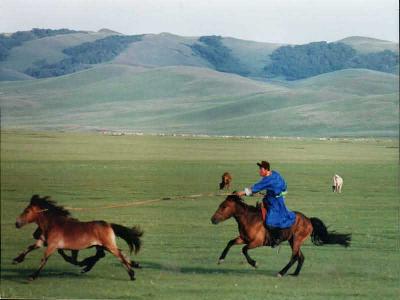
The Mongolians mostly reside in the Inner Mongolia Autonomous Region of China. The Mongolians call themselves Mongols, which means the everlasting fire. The Mongolian ethnic minority is also called as the ethnic minority on horseback. The Mongolians have their own language and letters. Off Year Festival
The Off Year Festival of the Mongolians takes place on the 23rdof the twelfth month of the lunar year, when people worship fire, and pray to the Fire God for happiness and wealth.
On the festival day, all family members will put on new clothes, and worship the Fire God with the mutton bones, kha-btags, incenses and dairy food. All family members eat barbecued mutton, drink alcohol and regale nightlong together. They keep feasting to worship the Fire God for seven days.
Spring Festival
From the last day of every year to the early days of the first month of the new year of the Chinese lunar calendar, the Mongolians celebrate the Spring Festival to send off the former year and greet the new one, and to pray for safety and happiness. Prior to the festival, every family will make new clothes and prepare the foodstuff and wine.
On the eve, people will firstly set off the need fire and throw the food on the fire to worship the spirit of the ancestors, then, drive away ghosts and prevent themselves from the evil. All family members have the dinner to send off the former year. To follow, the domestic entertainments come. On the early morning of the first day of the New Year, people will follow the custom to pay the New Year call on their friends and relatives.
On the eve, people will paste red paper on the windows, and set the need fires outside, and set off the firecrackers, for the Mongolians believe that the red color can ensure safety.
Nadam Fair
The word Nadam means the entertainment of games in Mongolian language. The Mongolians regard Nadam as a great festival. It is held in each August, when the livestock is fat and strong. This is in fact a large entertainment gathering to celebrate the harvest.
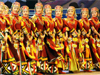
There are folk-style dances and singing performed in the Nadam. The Mongolians are good at dancing and singing. The Fuxin Mongolian Autonomous County is reputed as the Land of Folk Songs. There are more than one hundred singers, who are both singers and composers. The programs of the entertainment include Haolaibao, comic dialogue, antistrophic singing, and performances by horse-head lute, Yataghan Dance and Wine Cup Dance, etc.
On the fair, men and women, old or young, are dressed up, and go to participate or watch by car or on horse. The entertainments include horserace, wrestling, arrow shooting, dancing and singing. The Mongolians in Liaoning Province commonly dress in Han costumes, i.e. uniforms or civvies. In the event of the Nadam or other festivals, they put on the Mongolian long gowns. They prefer costumes in red, yellow and blue to those in other colors. Five-color ribbons are inlaid on the shoulder and the front of gown; the red and green silk bands on the waist. They wear boots and usually have a sword with scabbard, snuffbox and sickle on the waist.
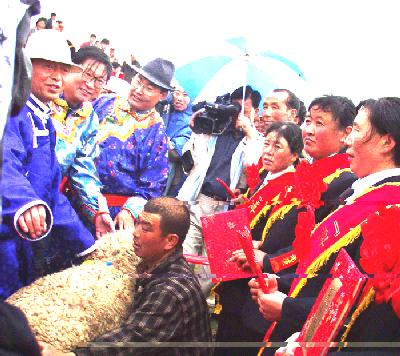
The Nadam is at the same time a fair of agricultural and livestock goods. Besides the industry and farming sideline products, there is also other local special goods such as beef and mutton, fumed food, cheese, dried cheese, cream, milk curd and yoghourt. The ghee tea and Baked Full Mutton is also supplied on the tea booths and restaurants. In weekdays, the staple foods of the Mongolians in Liaoning Province are composed of cereals and vegetables. The Nadam provides the only chance to taste the Mongolian traditional rich dishes.
Aobao Gathering
The Aobao Gathering takes place between May and June of each year to worship heroes and celebrate a bumper harvest.
When the festival approaches, the flowers are booming on the pasture and the weather is rather fine. People put on gorgeous costumes and take them with abundant dairy foods to worship Aobao and listen to the scripture chanting; then, the ceremony of the colt fastening and horse milking will be held, followed by horse racing. During the Aobao Gathering, people drink tea from the same kettle, and eat meat from the same pot. They drink as much as they like while they sing and dance.
The festival lasts three days.
Luban Festival
It takes place on April 2 of each lunar calendar year to memorize and celebrate the architectural achievements. It is a traditional festival celebrated by the Mongolians in the west of Tonghai County of Yunnan Province. It lasts just one day. The Mongolians in this region have learned the architectural techniques from other minorities. The houses they have built are not only special and beautiful, but also durable, and are praised by the peoples of other minorities in the neighborhood.
On the festival, the masons, carpenters and square men undertaking the construction outside will hurry back home to celebrate the festival. Every village will slay pigs and sheep, and set up a stage to play drama. People carry the sandalwood statue of Lu Ban, a great carpenter in ancient China, beat gongs and drums, and stage pageants in other villages. Afterwards, they gather on a piece of ground to sing and dance together.
At the beginning, young men serve as the leading dancers, they carry four-string instruments decorated with a dragon head. People that follow are divided into lines, and sometimes stand in a circle and sometimes interlude. The scene is very spectacular. |