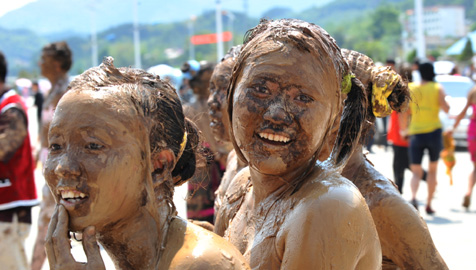
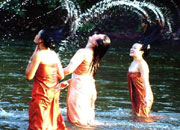
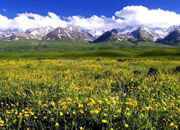
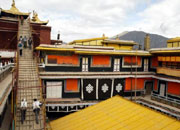
| The Drungs mostly reside in the Drung River valley along Gongshan Mountain in Yunnan Province. The local people mainly live on agriculture, hunting and collecting. They wear self-made flax; a few cover their body with leaves and animal furs. Women uphold the custom of face tattoo.
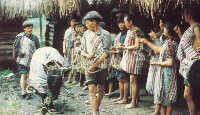
The word Kaquewa is a transliteration of the Drung language, which means, to gather the clan people for the worship, or the New Year Festival. This is the only traditional festival of the Drungs. In the past, the date of celebration is in December of the lunar calendar. It lasts three days. Each family is free to choose a fine day to hold the celebration.
The ceremony of the Drungs' festival is somewhat similar, and the programs of the festival are arranged in an apple-pie order. The Drungs, whose productivity lags far behind, never forget to worship the Mountain God in case of a happy event. They offer offerings such as various animal figures made of buckwheat to pray the god for more games in the next year. In the year of abundant foodstuff and clothing, they will double their efforts to slaughter cows for the god worship, for in their minds it is only with the god blessing that the Drungs can have a better life.
In their primitive faith, the Drungs comply all the time with the teachings of the ancestor. It is said that since human beings became friends with the god, it introduced animals to help people with the cultivation. When the falling leaves announced the autumn' approach, the seeds planted by human, god and animals brought about a bumper harvest. The human and god became the couple who lived to old age in conjugal bliss. On their wedding, the guests were animals and birds. The host and invitees enjoyed the feast to their heart's content. The couple got the enlightenment from the dance of animals and birds, so they became good at singing and dancing. At the meantime, the date of the wedding of human-god marriage was appointed to be that of their happy event, which was, following the customs by generations, and have evolved to today's Kaquewa Festival.
Once the date of the festival is confirmed, the host will notify the friends and relatives by invitations. The so-called invitations are made of carved wood, knot or oral messages. The number of jags and knots represents how many days it will take to celebrate the festival. The notified family will prepare gifts and take part in the festival's entertainments.
On the early morning of the first day of the festival, women hang their well-woven flax fabric on the bamboo pole and plant it on the cleaned slope of the roof to show the beginning of the celebration. They invite their friends and relatives home, drinking wine, tasting delicious food and greeting each other. Men throw the wood bowl over the suspended rice cooker. If the upside of the bowl faces the air, it foresees good luck. They will hold the celebration late in the night.
In the morrow, all villagers gather together on a large lawn of the village to hold the grandest ceremony, which includes the arrow shooting and stabbing cattle contests. In the ceremony of arrow shooting, a symbol of the animal god in the shape of cylinder is made of cooked wheaten food, with other wheaten animal figures setting around the animal god. The worship master presides over the ritual. After the sacrifice, the master will throw them over to people, and the archers will shoot them freely. The Drungs believe that what they have hit means what they will get while hunting. With a great din of gongs and drums, people dance and sing in a circle.
During the festival, what is the most spectacular is the Cattle Sacrifice to Worship the Heaven. Only the villages with the good conditions carry out this activity. The cattle are offered in pair. Sometimes, one family supplies it, and sometimes it is purchased with collective money. When the ceremony of the cattle stabbing begins, all villagers assemble to grassland with food and beverage.
The clan head or ritual master who preside over the ceremony leads the cattle to the center of the ground and ties it to a post. Then, a woman hangs a string of pearls on the horn and puts a Drung-style carpet over the cattle's back. When the offering is well set, the ritual master lights the pine torch and pine tags. He kowtows facing the east and mumbles, Mountain God, we offer you this year the cattle and pray you for blessing us with abundant quarries, a bumper harvest and a safe life. When the recitation is finished, he takes away the carpet and pearls. Two brave hunters, holding a long bamboo lance and dancing, move to the center of the ground. People toast the cattle. They stand in a circle, beating gongs and drums, singing while performing the Cattle Stabbing Dance. Two hunters pierce the lance into cattle oxter and hold it until the cattle lie down. People cheer for their warriors. Afterward, people cook the beef, one portion for each participant. People dance and sing to pray for a merry festival and safety for the coming year. The Kaquewa Festival is the beginning with a lucky and festal atmosphere.
Now, the Drungs also celebrate the Spring Festival, besides their traditional Kaquewa Festival. |