Newsmaker
Luobu Sida: a leading Thang-ga painter and a committed teacher
By Sun Yuqing (chinadaily.com.cn)
Updated: 2009-09-21 14:29
Lhasa: “Of course, I worry about the future of Thang-ga, but I will try my best to protect and preserve the traditional techniques. I already feel happy if one of my ten students can inherit the painting skills,” Luobu Sida, a leading Tang-ga painter and teacher in Tibet, told China Daily during an exclusive interview on September 11, 2009.
|
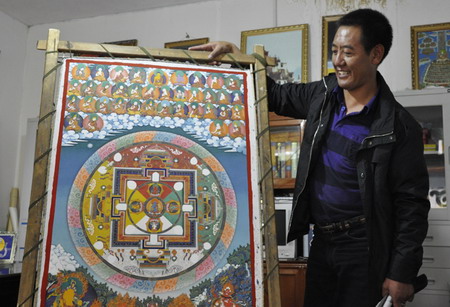 Luobu Sida displays a finished Thang-ga in Luobu Sida's Thang-ga school in Lhasa, Tibet, September 11, 2009. [Chinadaily.com.cn/ Uking Sun]  |
Thang-ga is scroll painting usually mounted on colorful satins and fabrics. Developed in the 7th century, this unique style of painting is made by folk handicraftsmen and holds a sacred place in Tibetans' hearts. Thang-ga is found in palaces, temples, and folk houses. In terms of content, Thang-ga features all aspects of Tibetan people's lives, such as religion, history, culture, art, science and technology.
The Thang-ga painting has several schools, and Luobu Sida’s family has a history of making Mian’sa style Thang-ga for four generations. At the age of 10, Luobu started to learn from his grandfather and later learned from other leading painters, including Gaqin Luosang Pingcuo. From 1989, he was invited to participate in a number of construction and renovation projects, such as paintings for the coffin tower of the 10thPanchan Lama, and paintings for Drepung Monastery, one of the "great three" Gelukpa monasteries of Tibet.
A pride to work in Potala Palace
Since 2005, Luobu Sida started to copy the murals in the hall where the mandala of the Wheel of Time is placed in thePotalaPalace. Mandalas are pictorial representations of the Buddhist universe, and this mandala contains 200,000 pearls, coral, turquoise and gold thread, making it one of the most beautiful works of Buddhist art.
In the hall, there are a total of 40 square meters of valuable paintings covering the walls, which were made during the 18thcentury and vividly depict the Buddhist stories. Some parts of the paintings have cracks or broken materials due to a long history and natural erosion. The paintings are first divided into parts according to scenarios. Then one part after another, Luobu copies the paintings on Tang-ga of the same size to keep alive those treasures and prepare for future protection.
For the authenticity and integrity, Luobu has to use the magnifier to recognize the smallest details and then carefully draws one stroke after another. In some cases, he had to refer to historical Buddhist documents to recreate lost traces and capture exquisite movements and impressions found in the original paintings.
At the beginning, Luobu worked everyday here and quickly found his body couldn’t endure the labor. “To focus on thehairlike strokes for hours and then hold my breath to draw on the Tang-ga is painful for my neck and shoulder,” Luobu said. Later he changed to work three days a week, on Monday, Wednesday and Friday. Five years have passed, and Luobu expects that he will finish the copying inPotalaPalacein 2010, a job which fills him with pride.
To open school and teach the traditional techniques
Luobu spends the rest of his time teaching students of Tang-ga in his home-like school. The idea of opening a Tang-ga school originated in 2001 when he realized that the traditional method, passing usually from the parents to the children, was not enough to keep alive this cultural heritage during the expansion of commercialism. The market inLhasais overwhelmed with machine-made Tang-ga exported fromNepaland other regions, even though those products use chemical materials and may lose color after several years, Luobu said. He worries that with large-scale manufacturing the cultural and religions practices have been seriously weakened.
The school, a two story building, was rented from the monastery on the Chakpori Hill, which is on the right side of thePotalaPalace. Although Luobu has to pay around 4,500 yuan per month for the rent, his courses have been free and open to anyone interested. There’s also a room specifically for students to cook for themselves.
By 2009 Luobu had educated around 100 students. Sixty of those can independently master all procedures, from pigments preparation, to sketching, coloring, application of god powder, and mounting.
“It’s a very hard process. People usually need six to seven years to learn all the procedures, and you also need to spend hours in the room, so some students quit in the middle,” Luobu said.
Most of the students are coming from rural areas inTibetand some are slightly disabled. Luobu hopes students not only can learn the traditional techniques of making Tang-ga but also hopes they can make a living from the work.
“Graduates can either leave to have their own studios, or they can work for me and get a salary. They are free.” Luobu said.
It seems to be a good learning opportunity, but Luobu also admits that society is changing rapidly and young people can find an easier job and make more money rather than sitting for hours and days drawing the lines, patterns and motifs of Tang-ga. For a master like Luobu, he once spent over a year to complete a painting of 3 meters long and 1.7 meters wide. “Everything is handmade and it is a big challenge for my patience,” Luobu said.
Tibetans enjoy the tradition of drinking barley wine, but Luobu is the few who has chosen to abstain from drinking at all for fear of damaging his mind. He explained, “You have to keep your hand stable, hold your breath, release your strength smoothly and evenly, so the drawing can be perfect. The drinking may affect the nerves.”
The teaching and renovation job in thePotalaPalacehas taken a lot of his time. “I certainly can make more money if I focus on the orders of Thang-ga from all over the world, but what I want most is to keep this traditional art alive and enable more people to learn this. I don’t work for money,” Luobu said. He also said his plan for the future is to open a large school and recruit more students.
(A Wang from the Office of Intangible Cultural Heritage, Tibet Cultural Burea has contributed to this report.)