Newsmaker
First woman leader of Taoist clerical orthodoxy
By Erik Nilsson and Guo Rui (China Daily)
Updated: 2009-12-14 08:40
 |
Large Medium Small |
The vigor of Wu Chengzhen's faith has made her an exception to nearly two millennia of Taoist clerical orthodoxy.
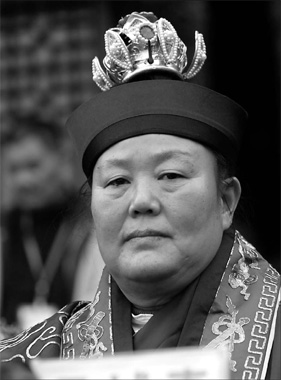 Wu Chengzhen is the first principal abbess (Fang Zhang) of a Taoist temple in the religion's history. [Photos by Sun Xinming] |
"I think the ordination of a woman to such a high rank is a sign of the times," she says.
"It won't change anything about my daily life, but inside, I feel happy and grateful and a little ashamed, because I should do more."
The abbess wraps her crossed legs in a peach-colored blanket as she sits on the bed of her dorm room in Renmin University of China in Beijing, where she's now studying. A brown sweater peaks out from beneath her dark blue robe and her bun pokes out of the center of a cylindrical Taoist cap.
Periodically, her eyelids droop and she retreats into da zuo (Taoist mediation) mid-conversation. Moments later, she snaps back from her trances, speaking lucidly and seeming to have heard everything said while in her daze.
Wu relates her new station to the ancient myth of the Eight Immortals, a tale revered by Taoists. One of the deities, He Xiangu (Lotus Immortal), was a woman.
"Taoism strengthens equality among all people," Wu says. "It's also more egalitarian toward women than other major religions."
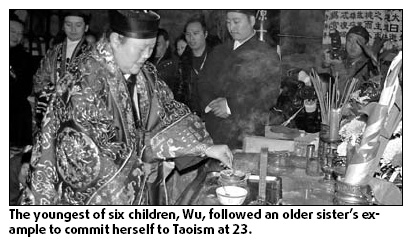
Wu comes from a devout family and is the youngest of six children, named Wu Yuanzhen before she was given her religious name. During her middle school years, she immersed herself in the home libraries of her Christian, Buddhist and Taoist relatives.
Her father was profoundly influenced by Confucian ethics, especially familial piety. When his mother fell ill at age 56, he hacked a chunk out of his humorous (the upper arm bone) with a knife for her to eat. He hoped such a grand gesture would move the gods to heal the woman.
Wu says it worked. Her grandmother immediately recovered and lived to the age of 87. The event is recorded in the Wu Family Genealogy kept by the government of Xinzhou, a county in Wuhan.
Wu followed an elder sister's example to commit herself to Taoism at age 23.
In an interview with the Wuhan-based Changjiang Times, Wu said she began her life at the Changchun Guan (guan refers to a Taoist temple), cooking, washing and planting vegetables.
She recalls that her master once told her to check if the water in a kettle had boiled. When she lifted the lid to look inside, the steam almost burned her face.
"My masters often scolded me: If I couldn't do anything, why did I leave the secular life?"
But she proved to be a persistent disciple - the only one of eight who remained after a year of training.
"Taoism focuses on optimism, cherishes life and deals directly with reality," she says.
But Wu accepts the supernatural in her conception of the corporeal. She claims to have seen dragons in Jilin province's Longtan Temple. She says the creatures swam in circles in the river while she and 25 believers stood on the banks communicating with the gods in June 2001.
"It wasn't one dragon, one time or one day. It was three dragons, three times and three days it's true; you can ask the local people."
She describes the legendary rulers of water as being several dozen meters long with white bellies. Upon their arrival, the waters stilled and the skies became sunny, she says.
"There are many things we don't know much about, but we can't say they don't exist," she says.
Wu claims to have also seen Taoist gods flying toward her clad in radiant attire. "I always feel L Dongbin (one of the Eight Immortals) by my side," she says.
"If the pantheon chooses me, I will persevere in cultivating myself to also become an immortal."
Wu says she saw the deities during da zuo, which she does for several hours a day.
Between prayers and meditation, she attends to her daily work for the temple. This includes cultural tasks, such as preaching and advocating Taoism - she has some 10,000 disciples from all walks of life - and "hard construction" tasks, such as building Taoist teahouses and restaurants in the temple, and planning a hospital and a museum in the coming decade.
"I want to create a place where people can feel Taoist culture in everything - the food, the buildings, the music, the medicine, the teahouses and the tai chi," she says.
"There's so much to do; it will require tens of millions of yuan."