Voyager 1 has left solar system: NASA


LOS ANGELES - Voyager 1 has crossed a new frontier, becoming the first spacecraft ever to leave the solar system, NASA said Thursday.
Thirty-six years after it was launched from Earth on a tour of the outer planets, the plutonium-powered probe is more than 11 1/2 billion miles (18.51 billion kilometers) from the sun, cruising through interstellar space _ the vast, cold emptiness between the stars, the space agency said.
 |
|
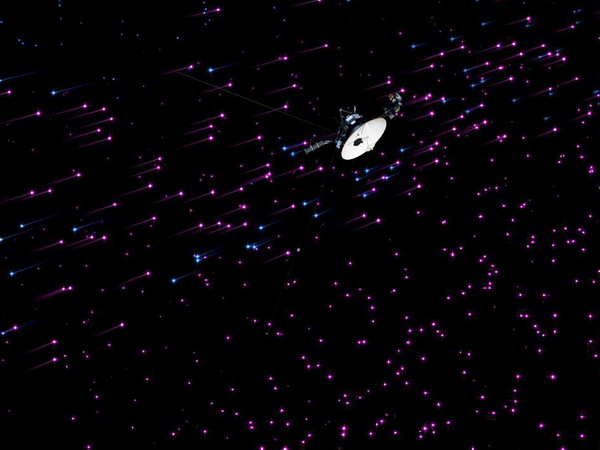
This artist's concept shows NASA's Voyager 1 spacecraft exploring a new region in the solar system called the "magnetic highway" in this handout provided by NASA. [Photo/Agencies] |
Voyager 1 actually made its exit more than a year ago, according to NASA. But it's not as if there's a dotted boundary line or a signpost out there, and it was not until recently that scientists with the space agency had enough evidence to say that the probe had finally plowed through the hot plasma bubble surrounding the planets and escaped the sun's influence.
While some scientists remain unconvinced, NASA celebrated with a news conference featuring the theme from "Star Trek."
"We got there," said mission chief scientist Ed Stone of the California Institute of Technology, adding that the spacecraft was "setting sail in the cosmic seas between the stars."
While Voyager 1 may have left the solar system as most people understand it, it still has hundreds, perhaps thousands, of years to go before bidding adieu to the last icy bodies that make up our neighborhood.
Voyager 1 will now study exotic particles and other phenomena in a never-before-explored part of the universe littered with ancient star explosions and radio the data back to Earth, where the Voyager team awaits the starship's discoveries.
The interstellar ambassador also carries a gold-plated disc containing multicultural greetings, songs and photos, just in case it bumps into an intelligent species.
Voyager 1's odyssey began in 1977 when the spacecraft and its twin, Voyager 2, were launched on a tour of the gas giant planets of the solar system. After beaming back dazzling postcard views of Jupiter's giant red spot and Saturn's shimmering rings, Voyager 2 hopscotched to Uranus and Neptune. Meanwhile, Voyager 1 used Saturn as a gravitational slingshot to power itself past Pluto.
Voyager 1, which is about the size of a subcompact car, carries instruments that study magnetic fields, cosmic rays and solar wind.
Last year, scientists monitoring Voyager 1 noticed strange happenings that suggested the spacecraft had broken through: Charged particles streaming from the sun suddenly vanished. At the same time, there was a spike in galactic cosmic rays bursting in from the outside.
Since there was no detectable change in the direction of the magnetic field lines, the team assumed the far-flung craft was still in the heliosphere, or the vast bubble of charged particles around the sun.
The Voyager team patiently waited for a change in magnetic field direction _ thought to be the telltale sign of a cosmic border crossing. But in the meantime, a chance solar eruption caused the space around Voyager 1 to echo like a bell last spring and provided the scientists with the data they needed, convincing them the boundary had been crossed in August of last year.
With the new data, "it took us 10 seconds to realize we were in interstellar space," said Don Gurnett, a Voyager scientist at the University of Iowa who led the new research, published online in the journal Science.
The new observations are fascinating, but "it's premature to judge," said Lennard Fisk, a space science professor at the University of Michigan and former NASA associate administrator who was not part of the team. "Can we wait a little while longer? Maybe this picture will clear up the farther we go."
Fisk was bothered by the absence of a change in magnetic field direction.
Harvard astrophysicist Jonathan McDowell said he would like to see more data and Voyager 1 "solidly outside for a while."
Voyager 2 trails behind at 9 1/2 billion miles (15.29 billion kilometers) from the sun. It may take another three years before Voyager 2 joins its twin on the other side. Eventually, the Voyagers will run out of nuclear fuel and will have to power down their instruments, perhaps by 2025.