Collections at Taipei Palace Museum
Updated: 2007-06-18 10:26
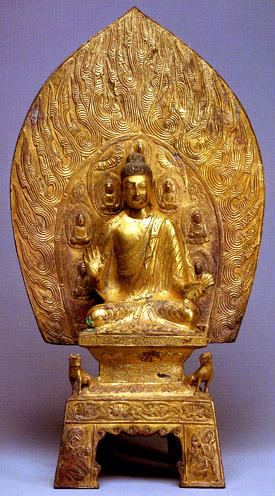
Upon the Yuan Dynasty conquering the Song, the victor took the royal collections and shipped those items from the Song's capital, Lin'an (present-day Hangzhou) to its own capital, Dadu (present-day Beijing). Shortly after the perdition of the Yuan, Ming general Xu Da transported all the precious art works collected in Yuan's palace to Ming's capital, Nanjing. Later, Ming Emperor Yongle relocated the capital to Beijing, taking along the palace collections. When the Qing Dynasty prevailed over the Ming, that most recent victor commandeered the col-lections. During the reign of Qing Emperor Qianlong, realizing that the emperor was fond of artifact collections, officials and ministers competed to cater to his pleasure by contributing widely and carefully selected articles, thus the royal collection expanded to an unprecedented scale.
After the successful 1911 Revolution, the then government of the Republic of China (1911-1949) devoted three front halls of the Forbidden City to the Ministry of Domestic Affairs for the exhibition of antiques and artifacts collected in the Forbidden City, as well as collections from the Palace Museum in Shenyang, capital of Liaoning Province, and from the Mountain Resort in Chengde, Hebei Province. In November 1924, after Pu Yi, the last emperor, was evicted from the Forbidden City, the government of the Republic of China established a commission for dealing with the imperial collections of the Qing. On October 10, 1925, on the site of the Forbidden City, the Palace Museum was officially established.
In 1931, Japanese aggressors launched the "September 18 Incident" in Shenyang and occupied the entire northeast region of China, threatening Beijing and its peripheral areas. To protect the national treasures from the invaders, the government of the Republic of China moved to relocate the important cultural relics in Beijing's Palace Museum to Shanghai and Nanjing. In 1933, against the smoke and fire of war, the migration of the artifacts began. Thanks to secret and strict organization, the cultural relics were safely transported from Beijing to Shanghai and Nanjing, and later to Sichuan and Guizhou. And not one item was damaged or lost. The transportation took more than 10 years, and countless people devoted their effort to the grand and risky task. In 1945, after victory in the War of Resistance against Japanese Aggression, the treasures were transported back to Nanjing.
At the end of 1948, with the People's Liberation Army (PLA) victorious in the Liberation War, during the retreat from Nanjing to Taiwan some of these artifacts were shipped in three batches by the Kuomintang government. In 1965, the Taipei Palace Museum was constructed, offering a permanent place for housing and exhibiting the national treasures.
 | 1 | 2 | 3 |  |