Guge, A Lost Kingdom In Tibet
Updated: 2007-08-02 08:40
Religious strife leading to demise
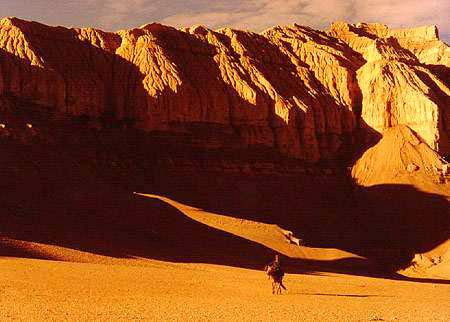
Facing such a huge wealth of artistic relics, people never stopped wondering how such a powerful state came to its demise almost overnight. What happened to her? Was it a sudden accident, or an inevitable event?
Some believe the Guge had something in common with the Maya in ancient Mexico and Guatemala and Pompeii in ancient Italy, all highly developed civilizations that inexplicably fell.
While religious enthusiasm prompted the birth and growth of Guge, religious strife brought it down. Conflict between the last Guge king and the upper-class monks, headed by the king's brother, arose and became hot when the latter grew powerful. It was said that Buddhist followers could be seen everywhere in Guge at that time. The last Guge king was worried that his kingship would be threatened if the monks grew more powerful. The idea came to him that Buddhism must be degraded.
So when, in 1624, P. Antonio de Andrade, a Portuguese missionary, reached Zhaburang, capital of the Guge, via northern India, the king took advantage of the opportunity and tried to establish Catholicism as a new religious weapon against the Buddhist monks. A church was built, and the king himself converted. He took the offensive, forcing lots of monks to be secularized and even exiled. There was a devastating insurgence from the monks. The neighboring rival state Ldakah saw an opportunity and collaborated with the monks to overthrow the rule of the Guge king. It turned out to be a long and bloody war.
The fortifications of Guge were carefully designed and distributed. Besides tactically located forts and walls, there was a network of secret underground tunnels that had been of great help in resisting previous invasions.
A story was passed down from generation to generation
that tells how Guge was defeated by the allied forces of rebellious monks and
Ldakah invaders. At the beginning of the war, the invaders captured some Guge
citizens. But because the was so heavily fortified and kept the attackers from
moving up to the top of the Guge castle where the royal family lived, the Ldakah
invaders came up with an idea. They drove the captured Guge people to the front
of the war, and had them build a huge, stone wall from the foot of the hill to
the top. They could move upward under the protection of the wall, and those
working on the wall would serve as a human shield. The Guge king was confronted
with a dilemma: if he ordered an attack, his people would be killed. If not, the
wall would reach the hilltop and the royal family would be captured, indicating
the fall of the kingdom.
 | 1 | 2 | 3 | 4 | 5 |  |