Touches of Finland


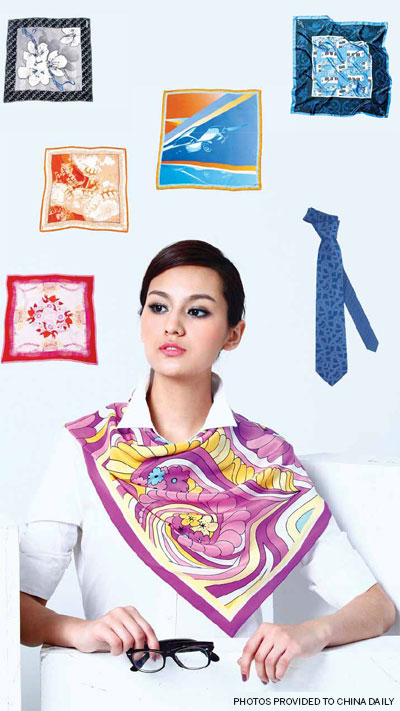

Designs from Northern Europe changed the way the Chinese look at scarves and ties, Gan Tian reports.
Caroline Xue believes a man's taste in clothes can be seen from his tie - and a woman's, from her scarf.
She introduced Marja Kurki, a Finnish fashion label specializing in silk ties and scarves, to China in 1994 and her 18 years in the business tell her that Chinese men and women are becoming more fashionable.
Marja Kurki started her own label in Finland in 1976. Her simple color combinations and designs in scarves, soon became the rage in Europe.
|
Related:? |
In 1992, Kurki was invited to China for a seminar to introduce her designs and marketing to Chinese professionals. In the airplane, she met Xue and Xue told her she had never seen people wearing a scarf like a hair band.
"During that time, Chinese women did not like scarves, especially in the north," Xue recalls.
"Because in the north, women wore scarves to protect themselves from sandstorms. Scarves are associated with something unpleasant," she says.
So, when she first introduced this label to China's big cities, Xue had to evangelize on the stylish uses of the scarf telling everyone that it was a fun fashion accessory, not foul-weather gear.
Nearly two decades later, it's easier to get the message across.
At a lecture Xue presented last month, her apprentices entered the classroom with different types of scarves in every direction. Some were worn on the waist, some were tied on bags as decoration, and some were butterflies on ponytails.
Initially, Marja Kurki's scarves didn't sell too well in the Chinese market. Xue went to stores in the shopping malls and canvassed the sales staff. The response: "Marja Kurki's designs were too European."
"At first, I didn't quite understand what was 'too European'. I took a look around, and suddenly found out the answer - simplicity," Xue says.
Simplicity is the core spirit of European design, and Marja Kurki's products are no exception. But throughout the 1990s and even at the beginning of last decade, most Chinese people were not interested in the "plain gray and blue" that was so popular in the designer's homeland.
In China, shoppers wanted color and floral patterns.
The design team in Finland took this information and went to work. Soon there was a made-for-China series of scarves ablaze with bright yellow, red and pink, and floral patterns.
"The Chinese like 'decorative fashion'. In a dress, the laces and the butterfly knot are already there, but Europeans like to play with it. They like to create their own fashion," Xue observes.
Color evolved in the men's line, too.
When Marja Kurki brought in its ties, big menswear labels like Dunhill and Zegna did not study this market, she says.
From 1994 to the early 2000, in Xue's memory, ties were blue - "all kinds of blues, dark blue, navy blue and dark blue is always the bestseller," she says.
But during the last five years, more young people have entered the management level, she says. They have broken with convention, wearing pink, yellow and violet ties.
There are still some differences. In the last season, Marja Kurki produced a series of green ties, reflecting environmental protection and an eco-friendly lifestyle.
That was a hit in Finland, but Xue predicted that this series would not be popular in China, as green is associated with illicit love affairs in this country.
Shapes have changed, too. In the past, Chinese men preferred thick wide ties, but nowadays, thin ties are more acceptable.
The changing lifestyle of Chinese men can be tracked in Marja Kurki tie-sales figures. They climbed very quickly from 1994 - as China's economy took off - and reached a peak in 2000. After that, tie sales stagnated.
At first, Xue says, people embraced the businesslike-look ties delivered. Ties reflected a certain prosperity, which helped the label's sales. However, after 2000, the global lifestyle became much casual, even in business world.
"Casual Fridays have been promoted since the middle of the last decade, which means ties are not necessary. And look at us now, it is 'casual everyday'," Xue says.