Sesame-crusted moons


 |
|
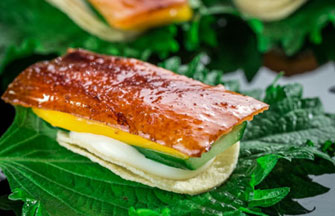
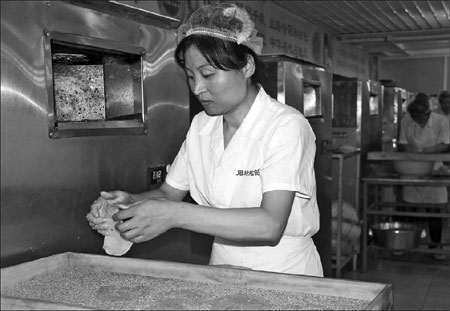
Thin flat breads are rolled in sesame and baked to a crisp fragrant wafer. Zhoucun shaobing is now one of Shandong’s most popular souvenirs. Photos by Ju Chuanjiang / China Daily |
 |
|
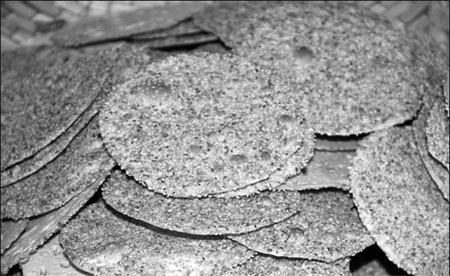
Fragile moons that are richly crusted with sesame, Zhoucun shaobing uses a fusion of Chinese and western baking techniques fi ne-tuned by a dedicated baker. |
It may no longer be the center of commerce it used to be, but Zhoucun in Shandong has a lasting legacy from its glory days. Wang Qian discovers the origins of shaobing.
Thousands of years ago, Zhoucun was a buoyant commercial hub in Shandong. It buzzed with merchants from many countries, and some of them brought along recipes of their favorite snacks.
One of them is the shaobing, or roasted bread. It is a thin round wafer crusted with sesame and so fragile that it shatters into shards if you don't handle it with care.
The old art of making shaobing can be traced back to hubing, a type of thick baked bread from the Han Dynasty (206 BCAD 220).
Its name reflected its origins, as "hu" was a term used to describe Westerners. Traders who came in through the Silk Route from Western Asia introduced hubing into China.
This kind of hand-made bread soon became a best seller among the merchants in Zhoucun and many local chefs learned to make this.
Among the bakeries were Juhezhai.
"The original shaobing is about 2-cm thick and tastes no different from the common baked bread. People used to buy it as staple. It was my grandfather who improved its flavor," Guo Fanglin, the 77-year-old current owner of Juhezhai says with pride.
Inspired by a thin pancake popular locally, his grand-father Guo Yunlong, rolled out the dough as thin as possible to improve its texture and made it much crispier.
He stacked them in 10s and wrapped them in paper. The thin flatbreads became the city's most popular snack, and was chosen as a tribute to the Imperial court.
"The recipe and cooking methods are passed down from generation to generation and I only started to learn it from my father in my teens," he says.
Shaobing was a luxury item only the rich could afford to eat often in the past.
For the common folks, it was served on festive occasions, such as weddings and birthdays, for its traditional connotations of reunion and well being.
The turning point came in 1958 when Guo joined the state-owned Zhoucun Shaobing Company with his family recipe and techniques and taught workers how to make the breads.
In 1961 the factory patented the shaobing method and now has the exclusive right to call its products "Zhoucun Shaobing" after the district.
There are strict rules for selecting ingredients and cooking.
Wheat and sesame must be grown locally. The sesame must be stir-fried and toasted a golden-brown.
The pastry chef puts a ball of well-kneaded dough onto a porcelain sheet, and rolls it out into a thin pancake, which is then covered with sesame and then baked on a stovetop.
"It only takes me several seconds to roll out the pancake. Usually I am able to make about 3,000 pieces a day," says Xue Guiyun, 40, who has worked in the factory for 15 years.
The traditional craft of making shaobing in Zhoucun was listed as a National Intangible Cultural Heritage in 2008, the only one of its kind in Shandong province.
Currently, there are more than 400 skilled craftsmen producing a total of over 1,000 tons of shaobing each year. Apart from the sesame, shaobing also come in flavors ranging from the traditional sweet and salty, to spicy, creamy, seafood and vegetable flavors.
If you visit Zhoucun, you can also see the snack-themed museum where the history of the time-honored brand and the traditional way of making shaobing are documented.
The museum has become a hot tourist spot which attracts visitors from all over the world.
You can contact the writer at wangqian@chinadaily.com.cn.