Food fest


 |
|
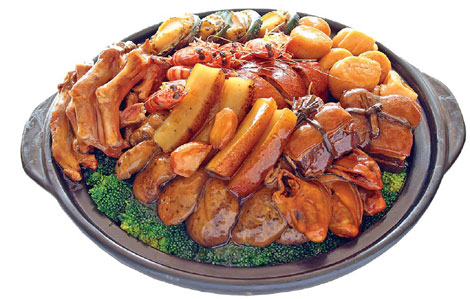
The poon choi served at Summer Palace restaurant in Beijing. Provided to China Daily |
 |
|
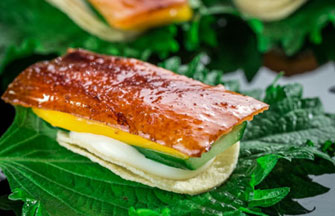
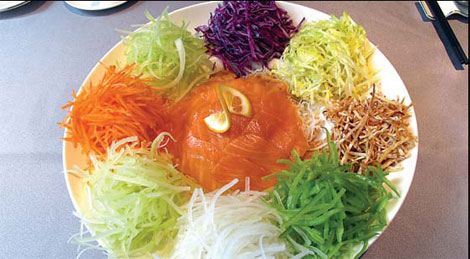
A plate of raw salmon with Chinese salad served at Purple Bodhi. Ye Jun / China Daily |
Eating is a big part of the Spring Festival, along with plenty of rest and wishes for a prosperous year ahead. Ye Jun reports.
Weeks before Spring Festival, the 53-year-old Beijinger Han Ping has already started buying goods to prepare for the family meals. "I'll steam some bread, prepare chicken, fish and jujube cakes," she says. "After that I'll stew some pork, marinate beef and boil a pot of starch noodles with bean curd, and deep-fry some bean curd puffs."
Han was an administrative clerk with Chongwen district government in Beijing, before she was invited to talk about food on TV. Now, she often teaches young people how to cook on both TV and her blog. As a senior housewife, she knows a lot about the capital city's festival food customs.
"In the old days, Chinese families would not cook in the first month of the lunar calendar," she says. "That was in order to have a rest after a year of hard work. Therefore, they had to prepare the month's food in advance."
In the past, businesses would close until the fifth day of the first month of the Chinese lunar calendar. The first day is called powu ("opening the fifth") and families rested until at least the 15th day of the first lunar month.
For Spring Festival Eve, Beijingers, like most people in North China, will eat jiaozi, or boiled dumplings. Han also makes deep-fried flour crackers, and cuts some ready-made bean curd products, to boil with cabbage and bean sprouts.
A thorough house cleaning is a must. But old Beijingers have many more rules to observe during important festival.
"After a year of being thrifty, the family will not turn the lights off on Spring Festival Eve," Han says. "The fire on the stove is kept on. The water jars are filled. There must be more than enough flour or stuffing to wrap jiaozi."
Han says today, the cooking of Chinese families is healthier. For example, pork is often stewed with bamboo sprouts. Bread is steamed not just with flour, but also with mashed corn.
Hou Xinqing, executive chef of Huaiyang cuisine at Summer Palace Chinese restaurant, says the big dish for the festival at his restaurant will be poon choi, or big bowl feast, originating from Hong Kong's village cuisine.
Summer Palace offers both Huaiyang cuisine and Cantonese food. Hou says poon choi has both a Huaiyang version, in which there are fish balls and meatballs, and a Cantonese version, which contains abalone and other seafood.
A formal version of poon choi is a hodgepodge of sea cucumber, abalone, winter bamboo sprouts, winter mushrooms, pork foot tendon, deep-fried pork skin, and egg skin jiaozi with shrimp stuffing, starch noodles and cabbage. The ingredients are boiled in a mixture of pork bones and chicken soup for a long time in a clay pot.
Busy working at his restaurant for the festival, Hou will not be able to return home until the seventh or eighth of the first lunar month. When he gets back to his home in Yangzhou in Jiangsu province, he says he will make some small fries in the local style for his family.
"Yangzhou's traditional festival food is brown-braised round pork foot," he says. "I'll also sautee some watercress, bean sprouts, small shrimps, and boil some pork ribs with winter turnips, in addition to making a soup with an old hen."
The owner of Purple Bodhi - known as Mrs Yang in entertainment circles - says the restaurant offers Taiwan, Cantonese, Huaiyang and Singaporean foods. Like all Chinese people, Yang says cooks give auspicious names to festival dishes.
"Spring roll is called 'big gold bar', egg skin jiaozi is called yuanbao, silver ingot, and fried bean sprouts are called ruyicai, 'grant one's wish' dish," she says.
For the festival, Yang recommends raw salmon with Chinese salad, a traditional specialty from Guangdong The Chinese name is feng sheng shui qi, which literally means "rising water and wind".
"As customers eat the salmon salad, we pray for good fate and fortune for the country, for businesses, and for ourselves."