Guardian of kitchen arts
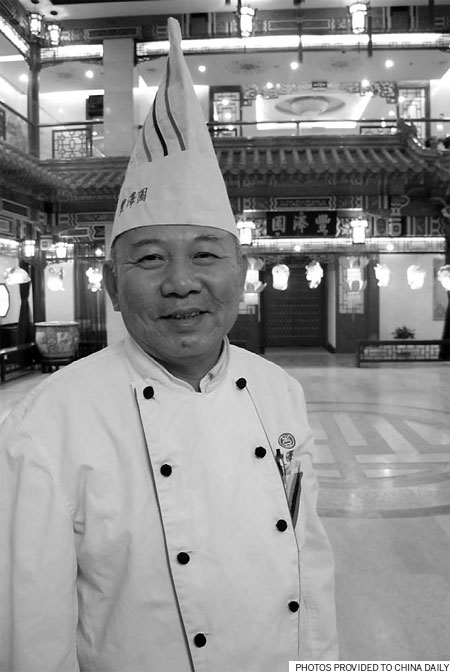
He is old school, a chef who started from the bottom rung as the lowliest kitchen apprentice. But look at him now.
He is 60 years old, but chef Yin Zhenjiang remembers exactly when he started to work in a restaurant. It was August 9, 1971 and his master was Wang Yijun, then executive chef of Fengze Yuan, the first Shandong cuisine restaurant set up in Beijing in 1930.
Yin was 19, and he began his apprenticeship lighting the coal fires in the kitchen. His mentor Wang guided him on every detail, from how to make a good mop, to filtering usable lumps of coal from the ashes of the fire.
He went through all the stages of apprenticeship, including plucking the fowls, cleaning the fish to cutting meat and the preparation of vegetables.
It was two years before he was allowed to serve up his first stir-fry, although it would normally take an apprentice three years.
"The Chinese cutting board is divided into a 'red chopping board', and 'a white chopping board'," he says. "The red chopping board refers to hot and cold fried dishes, while the white one refers to pastries such as steamed breads."
Dishes must be prepared and served in rigid order. For example, fried chestnut with cabbage should always go before oil-braised prawn.
"Cold dishes are served first, and hot dishes later. Expensive dishes come out first, and then the ordinary ones.
"Light dishes are made first, and stronger tasting dishes later," he says.
Fengze Yuan was the earliest and most authentic Shandong restaurant of the time, and its patrons included almost every major Chinese leader of the time, besides visiting foreign dignitaries.
In 1974, after working as an intern at two Beijing restaurants and a year in Yantai in Shandong, Yin was ready to sit for tests that would make him a formal chef. One of his judges on that occasion was former deputy Chinese premier Wan Li.
By 1977, Yin was already helping his mentor Wang Yijun manage the kitchen at Fengze Yuan.
Wang is now considered a grand master chef, the best in China.
Yin himself was certified as China's national level cuisine master in 2002.
Fengze Yuan still serves the classic signature dishes of Shandong cuisine. Its most famous must be the braised sea cucumber, for which the restaurant is unbeatable, according to critics.
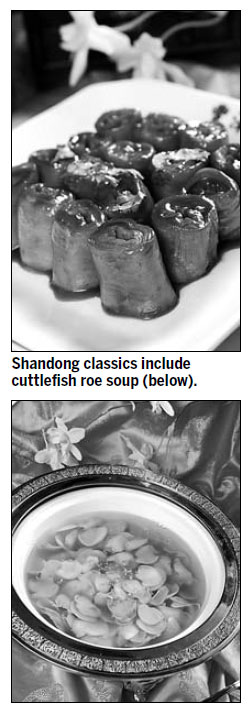
There is also fish in sweet rice wine sauce and the classic cuttlefish roe soup, a standard order in any state banquet.
One characteristic of Shandong cuisine, Yin says, is that vegetable dishes are not bland, while meat dishes are not greasy.
And the secret is in the stockpot, a clear stock and a milky stock made from pork bones and old chicken. The stocks are added to flavor and moisten almost every dish.
Seafood is another specialty, with the preparation lovingly detailed and sometimes elaborate, like the traditional sharks fin and abalone.
In the last 20 years, Yin observes, the culinary industry has developed by leaps and bounds and private enterprises are pushing the boundaries, with major restaurant chains doing well and getting stronger.
The regional boundaries for cuisines are blurring.
Ingredients from other parts of China can arrive in Beijing within three hours and the introduction of Western ingredients has also changed the way chefs cook.
Fengze Yuan's signature braised sea cucumber with shallot used to have only three seasonings - sugar, salt and soy sauce. Now the dish is seasoned with about 10 ingredients.
Besides its two standard stocks, there is now an additional stock, the yellow stock made from chicken, duck and dried scallops.
"The Chinese went through a phase when they only sought to be fed. Now they enjoy an abundance of meats and are in turn looking for a nutritious, healthy and safe dining table," he says.
Cooking methods may need to change if Chinese cuisine is to go global, the chef notes.
Yin believes there will be the merging of many different styles in future, and many heavily flavored and spicy cuisines such as those from Hunan will be moderated to better suit a national palate.
"But the development of any cuisine must be built upon the firm foundation of culinary heritage. If we learn all the skills that the old masters pass down, that will be good enough."