Personal taste


 |
|
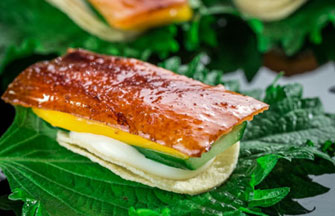
Roujiamo and yangrou paomo (below) served in Reallove Cuisine Restaurant in Beijing. Photos by Ye Jun / China Daily |

The country is catching Ye Jun's passion for Shaanxi cuisine, he reports in Beijing.
Shaanxi cuisine is personal. Well, at least it is for me. At age 19, I went to college in Shaanxi's provincial capital Xi'an. Although the school canteen was terrible, there was one thing I always looked forward to eating - yangrou paomo, (pita bread soaked in lamb soup).
Yangrou paomo provides a chance - requires you, actually - to play with your food.
Enjoying this dish requires you to rip apart two hard pitas made with unfermented flour, which the cook then boils in a massive wok of seething lamb soup.
The broth is so hot that the bread is ready in just a few seconds. It's served in a bowl of soup, topped with lamb slices.
So many years have passed, but I still remember the roaring air blowers above the wok and the long line in front of it.
Just like many other new foods, I didn't like yangrou paomo at first. But the third time was a charm that cast its spell on me, and I became addicted to the concoction that bubbled from that cauldron.
The rest of the canteen food was so bad that students stuck protest posters on the walls.
The dean had to call a meeting with student representatives to negotiate. It seems dramatic, now.
While the mutiny didn't lead to much improvement, one positive result was the introduction of a self-employed vendor who made tasty roujiamo - flour cakes split and stuffed with minced pork.
Eventually, an entire street behind the university began to bustle with food stands and small eateries.
One of my favorites was a street-side cold noodles stand that offered delightful rice and flour Qishan-style noodles.
The slippery noodles are mixed with green bean sprouts and gluten, and feature a mix of sour and spicy typical of the cuisine.
It's an amazing appetizer.

It wasn't until I left the city that I realized how many foods I missed. Oh, how I yearned for Shaanxi's noodles, flour cakes, Halal beef and lamb, and a million other snacks.
I realized I hadn't sufficiently savored my trips to Xi'an's celebrated Muslim food street, Xidajie. I had taken for granted Jia San's juice-filled baozi, Renmin Lu's jiaozi banquet and Lao Sun Jia's hulutou (pigs' large intestines).
So I began scouting Shaanxi restaurants in Beijing. Eventually, I found most of the foods I sought, but few were authentic.
One of my first destinations was the restaurant affiliated with Shaanxi government's Beijing office. The dishes were a tad too refined to be like what I fell in love with in Xi'an - but not as tasty.
Shaanxi food's public image is typically reflected in a scene from Zhang Yimou's film Story of Qiu Ju, in which the husband of Qiu Ju, a stubborn Shaanxi woman, squats on a bench to munch oil-drenched noodles out of a bowl the size of a wok.
Like yangrou paomo, many typical Shaanxi foods are thought of as coarse, rustic fare conveniently prepared for laborers.
Some dishes' names reflect this. Take guokui, or helmet cakes, which are believed to have first been made in ancient soldiers' helmets. Kudai mian, or belt noodles, are broad hand-pulled noodles.
My search for a good Shaanxi restaurant in Beijing continued.
I wound up at Huanghe Shui (Yellow River Water), a typical yet small Shaanxi eatery. Next, I visited Qin Tang Fu and Lan Hua Hua - middle-sized restaurants, offering home-style dishes and Shaanxi snacks.
These visits made me rethink my understanding of Shaanxi cuisine as rustic rural food that comes mostly in snack form but rarely in formal dishes.
That idea totally transformed after dining at Pinwei Chang'an. The restaurant opposite the Australian embassy offers delicately presented Shaanxi dishes. So does the recently opened high-end restaurant Reallove.
The Beijing restaurant is Reallove Cuisine Group's 10th outlet and the first outside Shaanxi. The group's Chang'an Yihao is a popular high-end Shaanxi establishment in Xi'an.
Reallove's executive chef Wu Zumin says the restaurant's founders wanted to provide tourists a place to taste true Shaanxi fare.
"Shaanxi was where 13 Chinese dynasties set up their capitals during a span of more than 1,000 years," Wu says.
"Shaanxi cuisine was then another name for Chinese cuisine. That was long before the eight major Chinese cuisines ever existed."
While traditional snacks are refined and beautifully presented, the restaurant offers some typical dishes. Hulu Ji (gourd chicken) is boiled and deep-fried until tender. The secret is the chicken is a free-range chick that weighs 750 grams.
There are many dishes on the menu you won't see elsewhere.
Reallove has done its homework and went to the library to discover the stories surrounding some historical dishes. It then put these on the menu to provide visitors food for thought.
Chang'an (Xi'an was called Chang'an in ancient times) roast beef is said to have originated from a famous banquet of Emperor Taizong of Tang Dynasty (618-907). Marinated chicken feet, pork skin and bamboo originated from Tang-era's traveling merchants, who worked up mighty appetites trudging the international Silk Road.
A formal dinner at Reallove costs about 300 yuan ($48) - six times more than the average bill at smaller spots like Huanghe Shui.
Wu says it's becoming more difficult to find Shaanxi chefs, because restaurants devoted to the cuisine are proliferating and restaurants of other styles are including more Shaanxi fare on their menus.
Beijing gourmet Dai Aiqun says he wishes Reallove would stick to Shaanxi cuisine and ditch the Cantonese add-ons its menu offers.
He also believes the proliferation of restaurants will help people rediscover Tang-era delicacies like camel hoof.
Dai suggests developing new dishes with traditional flavors.
"For example, they can make sea cucumber with Shaanxi's typical sour and spicy flavor," he says.
If Reallove cuisine restaurant can pull it off, it could do to Shaanxi cuisine what South Beauty did to Sichuan fare - that is, kick its profile and taste up a notch nationwide.
That would be good news for Beijing's gourmands, because they would have quite a few new dishes to try. And it would be good news for me, because I can indulge in more of the classic favorites of my youth.