Spanish maestro with stars on his mind


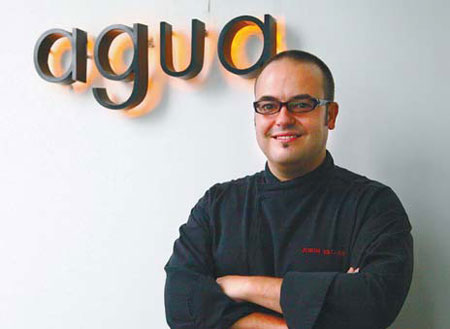 |
| Jordi Valles Claverol, chef at Agua Beijing. Fan Zhen / China Daily |
He has cooked for movie stars. He has worked in a restaurant with three Michelin stars. And now, Chef Jordi Valles Claverol is in Beijing to make Chinese foodies starry-eyed with delight.
Ask him what his secret is and he'll tell you: it's all about finding common ground.
Peking ducks, Sichuan sausages and dim sum? The chef has already found their counterparts in his authentic Spanish recipes.
"Instead of showing the differences, I try to say, 'Hey it's similar to your taste!'"
One of his signature dishes is traditional suckling pig. The Chinese and the Spanish both eat everything, from snout to tail, says the chef.
"The crispy skin, tender meat and those lovely crackling sounds in the mouth, it's just the same as Peking duck."
The hand-made chorizo, by the same token, is like Sichuan sausages translated into Spanish. Everything is made from local ingredients and even the production process is not as alien as you may think.
What makes it exotic is that "you have to put in the paprika, the Spanish spice, to provide the Spanish flavor, instead of Sichuan pepper".
What epitomizes Cantonese food is dim sum culture. When Valles Claverol talks about tapas culture in Spain, East and West meet again.
"In Spain, people like to relax and sit outdoors. Today you bring one potato omelet and tomorrow I'll bring the tomato bread with chorizo. With everything in the middle, it's the moment to talk and to share. It's the same thing with the Chinese," Valles Claverol says.
The tapas come in small portions just like dim sum. Everybody at the table can sample from every plate.
"The general idea is to share. I never change my recipes or dish presentations to adapt to local tastes, otherwise it would not be authentic food. But I find similar things from Spain and from China," says Valles Claverol, beaming. "It's one of the successful parts of this restaurant."
Valles Claverol took the helm of the restaurant in 2008 after working at Barcelona's most celebrated restaurants, the two Michelin-starred Neichel Restaurant and three Michelin-starred El Raco de Can Fabes.
Agua then won awards including Restaurant of the Year 2009, Best Spanish Restaurant, and Chef of the Year from City Weekend, Best European Restaurant in Modern Weekly and Best Western Restaurant in Time Out's Beijing edition.
But things were not easy at the beginning. One of the challenges was to teach his crew how to taste.
Born into a family of restaurateurs, Valles Claverol spent most of his younger years in the kitchen smelling, tasting and built up his memory bank of everything in the kitchen related to the natural world.
When he talks about boiling seafood, he wants it to be like the sea water in Spain. It is much more than a bowl of water with salt in it. It takes precise proportions to get the perfect marriage of the two ingredients.
"But my employees have never been to the sea in Spain. I have to build this for them little by little. Why this is correct, while the other is not. Why this is close to the original recipes in Spain, while that isn't," the chef says.
It took years of effort to get his well-trained team into shape.
"It's tough to motivate your team for four or five years," the chef continues. "But once you get this base, you can believe in them.
"This restaurant is good because of them, not because of me. It's never about the individual. It's the team that makes the work," the chef says, casting a proud glance at his busy crew in the bustling kitchen.
Valles Claverol has already prepared gift hampers for Beijing's gourmets, for the coming Spring Festival. The baskets will be filled with homemade sausages and cheeses.
"Everything is handmade and done with love."
The chef expects to sell about 1,000 hampers this year, five times more than last year.
When asked about the future of Spanish food in China, Valles Claverol smiles. "When I came to China in 2007, there were only two Spanish restaurants. Now there are 17. I think this is the answer."
Eric Jou contributed to the story.
fanzhen@chinadaily.com.cn