Journey off the eaten track in Cape Town


 |
|
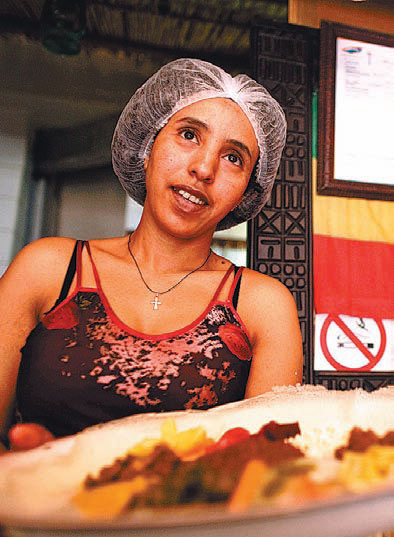
At the Little Ethiopia Restaurant on Shortmarket Street, Yeshi Mekonnen presents a plate of East African delicacies. Pieter Bauermeister / New York Times Syndicate |
Bebe Rose, a Cameroonian who owns Bebe's restaurant in Cape Town, stood with her arms folded and peered down with one brow raised as she scanned the plates of unfinished food spread out before me.
"What's the matter?" she asked. "You don't like my food?"
I did like her food. There were stews of kidney beans and okra, meat and starches. It was true that one item, the tripe, pushed my boundaries. In a shallow bath of a hearty brown sauce of ground nuts and red oil sat part of one of the four chambers of a cow's stomach, the rumen, or omasum, or perhaps the abomasum.
The problem, though, was that this was the last stop on a four-hour eating binge through central Cape Town, and my own sorry single-chamber organ was maxed out.
|
|
|
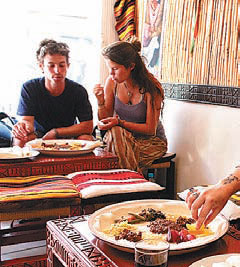
Customers at the Little Ethiopia Restaurant enjoy relaxing and eating. New York Times Syndicate |
Not from sheer gluttony, though. I had found a novel way to explore Cape Town, a city that I had visited several times over the course of 20 years.
A local company called Coffeebeans Routes offered to expose visitors to the city and its subcultures through a tour called the Cape Town Cuisine Route.
Unlike many other culinary excursions, the goal is not to find the finest dining but to use food as an entry to the city's inner life, visiting home kitchens, alley cafes and markets otherwise easy to miss.
Our first stop was the Escape Caffe. The clientele, and the baristas, looked like the South African counterparts to my regular cafe in Philadelphia.
Although Cape Town already had a robust cafe scene before its arrival, few places had decent coffee.
"Coffee beans are from Africa," Letlala says, as we sipped cortados from clear glasses. "And, anyway, coffee is a good palate cleanser before we begin eating. We will have a lot of food."
Having eaten very little before we started, I felt up to the task. We walked up the cobblestone street into the Bo-Kaap, the Cape Malay Quarter, with its view of bright pastel-colored homes running like a perspective painting up the incline of Signal Hill, and came to a spice shop.
The Bo-Kaap, like so much of the area, is in transition. There in the Bo-Kaap, Naima Fakier, a 38-year-old mother of four, talked to us through the aromatic aisles of leaves, bulbs, roots and seeds brought from India, with whom the community still has close ties.
 |
?The difference between Indian and Cape Malay is the heat: Cape Malay is less spicy," Fakier explained as we crossed a street and entered her kitchen, where we tucked into meal No 1. It began with daltjie, or chilli bites, which are like falafel but made with pea powder, spinach and fresh cilantro.
There followed bread and Cape Malay chicken, a bobotie, or Cape Malay curry, with onion, tomato, garlic, ginger paste, cardamom and cinnamon sticks.
Then a dessert of koesisters. The Afrikaner version of this pastry is hard, braided and cooked so that the syrup makes it sticky, while the Cape Malay version is soft fried dough with a simple syrup of tangerine peel, cloves, nutmeg and ginger, finished by a roll in coconut flakes.
I counted on the walk into the city center to give my appetite a second wind by the time we arrived at our next stop, the Little Ethiopia Restaurant on Shortmarket Street, run by Yeshi Mekonnen.
A plate arrived covered by injera, the traditional spongy bread East Africans use to pick up and eat food. We had tibs, or beef with onions, rosemary and fresh chilli. There were lentils with berbere, a mixture of ginger, black cardamom, cloves and other spices.
So much food, and Bebe Rose was waiting.