Nurturing honest food


 |
|
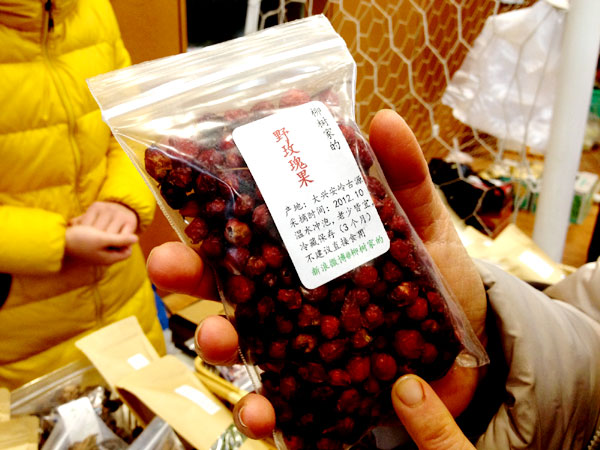
Beijing Country Fair, started in 2010 as an art project, has evolved to become a well-supported weekly market for CSA produce. [Photo by Fan Zhen / China Daily] |
Qi Dafu, one of the main organizers, says the market may actually change its name soon to better reflect the situation.
Despite her confidence that the farmers who join the market each week adhere strictly to organic principles, Qi says small farms simply cannot afford the certification process.
For example, if a farmer enlisted the services of a Nanjing-based national certification center - one of the more authoritative among 23 qualified bodies in the country - yearly certification costs, including application fees, and the investigating officer's travel expenses, board and lodging, would total at least 14,000 yuan for each crop of each produce.
For the small vegetable farmer who needs to plant a variety of produce, certification is almost impossible, while a larger rice producer would have to spend about 40,000 yuan if he wants his two harvests a year certified.
Meanwhile, according to Wu Wenliang, dean of the school of resources and environment sciences at the China Agricultural University, the situation is aggravated by some certification bodies that are willing to compromise standards - for money.
Such unscrupulous organizations have already attracted the attention of the authorities and the government has promised stricter supervision.
Even so, Wu adds, it is still hard for certification to be 100 percent accurate since, on the flip side, there are also dishonest producers who can fake measures that investigators cannot easily detect.
For producers like Sunlin Farm owner Lin Jian, the unreliable process of organic certification has simply added to his doubts about certification itself.
Lin admits that even by strictly following organic rules, his products may not be necessarily "organic" by the strictest standards due to elements beyond his control, such as the contaminants in air and water.
"But I promise our products are the best you can find under the current conditions. To win consumer trust, I just tell them everything. It's easier, simpler and more straightforward," he says.
In this regard, the Beijing Country Fair is more than a platform for trade.
Consumers taste the food, listen to the farmers explain the farming process and hopefully become friends who trust each other.
The other driver is the power of word of mouth, as friends bring more companions each week.
This creates what many producers in the market jokingly describe as "emotional certification", which they believe is more effective than paper certificates.
This emotional connection, coupled with the Country Fair's relatively stable prices, as opposed to fluctuations in markets outside, has nurtured a growing number of regular customers.
According to Qi, many farmers are finally seeing profit after making losses for many years. And if current trends continue, Qi is hopeful that the farmers will finally be able to sustain a decent livelihood.
Lin Jian is one of the more fortunate. He now makes some profit after suffering a succession of losses since 2004 when he started his farm. He now has about 100 regular member-subscribers whose purchases account for most of his sales, with the remaining income coming from the weekly market.
His members enjoy more than just a discount on his products, they also have the privilege of participating in the farming process.
Lin plans to launch more interactive activities, such as farming classes for children and field practice for young mothers - all aimed at giving consumers a chance to develop trust in the farm's organic principles.
"When you see the farmer's daughter run barefoot and fall, only to pop up again with a hedgehog in her hand, you'll know where the trust comes from," Qi says, painting a pastoral scene.
"This is what we have been pushing for.
"We want to connect each farm with regular members that will stay with the farm a long time. That is what community-supported agriculture truly means."
Professor Wu from the China Agricultural University believes the smallholder farms are still a niche market and the membership system is still their most feasible business model.
Contact the writer at hanbingbin@chinadaily.com.cn.
Deng Zhangyu contributedto this story.