Growing taste for more detail on what we eat


|
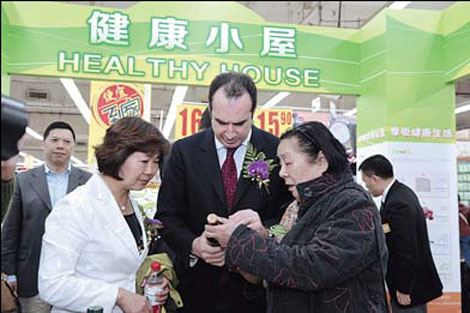
Thierry Garnier (center), vice-president of Carrefour and president of Carrefour China, helping two Chinese women examine the label of a bottled soy sauce that displays the amount of protein, fat, carbohydrate and sodium in the contents. To cope with the fact the Chinese are becoming increasingly concerned about what they eat after a series of food safety scandals, many foreign-funded retail businesses have begun to improve transparency surrounding the products they sell to Chinese customers. Provided to China Daily |
As well as raising more complaints on food safety, the Chinese are becoming increasingly concerned about what they eat after a series of food safety scandals.
In 2008, six babies died and 300,000 were made sick after drinking infant formula contaminated with the industrial chemical melamine. In 2011, another milk contamination scandal was reported involving a leather-hydrolyzed protein, like melamine, in milk products.
In addition to the milk disgrace, some products were also reported to be uncertificated as healthy, including cooking oil, chicken, pork, beef and rice.
The outcome was outrage across the country. Public confidence in the food industry plummeted.
"After the media disclosed food safety problems, I started only going to large supermarkets to shop and like to read the information on the packaging," said a customer at a Carrefour store in Beijing.
With the growing demand for safety and health concerns over recent years, it has become a growing trend within the world food industry to indicate the nutritional value of food. The implementation of the China Nutrition Label Principle is a business commitment to the health of customers, as well as a powerful measure to guarantee the healthy development of the China food industry.
On Jan 1, 2013, the first Prepackaging Nutrition Label Principles in China were carried out. Prepackaged food must be labeled with its level of "4+1", the 4 being the four elements protein, fat, carbohydrate and sodium and the 1 representing energy, as well as their ratios in terms of daily average requirement. It not only provides standard food nutrition information for customers but also has significant influence in preventing and controlling obesity, hypertension and cardiovascular illness.
In response to the government's call and public concerns, Carrefour SA, a French retail giant, launched what it called a Nutrition Knowledge Promotion Activity in Beijing on March 7 to provide food transparency to the Chinese and foster the healthy development of China's Food Industry. Nutrition labels are a direct and effective way for people to know their food nutritional content and characteristics.
The activity was aimed at understanding nutrition labels and enjoying a healthy life. Carrefour undertook the venture with other multinational companies including Nestle SA, China National Cereals, Oils and Foodstuffs Corp and Wyeth to encourage food makers to put nutrition labels on packaging and help the Chinese have a nutritious and healthy life.
On the same day, Carrefour Maliandao Store in Beijing installed an exhibition area called Healthy House to spread knowledge of nutrition. Staff invited nutrition experts to the store, shared label knowledge with customers and provided them with nutrition and health consultations to help customers understand the labels more easily. Other Carrefour stores in Shanghai, Guangzhou, Chengdu and Shenyang will launch similar activities later this month.
"Food safety is closely related with people's safety. Carrefour is committed to providing safe and healthy food to millions of Chinese people by promoting projects based on knowledge of nutrition, food-tracking systems and the Food Safety Inspection Laboratory", said Thierry Garnier, vice-president of Carrefour and president of Carrefour China.
Liu Kaitai, secretary of China's National Institute of Nutrition and Food Safety, said: "With the growing demand for health over recent years, it has been a growing trend of the world food industry to indicate the nutritional content of food. The implementation activities show the commitment of businesses to the health of customers, as well as the powerful measures taken to guarantee the healthy development of China's food industry."
Since entering the Chinese market in 1995, the world's second-largest retailer behind Wal-Mart Stores Inc, has established more than 200 outlets in more than 60 Chinese cities, providing a service to more than 500 million customers a year.
liwoke@chinadaily.com.cn
(China Daily 03/18/2013 page22)