Eye on the future


 |
|
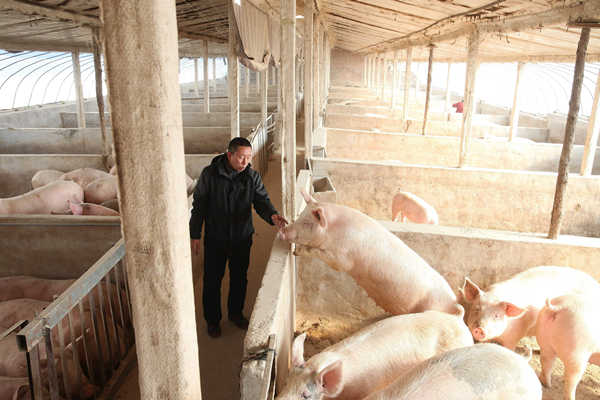
Si Guiquan says he raises pigs the oldfashioned way, exactly how they were farmed for generations, in his home village in Sanhe, Hebei province. [Photo by Jiang Dong/China Daily] |
|
|
|
|
|
|
|
For more Good Food Diaries |


It was in the later years of the 1990s, and beef hotpot restaurants were catching on in popularity in Beijing. Si Guiquan was working as a butcher at a slaughterhouse that offered meat processing services to some of the capital's most popular restaurants. He was killing cows and slicing the meat into dinner-ready portions for the restaurants. Ten years in this booming business apparently made him a tidy fortune. He was one of the few people able to afford three apartments in his native Sanhe city in Hebei province and another two in Beijing. But in 2005, he decided to quit because he got scared by the prevalent industry practices and work ethics.
At the beginning, Si says, beef in Beijing's restaurants came mainly from cows raised on small farms in Shandong and Hebei provinces. They were not meat animals, but were used to work the land. Some were sold after they become too old to work.
Greater demand for meat changed that. Large-scale, professional farms started to emerge as encroaching urbanization edged out smaller farmers.
Animals in the large farms usually eat industrial feed. After slaughter, the meat is often injected with water to increase the weight. To an experienced insider like Si, the poor meat quality is easy to detect by color and texture.
Si also had a nagging concern about the safety of these meats, especially after the birth of his daughter and twin sons. Industrial feed is often contaminated with excessive amounts of heavy metals.
"It is not something that you eat today and see its effect tomorrow. If our next generation have to grow up eating these things, I shudder to think what will become of them when they turn 50," he says.
After a long break contemplating his choices, Si decided to raise cows himself. Around 2008, he started his own farm, Si's Kangyuan Farm, firmly resisting industrial practices such as injection of water and the use of the fat-burning drug clenbuterol.
In less than one year, he had lost 300,000 yuan ($49,200) because he could not find a sustainable market. The determined farmer then sold his apartments in Sanhe and devoted himself to raising pigs, a decision which fortunately became the turning point.
On his farm back in the village he grew up, Si raises about 200 pigs that are local to the area, including the Great White from Beijing and the Black Pig. He also has some free-range chickens and a few Inner Mongolian cows.