Jiangsu dishes offer a legacy of rice wine


 |
|
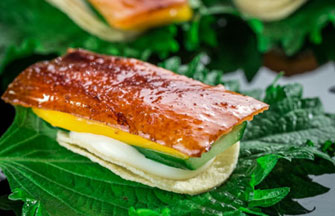
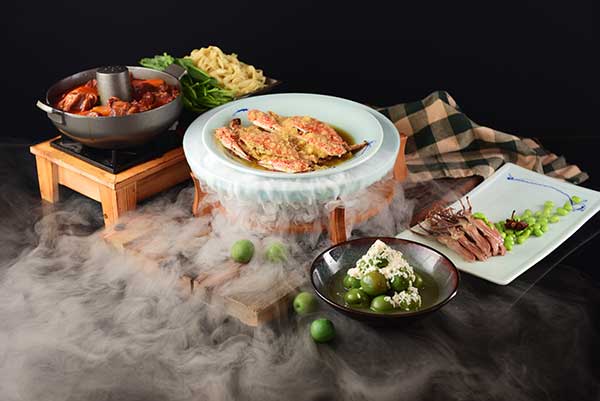
Nanjing Impressions, a restaurant chain that is headquartered in Nanjing, Jiangsu province, offers dozens of new dishes on the summer menu.[Photo provided to China Daily] |
More than 2,000 years ago, people in the ancient Yue State, where Yangzhou city of Jiangsu province is today, were already using Chinese wine and wine lees to flavor food. By the Southern Song Dynasty (1127-1279), the two cooking methods had become quite common in ordinary families' kitchens.
Both are featured on a new menu designed to "retain the old flavors" at Nanjing Impressions, a restaurant chain that is headquartered in Nanjing, Jiangsu province, and has outlets in Beijing, Shanghai, Tianjin, Wuhan in Hubei province, and elsewhere. The popular eatery attracts both foreign and Chinese diners with its distinctive Nanjing-style food. The food is a sub-category of Huaiyang cuisine, one of the four major cuisines in China, which is characterized by fresh ingredients and light flavors.
The new summer menu is themed "zuimei jiangnan", literally "drunk, beautiful regions south of the Yangtze River".
The new menu features two traditional cooking methods in Huaiyang cuisine, zui and zao. Zui involves soaking food ingredients in Chinese wines, while zao means marinating food ingredients in wine lees. Chefs with the restaurant chain got inspiration for the menu while traveling in the Jiangnan area to rediscover the flavors associated with the two methods.
Due to the difference in procedures, the resulting flavors are somewhat different. The soaking process of zui will give the food a hint of the wine flavor, but preserves the original flavors of the ingredients. With zao, on the other hand, foods are marinated in Chinese wine lees for a considerably longer time, and flavor of the lees infiltrates gradually, producing an obvious wine-lee flavor.
Dozens of new dishes on the summer menu are made with the two cooking methods.
Iced liquor-soaked crab, a signature dish in the Jiangnan area, is a highlight on the new menu cooked using the zui method. The recipe is a secret, but apparently chefs soak the crabs in yellow wine together with some traditional Chinese seasonings, such as ginger and soy sauce.
The crabs look as if they are alive, and different parts had different textures varying from soft and tender to a little bit chewy. The taste is refreshing, balancing the flavors of wine and crab meat, with a hint of slight sweetness.
I also liked the stewed taro and wine-soaked bullfrog.
In China, bullfrog is often cooked with strong spices and a profusion of seasonings, such as chili, to create a good flavor while covering the fishy smell. The bullfrog here, however, had light seasonings that still gave a distinct flavor to the bullfrog.
The so-called huadiao wine-preserved crab is also worth trying. Huadiao is a classic variety of top-level Shaoxing yellow wine, and the dish consists only of crab claws previously soaked in huadiao.
Other dishes using the zui method are also very delicious, such as wine-soaked greengage, which is sweet and sour - and very appetizing.
The zao method is the foundation of many delicacies on the new menu, too, including the tender and meaty pig knuckle.
Legend has it that an aristocrat in the Eastern Jin Dynasty (AD 317-420) once used the dish to please other aristocrats during banquets and thus made the dish a signature one in southern China.
I don't know what the dish looked like back then, but what I had in the restaurant was a pleasant and tasty surprise.
The dish arrived in a container cut from rock, and the pig knuckle inside had been sliced and was neatly presented.
The fermented duck tongue was also a treat, as the rice lees had given the chewy duck tongues a hint of sweetness.
Apart from the method-based delicacies, the new menu also offers diners dishes in season, such as crawfish and green soybeans.
Paige Sheffield contributed to the story.