3G startup costs hurting telecoms
Updated: 2009-11-06 08:18
(HK Edition)
|
|||||||


|
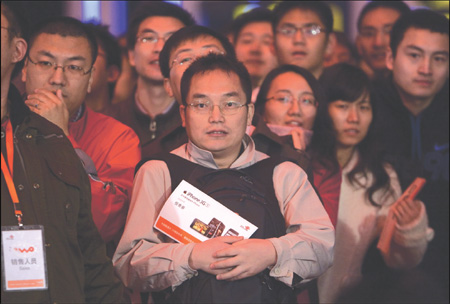
Customers wait to purchase Apple Inc iPhones at the product's launch in Beijing on the first day of its release. Bloomberg News |
HONG KONG: Despite the huge promise of wireless technology, the investment community is concerned that huge startup costs for third-generation (3G) wireless technology, as well as competition, are taking a toll on mainland telecommunication operators and clouding their earning prospects.
The country's three telecom operators all reported worse-than-expected third quarter earnings last month, despite achieving revenue growth as tremendous 3G rollout and marketing costs erode profit margins.
Latest data from the Ministry of Industry and Information Technology (MIIT) shows that the three operators spent a total of 17.2 billion yuan on 3G operations in the third quarter, pushing up the year-to-date 3G capital expenditure (capex) to 96.1 billion yuan as of end-September.

As a result, profit margins were eroded. For example, the country's second-biggest mobile-phone operator, China Unicom's operating profit margin declined significantly to 37.7 percent in the third quarter from 41.7 percent in the first half of the year.
It seems that 3G costs have started to impact China Unicom's profit a quarter earlier than expected, said investment bank J.P. Morgan.
What is perhaps most worrisome for investors is the high odds that 3G capex will continue to snowball in the quarters or even years ahead as operators race to expand their networks to grab greater market share.
"Costs relating to 3G cellular services will mount rapidly in the next few quarters, further depressing (China Unicom's) margins," said Allan Ng, an analyst at Bank of China International.
Swiss banking giant UBS also expressed concern about the viability of 3G.
"We view the 3G rollout as a potential downside risk for the industry, which could push it into a capex uptrend cycle with declining returns," explained UBS analysts Jinjin Wang and Wenlin Li.
The large increase in industry capex is boosting another risk factor for the sector - facility overcapacity, which will lead to fiercer competition for business among players and ultimately hurt their profitability.
"Our concerns with industry overcapacity remain," said Jimmy Cheong, an analyst with J.P. Morgan.
"We do expect more heightened competition from all three in the form of aggressive marketing and handset subsidies," he said in a research note.
Competition has actually been intensifying in the sector since early this year when the implementation of industry restructuring was completed.
In April this year, China Unicom started offering a uniform voice tariff that replaced different tariffs for local, long distance and roaming calls.
China Telecom, the country's third biggest mobile telecommunication services provider, followed suit with similar tariff plans to fence off Unicom's offense.
China Mobile, the largest mobile operator in the world in terms of capitalization, did not want to lose out. It eliminated all roaming fees for incoming calls in its GoTone packages in Jiangsu province starting October.
"We believe other provincial branches will follow suit in order to retain high-end users," the UBS analysts said.
French brokerage house CLSA said China Unicom's strategy is focused on low tariffs, which is a very competitive move, but one that only invites price cutting for the entire industry.
As competition intensifies and as commissions and handset subsidies increase, customer acquisition and retention costs will also inevitably increase.
All these factors bode ill for the profitability of all operators.
"We believe tariff competition could add pressure to industry revenue growth and potential handset subsidies could undermine industry margins," UBS analysts Jinjin Wang and Wenlin Li said.
That said, analysts remain optimistic about the prospects for the sector in longer term, citing the huge mainland mobile market.
They believe regulators will step in to rein in competition should it get out of control.
Wang and Li particularly favor China Unicom, believing that the company will continue to benefit from its strong WCDMA (3G) operation, despite the fact that its iPhone launch seems to be far from successful.
China Unicom announced on Tuesday that it had sold only about 5,000 iPhones nationwide since launching the model on October 30.
Market watchers blame the high price for the disappointing sales figure.
"We believe the higher-than-expected price is the major reason for the lack of customer interest," Wang and Li said.
Under Unicom's tariff plan, subscribers have to pay more than 5,999 yuan to obtain a Wi-Fi disabled 3G version iPhone.
In comparison, prices of unauthorised iPhones with Wi-Fi function in the gray market sell for 2,900-3,500 yuan only.
Apple says it is still optimistic that annual sales of iPhone in China could reach several million units in the coming years despite the disappointing initial sales.
But J.P. Morgan believes iPhone can sell in China - if the selling price is lowered to a more affordable level.
(HK Edition 11/06/2009 page3)