Hong Kong a key player in helping the yuan go global
Updated: 2011-06-03 08:20
By Alfred Romann(HK Edition)
|
|||||||


|
Zhou Li (fourth, right), publisher of China Daily Asia Pacific and chairman of Asia Leadership Roundtable, and panelists of the Asia Leadership Roundtable raise their glasses to toast China Daily's 30th anniversary. Edmond Tang / China Daily |

Debate over the internationalization of the yuan has moved forward from speculating on whether it will happen to looking at how China will manage the process. And what is the role of Hong Kong in helping the currency play a more important role in the global economy?
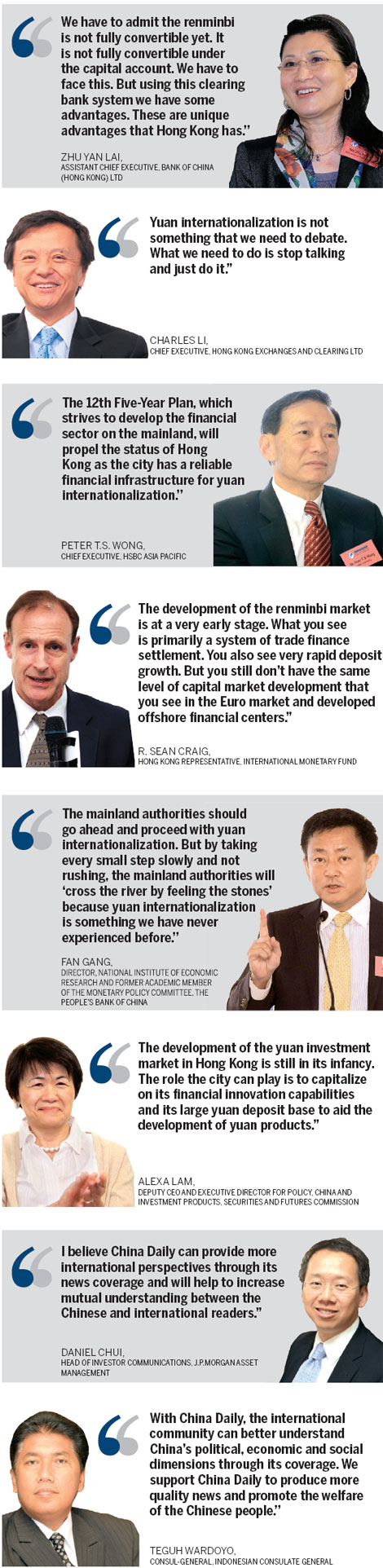
"Policy makers regard Hong Kong as a reliable and well-run market to run the first stages of internationalization," said Peter Wong, chief executive of HSBC Asia Pacific and one of Hong Kong's leading bankers.

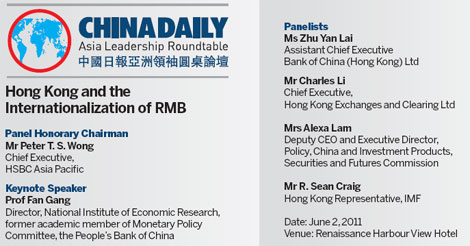
Wong was speaking Thursday at the China Daily Asia Leadership Roundtable on "Hong Kong and the Internationalization of the RMB". The roundtable marked the 30th anniversary of the newspaper. Six of Hong Kong and the mainland's leading financial and economic figures were brought together for the event.
Wong warned against focusing all efforts on Hong Kong creating an international currency, but rather remember that the ultimate goal is to use Hong Kong as a gateway for a more internationalized yuan.
"The world is all about internationalization. Test it (the yuan) in Hong Kong and move it out to other countries," Wong said.
As the debate continues over the role the yuan will ultimately play on the global stage, all those present agreed that the mainland's currency will ultimately become more internationalized.
"Things are moving very fast," said Professor Fan Gang, director of the National Institute of Economic Research and a former academic member of the Monetary Policy Committee of the People's Bank of China. "The internationalization of the RMB is something that we definitely want to achieve."
There are a number of challenges however. Internally, regulations that put constraints on the country's foreign currency regime and the convertibility of the yuan will have to be addressed. Externally, a long-standing trade surplus will also make it difficult to expand the use of the yuan in global trade.
Hong Kong can help address these challenges just as it has helped the mainland's economy open up. For example, Hong Kong has played a pivotal role in the development of the Pearl River Delta by providing a base for fundraising and a gateway for capital to and from the region.

China has already made significant progress towards the internationalization of its currency, said Fan in his keynote speech. Yuan deposits in Hong Kong have grown tenfold in just a couple of years from around 60 billion yuan in 2009 to more than 600 billion yuan now. The yuan is now used in corporate taxes, there has been a yuan IPO and settlements in the mainland's currency have now reached the 900 billion yuan mark.
There are multiple benefits for China arising from the yuan becoming an international currency. It would give mainland companies more strength, aid financial institutions and give policy makers more tools to create financial and economic policies.
Fan added that it also benefits Hong Kong in becoming the main facilitator in this process, particularly as it would attract more capital and better position the city as an international financial center.
The role of Hong Kong in the internationalization of the yuan also offers major advantages to other centers, said R. Sean Craig, Hong Kong representative to the International Monetary Fund. But even as developed as Hong Kong is, it lags behind other major offshore markets. It acts primarily as a trade settlement center.
"What we should do is make sure we very rapidly build up RMB assets," said Mrs Alexa Lam, deputy CEO and executive director, Policy, China and Investment Products at the Securities and Futures Commission.
As it is, the Special Administrative Region is endowed with a number of unique characteristics that will help in this regard. Hong Kong has a free economy and one that the mainland considers particularly important, as evidenced by the attention devoted to Hong Kong in the current 12th Five Year Plan, said Lam.
Still, there is plenty of room for Hong Kong to step up its importance in the process towards a more internationalized yuan. For the time being, yuan deposits remain relatively small. It was only last month that the first yuan-denominated REIT IPO was issued in Hong Kong, said Lam.
"Hong Kong is not about following precedents. Hong Kong is about being a leader," said Lam. The SAR has the infrastructure and regulation in place to drive the process forward and act as the platform for a global yuan.
And the SAR has another important advantage that it should make good use of, said Zhu Yan Lai, assistant chief executive of Bank of China (HK), the official clearing bank in Hong Kong for yuan business in the city. Chief among them is a preferential policy by mainland authorities and regulators that put Hong Kong at the center of any process to internationalize the yuan.
"We all share the ultimate goal of yuan internationalization, but I think all we want is to help the process. To build a healthy process and not destroy the process," said Zhu. "The clearing bank system is a very good way to help the process be smooth."
Hong Kong is an important field test for China to test its market mechanisms as it moves inexorably forward towards the internationalization of the yuan.
The process of internationalization is not going to happen overnight, said Charles Li, chief executive of Hong Kong Exchanges and Clearing, but it will happen.
"I don't think there is any one thing that is most important," said Li. "We are talking about building an ecosystem here."
The process should not just be re-denominating half of Hong Kong's economy into yuan. Rather, the process should be one that drives the yuan out towards the world rather than just replacing the Hong Kong dollar in the city.
"We are not talking about just changing half of Hong Kong's economy," Li said. "What we are really trying to do is to make it into an RMB enabler."
Ultimately, said Li, there are risks to the internationalization of the currency but there are also significant risks to doing nothing.
"Everybody who is against it should also be made to argue whether the risk of keeping it closed is also something that continues to be viable," Li said. "The internationalization of the RMB, I would say let's stop talking about it. Let's just do it."
(HK Edition 06/03/2011 page4)