Record dim sum bond sales stymie yuan loans
Updated: 2011-08-24 08:49
By Katrina Nicholas(HK Edition)
|
|||||||


While companies are selling record amounts of yuan-denominated bonds in Hong Kong, the development of the so-called dim sum loan market is going nowhere.
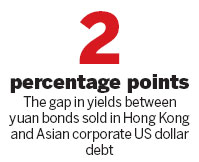
Companies are shunning loans in favor of yields which average 3.2 percent on yuan bonds sold in Hong Kong, 2 percentage points lower than rates on Asian corporate US dollar debt, according to HSBC Holdings Plc and Bank of America Merrill Lynch indexes. Banks also lack a communal benchmark lending rate for pricing yuan loans in the city.
The only dim sum loan is for China Automation Group Ltd, which borrowed 50 million yuan in December until June 2014 and paid 135 basis points more than Hang Seng Bank Ltd's yuan prime lending rate of 3 percent. While companies are avoiding the yuan loan market in Hong Kong, borrowers in Asia excluding Japan have taken out a record $181.2 billion of loans this year, the most in Bloomberg data going back to 1999.
"I'm surprised by the lack of interest in getting the loan market moving and I think it's because the bond market has had such a high profile," said John Corrin, global head of loan syndications at Australia & New Zealand Banking Group Ltd, who also chairs the Asia-Pacific Loan Market Association. "There's been a degree of apathy among leading banks and there's no good reason why that should be."
The lack of a floating reference rate over which to price such debt is an inhibitor to the syndicated loan market's growth in Hong Kong. The London interbank offered rate (Libor), a benchmark for more than $350 trillion of financial products worldwide, is set daily by the British Bankers' Association based on data from banks reflecting how much it would cost them to borrow from each other for various periods of time.
"All the dim sum bonds have been done at a fixed rate whereas virtually all loans are priced off an independent Libor, or Libor equivalent, and that doesn't exist at the moment," ANZ Bank's Corrin said in a phone interview yesterday. "The APLMA (Asia Pacific Loan Market Association) has been holding discussions with the Hong Kong Monetary Authority and Treasury Markets Association to try and move faster on this."
Likely to be called "CNH Hibor", the floating reference rate would mimic Libor in construction, drawing rates of a morning from about 14 banks in Hong Kong to gauge an average cost of interbank yuan borrowing in the city, Corrin said.
"We've been anticipating the rise of the dim sum loans market for some time, it's primarily the base rate issue holding things up" said Trevor Clark, Hong Kong-based co-head of Linklaters LLP's Asia-Pacific banking group. "Loans are flexible, for example, they can also be revolving or amortizing, and can be put in place quickly."
While momentum in the loans market will pick up once a benchmark rate is developed, true size and scale will come later, according to HSBC, this year's top arranger of dim sum bonds.
"The offshore yuan market is still in its infancy and rapid development in the bond market only started to occur last year," said Gina Tang, the London-based lender's head of debt capital markets for Hong Kong and China. "For the loans market to develop it will be more conducive if a benchmark base rate can be developed for the banks to participate more actively."
There may be a benchmark reference rate in place within six months, said Corrin, who expects "three or four deals before the end of the year, priced off banks' prime rates."
"The vast majority of Chinese companies which have issued in the CNH bond market would be suitable loan candidates, but not a lot of banks have been pushing this as a solution with borrowers," Corrin said.
While the worsening European debt crisis has stoked global demand for yuan-denominated assets and helped boost sales of dim sum notes to a record 106.7 billion yuan since January, difficulties sending money back from the city exist and could be another reason that has hindered the development of the dim sum loan market.
The central government "will expand yuan circulation channels between Hong Kong and the mainland," Vice-Premier Li Keqiang said on August 19.
"If policy makers could work out a set procedure for repatriating all this money back to the Chinese mainland, more companies would come and borrow in the dim sum loan market," said Kristen Kwok, Hong Kong-based counsel at Walkers Group, which specializes in offshore law.
Bloomberg
(HK Edition 08/24/2011 page2)