Riders on the storm: The governance impasse
Updated: 2012-12-12 07:20
By Joseph Li(HK Edition)
|
|||||||



|
Zhou Li (left), publisher and editor-in-chief of China Daily Asia Pacific, joins DAB Chairman Tam Yiu-chung for a photo after the interview. Edmond Tang / China Daily |
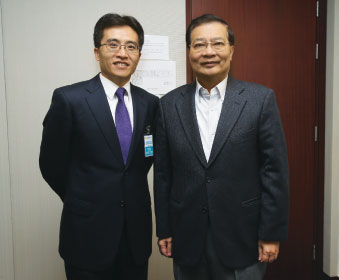

Chief Executive Leung Chun-ying has encountered many difficulties in the opening months of his tenure. But now, Tam Yiu-chung, DAB chairman, says the CE should learn the lessons meant to be learned and move on. Tam spoke to Joseph Li recently.
There is a sharp thorn in the side of Chief Executive Leung Chun-ying (CE) - a group of vocal and obstreperous opposition lawmakers, whose 27 seats in the 70 member Legislative Council (LegCo) give them enough clout to bring the legislative agenda to an impasse.
Even though there is a majority of 43 pro-government lawmakers in the LegCo, support for Leung is not solid among the pro-establishment camp.
Tam Yiu-chung, chairman of the Democratic Alliance for the Betterment and Progress of Hong Kong (DAB), recalls how CY Leung emerged the winner from a hard fought and often bitter election campaign, defeating the man heavily favored to win the post, Henry Tang.
"The Chief Executive election between CY Leung and Henry Tang was very fierce," said Tam. Despite Leung's victory, Tang's supporters remained unsatisfied with the outcome and refused to fall into line behind the new leader. The lack of unity in the pro-establishment camp does not help good governance, Tam admitted, and it remains to be seen when the situation will improve.
Tam, in an exclusive interview with China Daily, said the rift in the pro-establishment camp is one of several factors contributing to the governance gridlock.
"People say Asian people are not as open-minded as foreigners," Tam said. "In the US, when the court declared the winner of a presidential election, the other candidate did not grumble. Candidates will toast each other over a beer after the election."
Tam points out that CY Leung promised after the election that he would honor the pledges he made during the election - but the election platform was announced through the media and Leung never consulted the public or the LegCo.
"So some legislators said 'why should I support you since you have not consulted me? But we cannot blame him because he wants to implement his election platform. When it is all over, he should appraise the lessons learnt, because an election platform does not necessarily guarantee LegCo's support," Tam said.
Leung had also complained that the previous government left behind many problems for the new administration to clean up. Although what he said was true that the national education and the third free-to-air TV licence issues are old problems, it did no good for Leung to complain about it.
"It could have been better for someone else to speak out. Because when he spoke out, it gave the impression he was shifting the responsibility to the previous government," Tam commented.
With the political scene sharply polarized, the climate of public opinion shifts rapidly and opposition may swell suddenly and unexpectedly on even the most uncontroversial legislation. The government will be required to monitor the pulse of public opinion continuously, Tam observed.
There have been suggestions for a "semi-presidential system" to form a closer tie between the administration and the LegCo and to improve the governance. Under the plan, the chief secretary (CS) would be named by the political party gaining the most votes. But Tam dismisses the proposal as unrealistic.
"The Basic Law does not mention that. Again the electoral system in Hong Kong is not conducive to producing a majority party ," he said.
"Though our party has 13 seats, we can't solve the impasse even if we had a party member as the CS. Only if a party wins more than half the seats in the Legislative Council can solve the problem.
"But the advantage of a partisan-led system is that everyone must bear responsibility. Even when you are the ruling party, you can't go too far. Otherwise the opposition party will do the same as you have done when they come to power."
Tam is also aware that Zhang Xiaoming, deputy director of the Hong Kong & Macao Affairs Office under the State Council, recently said Hong Kong has a duty to enact the national security law under Article 23 of the Basic Law.
Hong Kong has a duty to enact the law on its own but this has not been done in the 15 years since the handover.
"It is good, and it is necessary for central government officials to reiterate this occasionally. But he has not said when the law should be enacted," Tam responded. "We all know that we can't do it in a rush like 2003. We can only do it after fully consulting the public and easing their doubts, but there are always people 'demonizing' Article 23."
Tam has no idea of any plan to enact Article 23, adding that Leung's administration is too busy tackling various other problems, including quality of life issues and problems left behind by the previous administration.
(HK Edition 12/12/2012 page4)