Business credit insurance emerges as new tool
Updated: 2012-12-15 07:00
By Oswald Chen(HK Edition)
|
|||||||


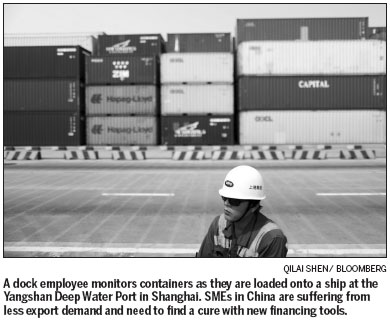
Shadowed by faltering consumer and export demand and soaring labor costs, mainland SMEs have to find new ways to tackle biz uncertainties. Oswald Chen reports.
Business credit insurance is a type of insurance that can be purchased by businesses selling to other counterparts offering open credit terms. Business credit insurance offers guarantees against their business having excessive losses due to their customers' inability to pay for goods or services purchased on credit. It is sometimes called accounts receivable insurance or trade credit insurance.
The mainland trade credit insurance industry has been developing rapidly. Export credit insurance is one kind of trade insurance which exporters purchase to yield financial protection in case of any default by overseas buyers or mainland producers.
In 2011, export credit insurance's underwriting amount on the mainland reached $216.24 billion, accounting for 11.4 percent of the country's total export amount in the same period and also much higher than the international average. It is estimated that the export credit insurance underwriting premium income will be significantly higher in 2012.
Besides mainland manufacturers, Hong Kong-based exporter firms also recognized the importance of a proper export credit insurance policy.
"When any business order exceeds HK$10 million turnover, the exporter firms should purchase export credit insurance for financial protection in case of any default of overseas buyers or mainland manufacturers. This is because the exporters usually have to do business on credit terms given the large size of the business order," local exporter firm Alpha Creative Manufacturing General Manager William Tang told China Daily.
Currently the mainland export credit insurance business is still monopolized by the China Export & Credit Insurance Corporation (SINOSURE). Though the export trade credit insurance market is still closed to other players, Coface, one of the three largest credit insurance companies in the world with headquarters in Paris, believes that the market will be opened in the future.
The French trade credit insurer is already eyeing the trade credit insurance business potential for domestic transactions as more mainland firms are willing to adopt credit insurance as a tool to hedge their business risks.
Underwriting trade credit business insurance policies are becoming a major revenue stream for the French business credit insurance company. Coface sees an annual 20 percent growth in revenue generated by the trade credit insurance business. The mainland market registers an annual 50 percent trade credit insurance revenue growth compared with the Hong Kong market's 10 to 15 percent yearly growth.
"We are seeing more mainland companies from different industry spectrums getting more aware of the importance of credit management which is definitly encouraging for the continuous market growth," Coface Asia Pacific Chief Executive Officer Richard Burton told China Daily in an interview. "We see very good potential for this market."
The increased awareness of credit insurance in the mainland business sector is mainly due to the difficulties faced by SMEs or private enterprises in accessing finance. There are several factors to explain the SME's financing problems.
According to Burton, the mainland SMEs' increasing financing difficulties are due to their credit management policy mismatch, its over expansion tendency, inappropriate diversification into other non-core businesses and the mainland banks' reluctance to lend to SMEs.
Burton added that the unfavorable economic factors in the real economy, such as the sluggish European and US export market, the increasing labor cost and the appreciation of the yuan currency, are increasingly taking a toll on the mainland SMEs' finances.
Besides the SMEs' difficulties in obtaining finances, the fact that many mainland companies are turning from export-oriented business to domestic consumption, is also fueling the market demand for trade credit insurance.
"They (mainland exporters) have to reduce their reliance on the waning European and US export markets, and they also have to transform their traditional business model of low-cost, low-margins to high-value, high-margins that focus on the domestic consumption market," Burton told China Daily.
Mainland SMEs currently contribute 60 percent of the nation's gross domestic product, creating 70 percent jobs and accounting for 50 percent of overall tax receipts. Despite their important role in the national economy, mainland SMEs receive only 37 percent of all commercial loans from mainland banks, according to Oriental Patron Research.
Amid the export sector downturn due to the sluggish US economic recovery and the lingering European sovereign debt crises, mainland SMEs and private enterprises are facing harsh monetary and fiscal tightening measures since 2010. This was because the mainland authorities wanted to counteract the country's economic overheating by announcing massive economic stimulus packages after the 2008 financial crisis.
Looking ahead, while Coface is bullish about the future market demand, the trade credit insurer is also optimistic that the mainland authorities will be more receptive toward trade credit insurance and may be even proactive in promoting trade credit insurance.
"The mainland government should foster the growth of other credit insurance tools such as factoring or receivable financing so that SMEs can have more financing tools to get financing in the market," Coface's Burton said.
"The mainland government should ensure the flow of SMEs' financial information at a cost-effective manner to credit insurers and banks so that they can properly assess their credit risks," Burton said in the interview with China Daily. "When more mainland banks and trade credit insurers can have better information concerning SMEs' business, operation and finance, the trade credit insurance business can be more easily conducted."
Coface will strengthen its partnership with Ping An Property & Casualty Insurance Company of China which has since 2003 expanded its domestic trade credit insurance business to help mainland companies protect themselves against the non-payment risks in their domestic transactions, Burton added.
(HK Edition 12/15/2012 page2)